16 Soft Swoop Fringe Hairstyle Ideas

A soft swoop fringe moves diagonally across the forehead instead of dropping straight down or splitting evenly like curtain bangs. Its defining feature is a smooth directional sweep with enough lightness to move rather than forming a stiff side bang. Finished length can range from brow-skimming to cheekbone level, with longer outer pieces blending into the sides. It works with bobs, lobs, and long layers, while subtle face framing helps the fringe connect naturally to the rest of the haircut.
Straight and wavy textures show the sweeping line clearly, but curls can create a softer curved interpretation when shrinkage and growth direction are considered. Fine hair usually needs a shallow fringe section, especially with low density. Dense hair can support a fuller swoop but may require controlled bulk placement. The part can be mildly offset or deep depending on the desired coverage and root lift.
Fringe styling is often quicker than restyling the entire haircut. However, growth direction, humidity, and fringe length affect how easily the sweep holds. Regular reshaping becomes useful when the fringe enters the eyes or stops blending smoothly into the side layers.
Quick List
- Brow-Skimming Soft Swoop Fringe Hairstyle
- Cheekbone Soft Swoop Fringe Hairstyle
- Long Soft Swoop Fringe Hairstyle
- Wispy Soft Swoop Fringe Hairstyle
- Full Soft Swoop Fringe Hairstyle
- Deep-Part Soft Swoop Fringe Hairstyle
- Bob With Soft Swoop Fringe Hairstyle
- Lob With Soft Swoop Fringe Hairstyle
- Long Layers Soft Swoop Fringe Hairstyle
- Feathered Soft Swoop Fringe Hairstyle
- Wavy Soft Swoop Fringe Hairstyle
- Curly Soft Swoop Fringe Hairstyle
- Fine-Hair Soft Swoop Fringe Hairstyle
- Dense-Hair Soft Swoop Fringe Hairstyle
- Air-Dried Soft Swoop Fringe Hairstyle
- Airy Blowout Soft Swoop Fringe Hairstyle
Brow-Skimming Soft Swoop Fringe Hairstyle

A brow-skimming swoop gives the fringe enough length to travel diagonally while still providing noticeable forehead coverage. The shorter edge can finish close to one brow, then lengthen progressively toward the opposite temple. Keeping the outer corner longer prevents the fringe from looking chopped off. It pairs well with shoulder-length or longer hair, subtle face framing, and an offset part that supports the natural direction of the sweep.
Straight and softly wavy textures make the line particularly easy to control. Medium density provides plenty of coverage, while fine hair may need a shallower fringe section. Use heat protectant before heated drying, a small round brush to guide the curve, and flexible hairspray for movable hold. A morning fringe reset may take only a few minutes; full wash-day styling depends on the remaining length.
At the salon, specify where the shortest section should sit when completely dry and where the long corner should finish. Because brow-level fringe shows growth quickly, reshape it once the shorter edge begins dropping into the eye or the diagonal line becomes difficult to maintain.
Pro tip:
Dry the fringe from side to side briefly before directing it into the final swoop. This loosens stubborn root separation and helps the diagonal curve settle without excessive product.
Make It Work for You:
If your forehead cowlick pushes the fringe upward, keep the shortest point slightly longer. Extra length provides useful weight while preserving the soft diagonal shape across the forehead.
Watch Out For:
Avoid cutting the entire fringe to brow length and simply pushing it sideways. Graduated length toward the temple is what lets the swoop travel naturally instead of bunching.
Cheekbone Soft Swoop Fringe Hairstyle

Cheekbone length creates a relaxed fringe that behaves almost like a long face-framing layer. The shorter side begins around the lower eye or upper cheek area, then sweeps diagonally toward the temple and blends into longer side pieces. Because the fringe does not sit directly over the brows, it leaves more forehead visible and can tuck away when needed. Shoulder-length and long layered cuts provide an easy transition underneath.
Straight, wavy, and loosely curly textures can adapt to this longer placement. It is especially practical for routines that cannot accommodate frequent bang trims. Use heat protectant before heated styling, a medium round brush for the broad curve, and lightweight styling cream for soft separation. Refreshing the front can take minutes; a complete style takes longer according to overall length and texture.
At the salon, identify the exact dry cheekbone landmark and show which direction you want the fringe to travel. Ask for the long edge to blend gradually rather than forming a disconnected step. Maintenance becomes useful when growth moves the fringe below the intended cheekbone position and removes its visible sweep.
Pro tip:
Curve the fringe away only near its lower half. Keeping the root and upper section relaxed creates a broad sweep instead of a dramatic flip beside the cheekbone.
Make It Work for You:
If you often tuck your hair behind the ear, keep the long side of the swoop tuckable. This gives you an easy alternate finish without changing the defining fringe shape.
Watch Out For:
Avoid excessive layering directly behind the fringe. The swoop needs longer supporting hair nearby so its outer edge can blend smoothly rather than ending as an isolated short section.
Long Soft Swoop Fringe Hairstyle

A long swoop fringe provides directional movement without the commitment of short bangs. The shortest point can sit between the cheekbone and jaw, with the rest sweeping toward the side and blending into longer layers. An offset part supplies the diagonal direction, while the fringe can move partly across the forehead or stay more open. Long lengths underneath make the transition especially gradual and flowing.
Straight and wavy hair show the broad sweep clearly, while looser curls can create a more textured version. Fine hair benefits from keeping the fringe section narrow, whereas dense hair can support a fuller sweep. Use heat protectant before heated styling, a large round brush for a broad curve, and flexible hairspray for light control. A front-only refresh can take a few minutes; styling long hair completely takes considerably longer.
At the salon, specify where the shortest dry point should land and how far across the forehead you want the fringe to travel. Because this version grows into face framing easily, reshaping can focus on restoring the intended diagonal line rather than maintaining a very precise bang length.
Pro tip:
Direct the fringe slightly forward before sweeping it sideways. That first movement creates space at the root and prevents the long section from simply hanging beside the face.
Make It Work for You:
If you prefer minimal maintenance, start the fringe near the jaw. It will retain a useful face-framing shape for longer as it grows and can tuck easily.
Watch Out For:
Avoid curling the long fringe tightly away from the face. A strong curl can hide the diagonal swoop and make the section look like an ordinary face-framing layer.
Wispy Soft Swoop Fringe Hairstyle

A wispy swoop uses a shallow fringe section and fine separation to create light diagonal coverage. Narrow pieces can begin near the brow, then lengthen toward the temple with small spaces allowing some forehead to show through. The outer edge blends into longer face framing, while the rest of the haircut can range from a bob to long layers. The effect stays airy because the fringe is not cut as one dense sheet.
Straight and softly wavy textures display the separated pieces clearly. Fine hair can suit this approach, but low-density hair needs careful sectioning so too much fullness is not removed from the temples. Use lightweight mousse for flexible support and a vent brush for directional drying. Refreshing the fringe can take only minutes; the rest of the styling time depends on the haircut.
At the salon, specify the section depth, dry shortest length, and amount of visible forehead you prefer. Ask for the wispy quality to come from controlled separation rather than repeated thinning. Maintain the fringe when the shortest pieces begin entering the eyes or the swoop loses its diagonal progression.
Pro tip:
Style the fringe as one soft section first, then separate only a few pieces after it dries. This creates intentional spaces without making the entire swoop appear stringy.
Make It Work for You:
For low-density hair, use a particularly shallow fringe triangle and preserve longer temple pieces. You can create visible softness while keeping more hair available around the sides.
Watch Out For:
Avoid thinning an already wispy fringe at every maintenance trim. Repeated weight removal can create flyaways and large gaps that make the diagonal shape difficult to read.
Full Soft Swoop Fringe Hairstyle

A fuller swoop provides stronger forehead coverage while maintaining a curved, movable edge. The fringe begins from a deeper section and travels diagonally from a shorter brow-area point toward a longer temple corner. Its surface stays smooth, but the ends should retain enough flexibility to blend into surrounding layers. A side or offset part reinforces the direction, while medium and longer hair balances the fuller front.
Medium to dense hair can support this amount of fringe particularly well. Fine hair with high density may also work, but a deep section can remove noticeable fullness from the sides. Use heat protectant before heated drying, a medium round brush to establish the curve, and flexible hairspray for control. A quick fringe reset may take several minutes; full wash-day styling takes longer.
At the salon, discuss section depth as carefully as finished length. Specify how much forehead coverage you want and where the long edge should merge into the side. Reshape when growth makes the fringe fall heavily into the eyes or causes its outer corner to lose connection.
Pro tip:
Lift the fringe only slightly while drying. Too much elevation can create excessive root volume, while lower tension keeps a full section sweeping smoothly across the forehead.
Make It Work for You:
If your hair is dense but easily puffs, keep the fringe slightly longer. Extra length adds control and allows the swoop to settle without relying on strong finishing products.
Watch Out For:
Avoid choosing a deep fringe section without considering side density. Pulling excessive hair forward can leave the temples noticeably thinner even when the fringe itself looks full.
Deep-Part Soft Swoop Fringe Hairstyle
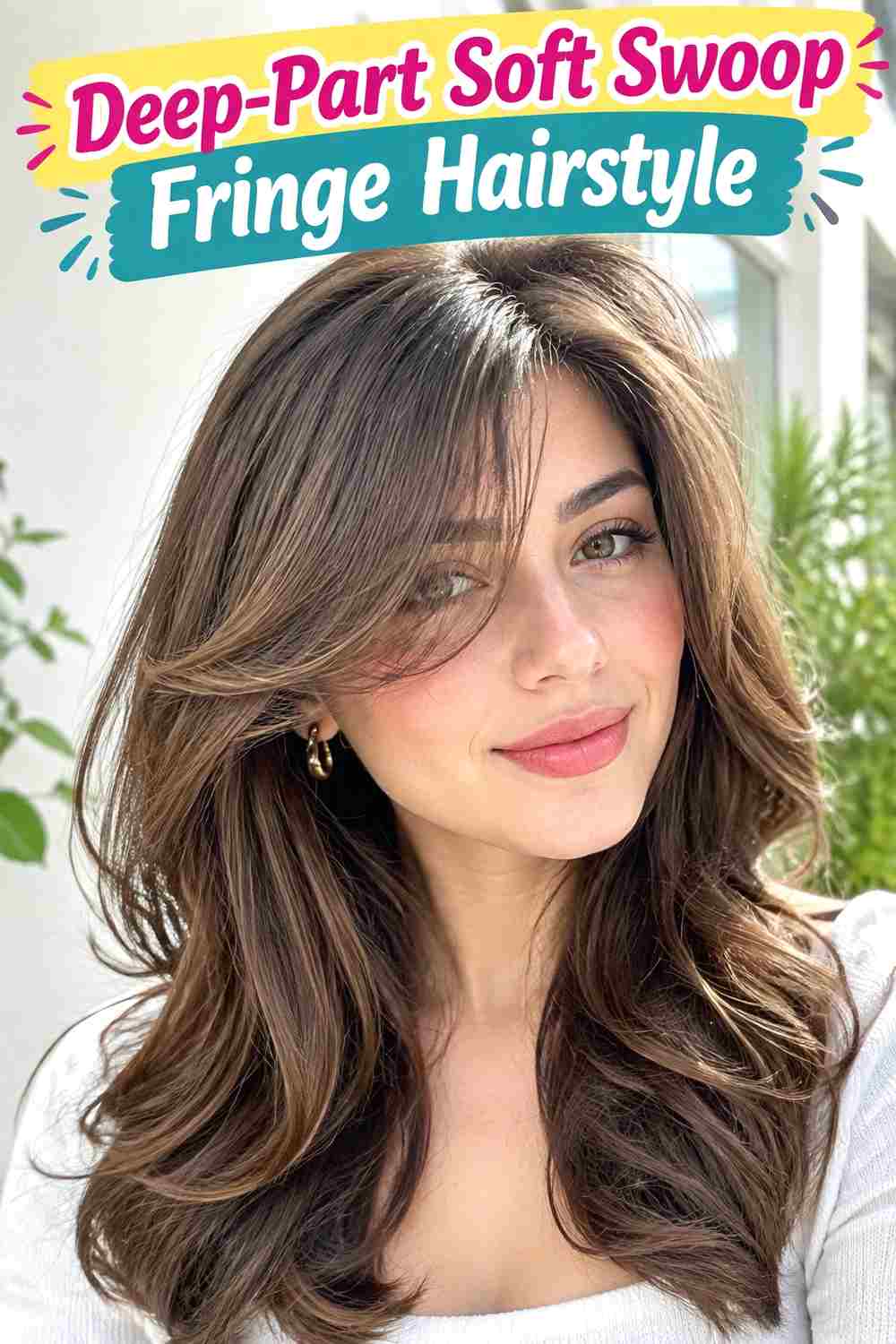
A deeper side part gives the swoop more distance to travel across the forehead. The heavier section begins well away from center, sweeps diagonally over the brow area, and lengthens toward the opposite temple. The outer edge can blend into cheekbone or jaw-level framing. Root volume is naturally asymmetric, with more lift and movement concentrated on the heavier side.
Straight and wavy textures can maintain this directional finish easily when the part agrees with the natural growth pattern. Fine hair may gain useful visual fullness from the shift, while dense hair needs less additional root lift. Use heat protectant before heated styling, a medium round brush for directional control, and lightweight hairspray. Resetting the part and fringe can take minutes; styling the remaining hair depends on its length.
At the salon, show exactly where you intend to part your hair. Specify the shortest dry fringe point while wearing that part, because changing the part later can alter the apparent length. Reshape when the sweep becomes heavy or starts falling into the eyes.
Pro tip:
Establish the deep part while the roots are damp rather than moving dry hair afterward. Early placement gives the fringe cleaner direction and reduces the need for repeated correction.
Make It Work for You:
If your natural part resists a dramatic shift, move only slightly deeper than usual. A smaller change can still create a clear swoop without making daily styling difficult.
Watch Out For:
Avoid cutting the fringe while wearing a temporary part you rarely use. The same pieces can sit at noticeably different lengths when returned to their normal growth direction.
Bob With Soft Swoop Fringe Hairstyle

A bob gives the swoop fringe a compact foundation. The perimeter can finish between the jaw and lower neck, while the fringe travels diagonally from brow or eye level into the side of the cut. Restrained layering keeps the bob recognizable, and a slightly longer front corner can help connect the fringe. The combination creates movement near the forehead without requiring extensive layering throughout the short shape.
Straight and softly wavy hair show the contrast clearly. Fine hair benefits from preserving perimeter weight, while dense hair may need targeted internal shaping. Use heat protectant before heated drying, a small round brush for the fringe, and lightweight styling cream for the bob ends. Fringe-only refreshing may take minutes; shaping the complete bob requires longer.
At the salon, specify the dry bob perimeter and fringe length separately. Ask where the swoop should merge into the side so the connection does not remove unnecessary perimeter fullness. Maintain the fringe when it enters the eyes and reshape the bob when growth changes its intended outline.
Pro tip:
Keep the bob ends quieter when the fringe has a strong sweep. One clear directional feature near the forehead prevents a short haircut from looking overly curved in several places.
Make It Work for You:
If your bob is low density, keep the swoop shallow and let a longer temple section provide the connection. This preserves more weight through the compact perimeter.
Watch Out For:
Avoid blending the fringe by heavily layering the entire front side of the bob. A narrow transition can connect the sections while protecting the cut’s lower fullness.
Lob With Soft Swoop Fringe Hairstyle

A lob gives the fringe more length to blend into, making the swoop feel particularly gradual. The main perimeter can sit around the collarbones, while the fringe starts near the brow, cheekbone, or somewhere between. Longer outer pieces travel toward the jaw before joining restrained face-framing layers. A side or slightly offset part supplies direction without requiring dramatic root height.
Straight, wavy, and loosely textured hair can carry the shape well. Fine hair benefits from a fuller lob perimeter, while dense hair can support additional internal movement. Use heat protectant before heated styling, a medium round brush for the fringe, and flexible hairspray for light hold. Refreshing only the front can take minutes; a complete collarbone-length blowout takes longer.
At the salon, specify the dry fringe landmarks and lob perimeter independently. Explain how gradually the outer fringe should meet the longer front. Reshape the fringe when it stops clearing the eyes comfortably, while the lob itself may follow a different maintenance schedule.
Pro tip:
Use a smaller curve through the fringe than through the lob ends. Different curve sizes keep the front connected without making the entire haircut look uniformly rolled or flipped.
Make It Work for You:
If you usually air-dry your lob, keep the swoop long enough to follow your natural bend. A cheekbone-length fringe often needs less daily correction than shorter bangs.
Watch Out For:
Do not assume the fringe and lob need trimming at the same time. The shorter front can lose its intended placement well before the longer perimeter needs significant reshaping.
Long Layers Soft Swoop Fringe Hairstyle
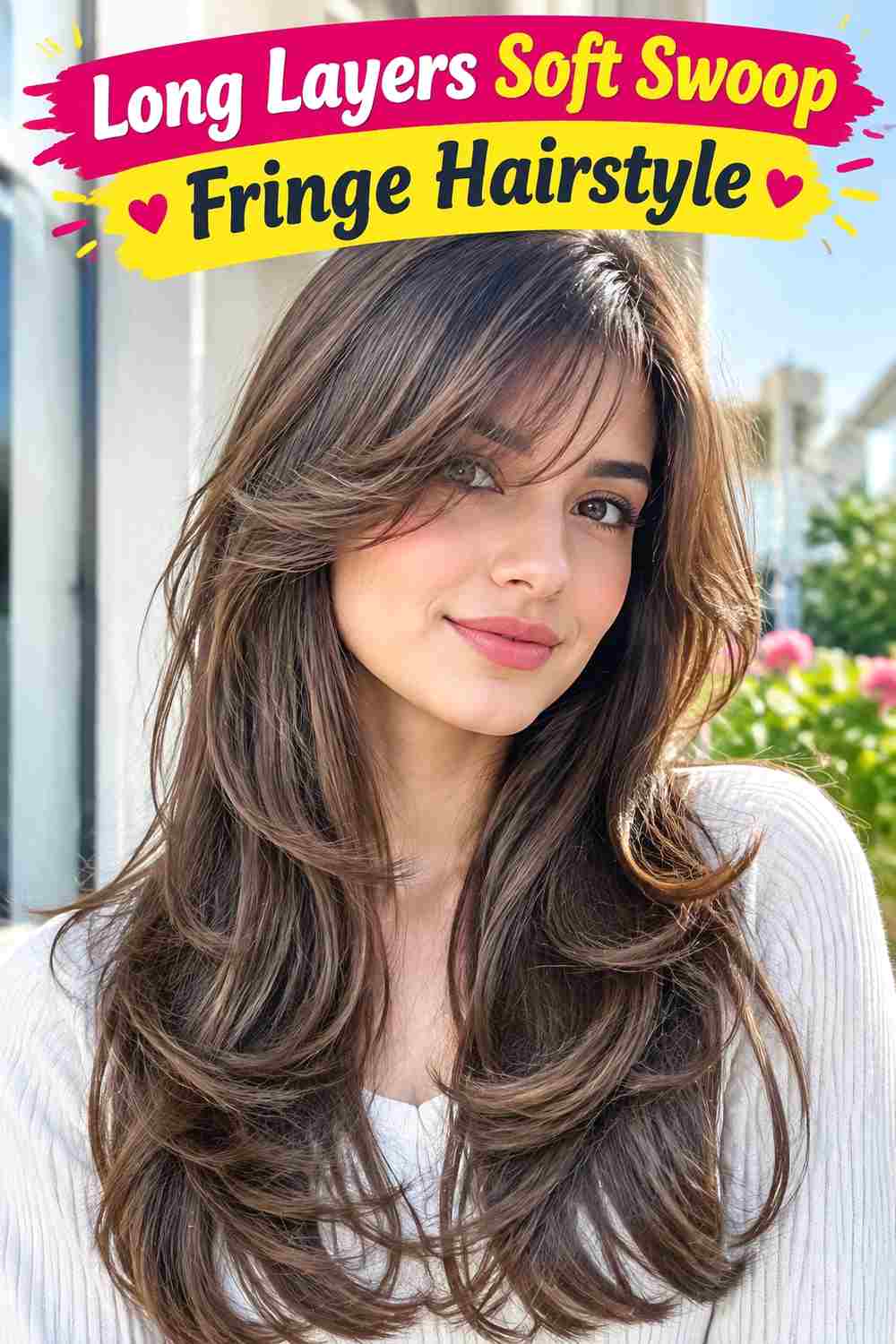
Long layers allow the swoop fringe to flow into several face-framing lengths rather than making one abrupt transition. The fringe can begin around the brow or cheekbone, sweep toward the temple, then connect into jaw-, collarbone-, and chest-level sections. The longest perimeter stays substantial, and an offset part gives the front its directional movement. Broad curves keep the layered progression soft.
Straight and wavy textures show the transition particularly clearly. Fine or lower-density hair benefits from concentrating shorter layers near the face, while dense hair can support more movement through the sides. Use heat protectant before heated styling, a large round brush for broad curves, and flexible hairspray for light hold. Refreshing the fringe and face frame can be quick; a full long-hair blowout requires substantially more time.
At the salon, identify the dry fringe endpoint and the next face-framing landmark separately. Ask for gradual connections while preserving the long perimeter. Reshape when the fringe merges into the longer layers and loses its distinct diagonal sweep.
Pro tip:
Style the fringe first, then progressively enlarge each curve through the longer layers. This makes the swoop look connected while keeping the different lengths visible and mobile.
Make It Work for You:
For low-density hair, limit shorter layering mainly to the front. The swoop can still transition beautifully while the back remains longer and fuller for better coverage.
Watch Out For:
Avoid extending short fringe-connected layers too far around the head unless you want substantial layering. Excessive removal can weaken the long foundation without improving the swoop itself.
Feathered Soft Swoop Fringe Hairstyle

Feathering gives the swoop a lighter outer edge and helps it flow into face-framing layers. The fringe begins shorter near one brow or eye, then lengthens diagonally and sweeps outward toward the temple. Cheekbone and jaw sections can continue that direction, while the remaining hair stays longer. The ends appear separated, but the fringe retains enough shared weight to move as one soft section.
Straight and wavy hair display feathered direction clearly. Fine hair needs restrained separation, while medium or dense hair can support a fuller feathered edge. Use heat protectant before heated styling, a medium round brush to guide the sweep, and flexible hairspray for movable hold. A quick front refresh may take minutes; complete styling takes longer according to overall length.
At the salon, specify the shortest finished fringe point and how light you want the outer edge. Ask for directional layering rather than aggressive thinning. Reshape when the feathered ends grow heavy enough to merge or the shortest section begins obstructing your vision.
Pro tip:
Turn the fringe outward only near its longer edge. Keeping the shorter section smoother creates a continuous sweep instead of making the whole fringe flip away from the forehead.
Make It Work for You:
If your hair is fine, keep feathering mainly at the outer corner. A more connected inner fringe preserves density while still giving the swoop a light, moving finish.
Watch Out For:
Do not confuse feathering with extensive thinning. The effect should come from graduated length and direction; overly sparse ends can lose the smooth diagonal line that defines the fringe.
Wavy Soft Swoop Fringe Hairstyle

Natural waves give a swoop fringe a less polished, more varied curve. The fringe can begin around the brow or upper cheek, follow a broad natural bend across the forehead, and lengthen toward the temple. Longer face-framing pieces connect it to the remaining waves. Instead of forcing a perfectly smooth diagonal line, the design allows small changes in direction while keeping the overall sweep visible.
Wavy hair is practical when the fringe length works with its natural pattern. Use lightweight mousse for flexible support and styling cream to refine selected pieces. A quick refresh may involve dampening the fringe and guiding it sideways with your fingers; a full wash and wave reset takes longer.
At the salon, show how the fringe behaves when completely dry and identify any strong growth changes near the hairline. Specify the shortest point according to its natural wave position. Reshape when growth stretches the bend downward or makes the fringe fall into the eyes instead of sweeping aside.
Pro tip:
Dampen the entire fringe evenly before resetting it rather than wetting one stubborn piece. Uniform moisture helps neighboring waves settle together and keeps the swoop from separating into mismatched sections.
Make It Work for You:
If your wave bends strongly near the brow, keep the fringe slightly longer and use that curve as part of the swoop instead of repeatedly straightening it.
Watch Out For:
Avoid brushing a dry wavy fringe repeatedly to make it smoother. Excess disturbance can create fuzz and break apart the broad wave needed for a clear directional sweep.
Curly Soft Swoop Fringe Hairstyle

Curly hair creates a swoop through the collective direction of several curl groups rather than one smooth sheet. Shorter curls can begin around the brow or eye area, then progressively longer curls move toward the temple and cheekbone. A side-biased natural part helps establish direction. The fringe should retain curl definition and enough length to account for shrinkage instead of being stretched into a straight-bang shape.
Curly and coily textures require dry-position planning because shrinkage can move the finished fringe much higher. Use lightweight leave-in conditioner for softness, curl gel for grouping, and a diffuser on cool or low airflow for drying. Refreshing a few front curls can take minutes; a full wash, definition, and dry requires substantially more time.
At the salon, show where the shortest curl should finish when completely dry and explain which direction the front naturally grows. Ask for a gradual progression toward the temple. Reshape when the curls begin falling into the eyes or lose the intended sideward relationship.
Pro tip:
Arrange the fringe curl groups while evenly damp, then allow them to set before separating. Keeping neighboring curls together initially makes the finished swoop easier to read as one directional shape.
Make It Work for You:
If your curls shrink significantly, preserve additional length at the shortest point. A longer dry target gives the fringe room to spring upward while still maintaining useful forehead coverage.
Watch Out For:
Avoid judging curly fringe length while it is stretched straight. Shrinkage varies by section, and cutting to a stretched brow landmark can leave the finished swoop unexpectedly short.
Fine-Hair Soft Swoop Fringe Hairstyle

Fine strands can create a light, flexible swoop when the fringe section is kept proportionate to overall density. A shallow section can start around the brow or lower, then lengthen toward the temple without taking too much hair away from the sides. The ends stay relatively connected, while an offset part adds directional root lift. Longer face framing can provide the blend instead of extensive fringe thinning.
Fine hair describes strand diameter, not the amount of hair present. Fine, high-density hair can support a fuller fringe than fine hair with low density. Use lightweight mousse for flexible root support and a vent brush for directional drying. A fringe refresh may take only minutes; full styling time depends on the rest of the haircut.
At the salon, explain whether you have fine strands, low density, flatness, or a combination. Specify the shallowest useful fringe section and desired dry length. Maintain the swoop when growth removes its diagonal shape rather than repeatedly thinning it for lightness.
Pro tip:
Apply mousse mainly at the fringe roots and use only the residue through the ends. Too much product can make fine pieces clump together and expose unwanted gaps.
Make It Work for You:
If your fine hair is also low density, start with a longer cheekbone swoop. It needs fewer short pieces and preserves more fullness through the temple and side.
Watch Out For:
Fine strands do not automatically require wispy thinning. Removing too much hair can make the fringe transparent and reduce the shared weight needed to maintain a smooth sideways sweep.
Dense-Hair Soft Swoop Fringe Hairstyle

Dense hair can create a substantial swoop with smooth coverage, but section depth and internal weight need careful control. The fringe can begin near the brow or eye and travel toward a longer temple corner. Rather than thinning the surface heavily, targeted internal adjustment can reduce bulk while preserving a clean outer line. A side or deep part supplies direction, and longer framing connects the fuller fringe to the haircut.
Straight and wavy dense hair can show the sweep particularly clearly. Hair with stronger natural texture needs additional consideration for expansion and growth direction. Use heat protectant before heated styling, a medium round brush for controlled direction, and lightweight smoothing cream for surface control. A front refresh can be quick; completely drying dense hair takes longer.
At the salon, discuss both fringe depth and where bulk tends to gather. Ask for controlled internal weight adjustment instead of random thinning. Reshape when new growth makes the fringe heavy enough to separate poorly or resist its intended sweep.
Pro tip:
Style dense fringe in one or two broad sections rather than many narrow pieces. Larger groups encourage a continuous diagonal curve and reduce excessive separation across the forehead.
Make It Work for You:
If your dense hair has natural wave, allow a longer swoop to follow that bend. The additional length can control expansion while reducing the need for daily heat styling.
Watch Out For:
Avoid indiscriminate thinning near the fringe roots. Short internal hairs can lift, expand, and become flyaways, making a full swoop harder to control as the section grows.
Air-Dried Soft Swoop Fringe Hairstyle

An air-dried swoop works with natural growth direction instead of depending on a round-brush finish. The fringe is usually long enough to follow an existing sideward bend, often finishing around the cheekbone or upper jaw. A natural off-center part guides the section across the forehead, while longer outer pieces blend into the sides. The finish can have slight irregularity without losing its overall diagonal direction.
Straight hair with a natural bend, wavy hair, and loose curls are practical candidates. Use lightweight leave-in conditioner for softness and flexible styling gel for gentle directional hold. Active styling takes only a few minutes, although complete drying can take much longer. Between washes, dampening the fringe evenly may be enough to reset it.
At the salon, explain that air-drying is your usual routine and show the fringe’s natural growth pattern. Ask for a dry length that works without a blowout. Reshape when growth causes the fringe to hang vertically or removes the visible sideward curve.
Pro tip:
Position the fringe while it is evenly damp, then reduce touching until it sets. Early direction matters more than repeated adjustments once natural bends have started drying into place.
Make It Work for You:
If your fringe naturally splits, choose the side that already receives more hair and build the swoop from there. Working with the split can reduce daily styling effort.
Watch Out For:
Avoid choosing a very short swoop if your hairline strongly resists sideways movement. Extra length provides weight and usually gives an air-dried fringe more predictable directional control.
Airy Blowout Soft Swoop Fringe Hairstyle

An airy blowout gives the swoop fringe smooth direction with light root lift rather than a flat, pasted-across finish. The fringe travels diagonally from a shorter brow or eye-level point toward the temple, while surrounding layers sweep away in larger curves. Moderate crown volume supports the movement, and the ends remain flexible so the front does not look stiff or overly curled.
Straight and softly wavy hair are practical starting points. Fine hair benefits from restrained product, while dense hair requires more drying time and controlled sectioning. Use heat protectant before styling, a medium round brush for the swoop and face frame, and flexible hairspray for touchable hold. Refreshing only the fringe and crown may take several minutes; creating a complete blowout takes substantially longer.
At the salon, specify the dry fringe landmarks independently of the blowout volume. The fringe should still have a workable shape when styled simply. Reshape when growth makes the shorter section enter the eyes or causes the outer edge to merge completely into longer layers.
Pro tip:
Let the fringe cool in its broad sideward curve before loosening it. Cooling improves hold while reducing the need for repeated heat passes or enough hairspray to stiffen the movement.
Make It Work for You:
If full blowouts do not fit your routine, style only the fringe and immediate face frame. Those sections provide most of the directional effect while the remaining hair stays natural.
Watch Out For:
Avoid tightly wrapping the fringe around the brush. Too much curl can lift it away from the forehead and replace the soft diagonal swoop with a rounded, bouncy bang.
Conclusion
Soft swoop fringe hairstyle ideas range from brow-skimming bangs with noticeable coverage to long cheekbone sections that behave almost like face framing. Fine or low-density hair generally benefits from a shallower fringe, while dense hair can support greater fullness with careful bulk control. Wavy and curly textures create a more varied sweep, whereas straighter hair shows a smooth diagonal line clearly. Bobs keep the fringe compact, while lobs and long layers provide more blending length. Deep parts increase directional volume, and feathered or wispy finishes create lighter edges. Consider natural growth direction, texture, density, face shape, finished fringe length, parting, upkeep, and styling effort together. The most practical swoop follows the hair’s movement while staying long enough to remain flexible.
Before Your Salon Visit
Choose one or two favorites and save clear references showing the fringe from the front and side. Discuss your texture, density, face shape, preferred fringe length, upkeep, and normal styling routine. Point out the exact shortest point, long corner, part position, face-framing connection, volume, and finish you like. Mention cowlicks or strong growth patterns around your hairline, and explain whether you normally air-dry or heat-style, because these details strongly affect how a swoop fringe naturally sits.
FAQs
How long should a soft swoop fringe be?
It can finish anywhere from around the brow to the jaw, depending on the amount of coverage and maintenance you prefer. Shorter versions show growth sooner, while cheekbone and jaw-length swoops are easier to tuck and generally transition into face-framing layers more gradually.
Can a swoop fringe work with a cowlick?
Often, but the fringe should account for the cowlick’s direction rather than simply being forced across it. A slightly longer fringe provides extra weight, and choosing the naturally cooperative side can reduce styling effort. Show your stylist how the hairline sits when dry and unstyled.
Does curly hair work with a soft swoop fringe?
Yes. Curly versions use progressively placed curl groups to create the sideways direction instead of forming one smooth sheet. Finished length should be planned when the curls are dry because shrinkage can move the fringe significantly higher than its stretched position.
How can I grow out a soft swoop fringe?
As it lengthens, the fringe can gradually shift from brow or eye level toward the cheekbone and jaw, becoming a face-framing layer. Maintaining the outer connection and adjusting the part can make the transition easier without repeatedly shortening the entire section.