12 Soft Trixie Haircut Ideas

Here, a soft Trixie haircut describes a short, airy shape with pixie-like layering and a gentler finish around the fringe, ears, and nape. Instead of a severe crop, the outline keeps enough length for pieces to sweep, bend, tuck, or feather naturally. The crown can be softly rounded or textured, while the front may use wispy bangs, longer curtain pieces, or a side sweep. A slightly extended nape can add movement without making the back feel sharply disconnected.
Texture and density should guide how much layering is used. Fine strands may need more weight preserved through the crown and lower edges, while dense hair can benefit from selective internal weight reduction where the shape becomes bulky. Wavy, curly, and coily hair need the finished dry length considered because shrinkage can alter the fringe, sides, and nape differently.
Styling can range from a short finger-style refresh to a more deliberate blow-dry or curl routine. Short layers reveal growth quickly, especially around the fringe and ears, but a softer outline can grow out more gradually than a very tight crop. Reshaping is most useful when the crown stops separating, fringe enters the eyes, or the side and nape proportions lose their intended balance.
Quick List
- Soft Wispy Fringe Trixie Hairstyle
- Side-Swept Layered Trixie Hairstyle
- Curtain Fringe Soft Trixie Hairstyle
- Rounded Crown Soft Trixie Hairstyle
- Wavy Air-Dried Soft Trixie Hairstyle
- Curly Soft Trixie Hairstyle
- Fine-Hair Feathered Soft Trixie Hairstyle
- Dense-Hair Weight-Balanced Soft Trixie Hairstyle
- Ear-Tucked Soft Trixie Hairstyle
- Long-Nape Soft Trixie Hairstyle
- Soft Choppy Trixie Hairstyle
- Grown-Out Soft Trixie Hairstyle
Soft Wispy Fringe Trixie Hairstyle

A light fringe gives this short cut its softest feature. The bangs skim the brows in narrow, separated pieces, while longer outer corners blend into cheekbone-level side layers. The crown stays short but not spiky, and the hair around the ears keeps enough length to curve naturally rather than forming a hard clipped edge. At the nape, slightly longer pieces create a gentle taper. Straight and softly wavy textures can show this airy separation clearly, while lower-density hair benefits from keeping the fringe section narrow.
Use heat protectant before guiding the fringe with a small round brush, then work a tiny amount of lightweight styling paste through selected crown and nape pieces for separation. A quick refresh can focus only on the bangs and top layers; a full wash-day blow-dry takes longer depending on density and starting texture.
At the salon, ask for a narrow fringe section with longer outer corners and specify how much ear coverage you want. Keeping those landmarks clear prevents the haircut from becoming either too blunt or too cropped. Maintain the fringe when it begins covering the eyes, and reshape the cut once the crown settles flat or the ear area loses its soft outline.
Pro tip:
Style the fringe while it is slightly damp, directing the center down before loosening the tips. Early placement helps the pieces separate naturally instead of splitting at random.
Make It Work for You:
For low-density hair, keep more weight through the crown and use fewer short side layers. The wispy fringe can stay light without making the entire haircut appear sparse.
Watch Out For:
Making the fringe too wide can remove useful density from the temples. Keep longer side pieces so the front connects smoothly with the short layered shape.
Side-Swept Layered Trixie Hairstyle

A longer side-swept front gives the short layers a directional feel without creating a heavy fringe. The front crosses diagonally over the forehead, with the shortest layers beginning near the temple and blending into softly tapered sides. The crown remains airy, while the opposite ear can be more exposed for contrast. The nape stays slightly longer than the side sections, but the transition remains subtle rather than mullet-like. Straight, wavy, and medium-density hair can carry this shape especially well when a natural growth pattern already favors one side.
Apply heat protectant before shaping the front with a small round brush, then use root-lift spray lightly through the crown for movement. A short refresh may involve resetting the part and front sweep; a full wash-day style takes longer if your natural texture needs significant reshaping.
At the salon, establish your usual part before the front is cut and point to where you want the longest sweep to finish. Ask that the side layers remain long enough to blend with the fringe instead of leaving a disconnected step above the ear. Maintenance becomes useful when the sweep repeatedly falls into the eyes, the crown loses lift, or the shorter side grows enough to hide the intended asymmetry.
Pro tip:
Dry the front briefly opposite its finished direction, then sweep it back across. That root change adds lift without requiring a shorter fringe or extra crown layers.
Make It Work for You:
If you switch your part often, keep the side-swept section slightly longer. The front will remain flexible enough to move without exposing an unexpectedly short section.
Watch Out For:
A very deep part can make the heavier side look bulky. Adjust the part before removing extra hair, because placement may be causing the imbalance.
Curtain Fringe Soft Trixie Hairstyle

Longer curtain pieces create an open front while preserving the compact, layered character of the cut. The shortest center pieces sit around the upper cheekbone or below the eyes, then lengthen toward the temples and connect with soft side layers. The crown has gentle lift rather than sharp spikes, and the hair around the ears can skim or partly expose them. A slightly extended nape keeps the back relaxed. Straight, wavy, and loose-curly textures can all support the shape with adjustments for natural movement and shrinkage.
Use heat protectant before shaping the curtain pieces away from the face with a round brush, then work lightweight mousse through the crown for flexible lift. A quick refresh can focus on the front opening and top; a full blow-dry takes longer depending on density and texture.
At the salon, show where you want the shortest center section to finish and how long the outer corners should remain. That progression controls whether the front looks like curtain fringe or simply long side layers. Ask for the ear area to stay soft rather than tightly tapered. Reshape when the fringe stops opening naturally, the crown falls flat, or the nape grows wider than the delicate outline you prefer.
Pro tip:
Dry the center forward before sweeping the outer sections away. This gives the curtain fringe a controlled opening rather than forcing an exaggerated split directly from the roots.
Make It Work for You:
For curly hair, keep the center and outer pieces longer and assess them fully dry. The front can still open softly while allowing room for natural spring.
Watch Out For:
Shortening the outer corners too much can disconnect the fringe from the side layers. Preserve a gradual transition through the temples to maintain the soft silhouette.
Rounded Crown Soft Trixie Hairstyle

A softly rounded crown gives this Trixie more polish without turning it into a rigid pixie. Upper layers follow the curve of the head, creating gentle fullness through the top before tapering toward the ears and nape. The fringe can be short and wispy or swept lightly to one side, while the sides remain soft enough to tuck partially behind the ears. The nape sits close but not sharply clipped. Straight, wavy, and loosely curly textures can all support the rounded silhouette when layer length is adjusted appropriately.
Apply heat protectant before shaping the crown with a small round brush, then use lightweight mousse near the roots for flexible support. A quick refresh can concentrate on the top and fringe; a full blow-dry requires more time when the natural texture differs from the smooth rounded finish.
At the salon, point to where you want the fullest part of the crown rather than simply asking for “volume.” Ask that the lower sides retain enough weight to taper smoothly instead of creating a mushroom-like edge. Reshape the cut once crown layers grow too long to hold their curve or the ear and nape areas begin looking heavy. Dense hair may need targeted internal weight adjustment beneath the upper shape.
Pro tip:
Direct the crown upward but guide the sides slightly downward while drying. This concentrates fullness on top instead of spreading the rounded silhouette too widely near the ears.
Make It Work for You:
For fine strands, use fewer crown layers and rely partly on root direction for lift. This keeps the rounded shape without removing too much density from the sides.
Watch Out For:
Too much volume directly above the ears can make the cut look overly round. Keep the strongest fullness higher and let the lower outline stay quieter.
Wavy Air-Dried Soft Trixie Hairstyle

Natural bends make a soft Trixie feel relaxed and mobile without requiring a precise blowout. The crown stays short enough to lift, but the layers remain long enough for waves to form instead of turning fluffy. Around the ears, irregular pieces can skim forward and backward, while the nape extends slightly beyond the side length. A wispy front falls naturally rather than sitting in a perfectly straight fringe. This version works especially well when the haircut follows the existing wave pattern rather than trying to force every section into identical movement.
Use lightweight leave-in conditioner for slip, add curl-enhancing mousse for flexible definition, and use a diffuser on a cool setting only when you want to shorten drying time. A quick refresh can involve dampening flattened crown or fringe sections; full wash-day styling takes longer because natural drying depends on density and environment.
At the salon, show how your waves sit completely dry and identify where you want the ear pieces and nape to finish. Ask for layer lengths that encourage existing bends rather than chopping through areas that already spring strongly. Maintenance becomes useful when the upper waves fall flat, the side pieces become too bulky, or the nape stops looking deliberately extended.
Pro tip:
Arrange the front and ear pieces while damp, then limit touching as they dry. Less handling helps wave groups stay defined and prevents unnecessary surface frizz.
Make It Work for You:
If your crown is straighter than your sides, keep the top slightly longer and let the fringe and ear pieces provide most of the texture. The shape stays soft.
Watch Out For:
Cutting the crown too short can make waves expand instead of bend. Preserve enough length for the natural pattern to form before deciding more texture is needed.
Curly Soft Trixie Hairstyle

Curls give this short shape natural lift while keeping the outline soft around the face and ears. The crown carries rounded curl groups, while shorter side layers expose part of the ears without creating a hard taper. A curly fringe can sit around the brows or slightly above them, depending on shrinkage, and the nape remains long enough for several curls to fall softly against the neck. The finished dry silhouette matters more than matching a fixed cutting length across different curl groups.
Apply lightweight leave-in conditioner for slip, use curl gel for definition, and dry with a diffuser on a cool setting when you want controlled volume. A quick refresh can target only flattened fringe or crown curls; a full wash-day routine takes longer and varies by density.
At the salon, discuss the desired dry fringe position, crown height, and nape length separately because each area may shrink differently. Ask for bulk to be reduced only where the silhouette actually becomes too wide. The haircut needs reshaping when the fringe starts covering the eyes, the crown loses lift, or the lower curls collect into a heavy block. A soft Trixie does not require straightening the sides or nape to look controlled.
Pro tip:
Refresh individual front curls rather than wetting the entire fringe. Selective reactivation preserves definition and prevents surrounding curls from shrinking into a different position unnecessarily.
Make It Work for You:
For tighter curls, preserve extra length around the fringe and nape. The cut can remain compact through the sides while allowing enough room for dry shrinkage.
Watch Out For:
Removing bulk evenly throughout curly hair can flatten useful fullness. Adjust only areas that make the dry shape too wide or heavy for the intended silhouette.
Fine-Hair Feathered Soft Trixie Hairstyle

Feathered edges give fine hair movement without requiring aggressive thinning. The crown stays relatively long for a short cut, with soft layers sweeping toward the sides instead of standing in sharp spikes. A narrow fringe can skim the brows, while the temple pieces remain substantial enough to frame or tuck behind the ears. The nape extends softly and keeps a few connected sections rather than ending in extremely wispy tips. This design works best when the amount of layering reflects both strand thickness and overall density.
Apply root-lift spray lightly at the crown, use heat protectant before shaping with a round brush, and finish with flexible hairspray over the upper layers. A quick refresh can focus on root direction and fringe placement; a complete blow-dry takes longer according to density and natural texture.
At the salon, ask to preserve weight through the crown, temples, and nape while using feathering mainly to soften visible edges. Fine hair is not automatically low density, so there is no need to remove more simply because individual strands are delicate. Reshape when the crown starts collapsing or the perimeter loses its soft definition. If flatness is the main concern, styling direction may solve it without adding more short layers.
Pro tip:
Create crown lift before separating the feathered edges. Building height first helps you see where texture is actually needed and prevents unnecessary thinning around the perimeter.
Make It Work for You:
If your fine strands are also low density, keep the fringe narrow and nape more connected. A few soft edges provide movement without sacrificing useful visual weight.
Watch Out For:
Heavy texturizing can make fine temple and nape sections look sparse. Keep enough solid hair beneath the feathered surface so the haircut retains a clear shape.
Dense-Hair Weight-Balanced Soft Trixie Hairstyle

Dense hair can create a beautifully substantial short shape, but the weight needs to be distributed so the crown does not become bulky and the sides do not flare. The upper layers remain long enough to move, while the hair around the ears tapers softly instead of being thinned aggressively. A light fringe offsets the fuller crown, and the nape stays narrow enough to avoid becoming a heavy block. Straight, wavy, or curly dense hair can wear the idea when bulk is addressed selectively.
Apply heat protectant before shaping the crown with a round brush, then use lightweight styling cream through the mids and ends to control expansion. A quick refresh may focus on the crown and ear area; washing and fully styling dense hair is the longer task.
At the salon, point out where your dry hair becomes widest and ask for controlled internal weight removal only in those areas. Preserve the outer perimeter around the fringe, ears, and nape so the soft outline remains connected. Maintenance becomes useful when bulk gathers behind the ears, the crown loses layer separation, or the nape spreads wider than intended. If the hair is naturally wavy or curly, let that texture provide movement instead of relying on extensive heat styling.
Pro tip:
Let dense hair cool and settle before deciding additional weight needs removing. Freshly lifted short layers may relax significantly once dry, changing where the bulk actually sits.
Make It Work for You:
For dense curls, keep internal adjustment conservative and preserve enough length for curl grouping. The shape can stay controlled without breaking the natural pattern into fuzzy pieces.
Watch Out For:
Blanket thinning can create short internal hairs that push outward. Reduce weight strategically instead of removing density evenly through the entire short shape.
Ear-Tucked Soft Trixie Hairstyle

Longer temple pieces make this short cut easy to tuck while leaving the crown and nape softly layered. The fringe can stay light and side-swept, while one or both sides retain enough length to slip behind the ears without tension. The crown has gentle separation rather than high volume, and the back tapers into slightly longer nape pieces. The result feels neat around the face without creating a severe exposed-ear crop. Straight and wavy textures usually tuck easily, while curly hair may need additional usable length around the temples.
Apply heat protectant before shaping the front with a small round brush, then use lightweight styling cream on the temple and nape pieces for control. A quick refresh can involve resetting the fringe and tuck; a full wash-day finish takes longer depending on texture.
At the salon, explain that you regularly tuck the sides and show where the temple sections need to reach when dry. Ask not to place the shortest layers directly over the ears, since those pieces may repeatedly spring out. Maintenance becomes useful when the side sections stop tucking securely, the fringe becomes heavy, or the nape loses its soft taper. If you alternate sides, keep both temple areas similarly usable.
Pro tip:
Arrange the fringe before tucking the sides so you can see which front pieces should remain loose. This keeps the face frame from disappearing behind the ears.
Make It Work for You:
For curly hair, leave the temple sections longer and tuck only after they are mostly dry. Extra length reduces stretching and allows a few front curls to remain free.
Watch Out For:
Very short layers directly above the ear can pop outward throughout the day. Keep that area long enough to lie behind the ear without constant adjustment.
Long-Nape Soft Trixie Hairstyle

A longer nape gives this Trixie a slightly more directional back without turning the shape into a sharply contrasted mullet. The crown remains compact and softly layered, while the sides skim the ears and blend gradually into several longer pieces at the back. The fringe can be wispy or side-swept, and the nape may sit straight, curve naturally, or form a soft wave. The important feature is the gentle length progression rather than an abrupt jump from short sides to a long tail.
Apply heat protectant before refining the nape with a small flat iron, then use texturizing spray lightly through the crown for separation. A quick refresh can focus on the fringe and final nape pieces; a complete styling routine takes longer if your natural texture differs from the chosen finish.
At the salon, point to exactly where you want the dry nape to finish and ask for enough transitional length behind the ears to keep the back connected. If the sides are taken too short, the longer nape can appear much more dramatic than intended. Maintain the cut when the crown loses movement, ear pieces become bulky, or the nape grows past the length that still feels balanced with the compact top.
Pro tip:
Style the crown before deciding how much separation the nape needs. A softer back often balances airy upper layers better than heavily piecey ends at the neck.
Make It Work for You:
If your nape naturally waves, let that bend remain and refine only the crown and fringe. The longer back can look intentional without being completely smoothed.
Watch Out For:
Shortening the area behind the ears too aggressively can make the nape look disconnected. Preserve a visible transition from the sides into the longer back.
Soft Choppy Trixie Hairstyle

Choppy layering gives this short cut separation without relying on a severe spiky finish. The crown includes varied lengths that break up the surface, while the sides remain soft enough to skim the ears. A lightly irregular fringe can sit around the brows, and the nape ends in several textured pieces rather than a perfectly clean line. An off-center part works well with the broken movement. Medium-density and dense hair can support stronger choppiness, while finer hair may need the effect concentrated higher in the shape.
Apply heat protectant before adding small directional bends with a flat iron, then use texturizing spray through selected crown and nape pieces. A quick refresh can focus on areas that flattened overnight; restyling the complete texture after washing takes longer.
At the salon, specify where the shortest crown layer should finish and ask that the temple and nape sections retain enough weight to stay soft. Choppy does not require every edge to be heavily thinned. Reshape when the upper layers merge into a single heavy section or when the lower pieces become too uneven to look deliberate. If your hair already has natural wave, use that movement rather than creating identical bends throughout.
Pro tip:
Define only a few choppy sections strongly and leave others softer. Contrast between textured and calmer pieces makes the separation look deliberate instead of uniformly rough.
Make It Work for You:
For fine hair, keep the strongest choppiness through the crown and fringe while preserving more connected sides and nape. This protects density around the perimeter.
Watch Out For:
Over-texturizing the nape can make it look sparse and accidental. Retain enough solid hair underneath the separated surface pieces to support the soft outline.
Grown-Out Soft Trixie Hairstyle
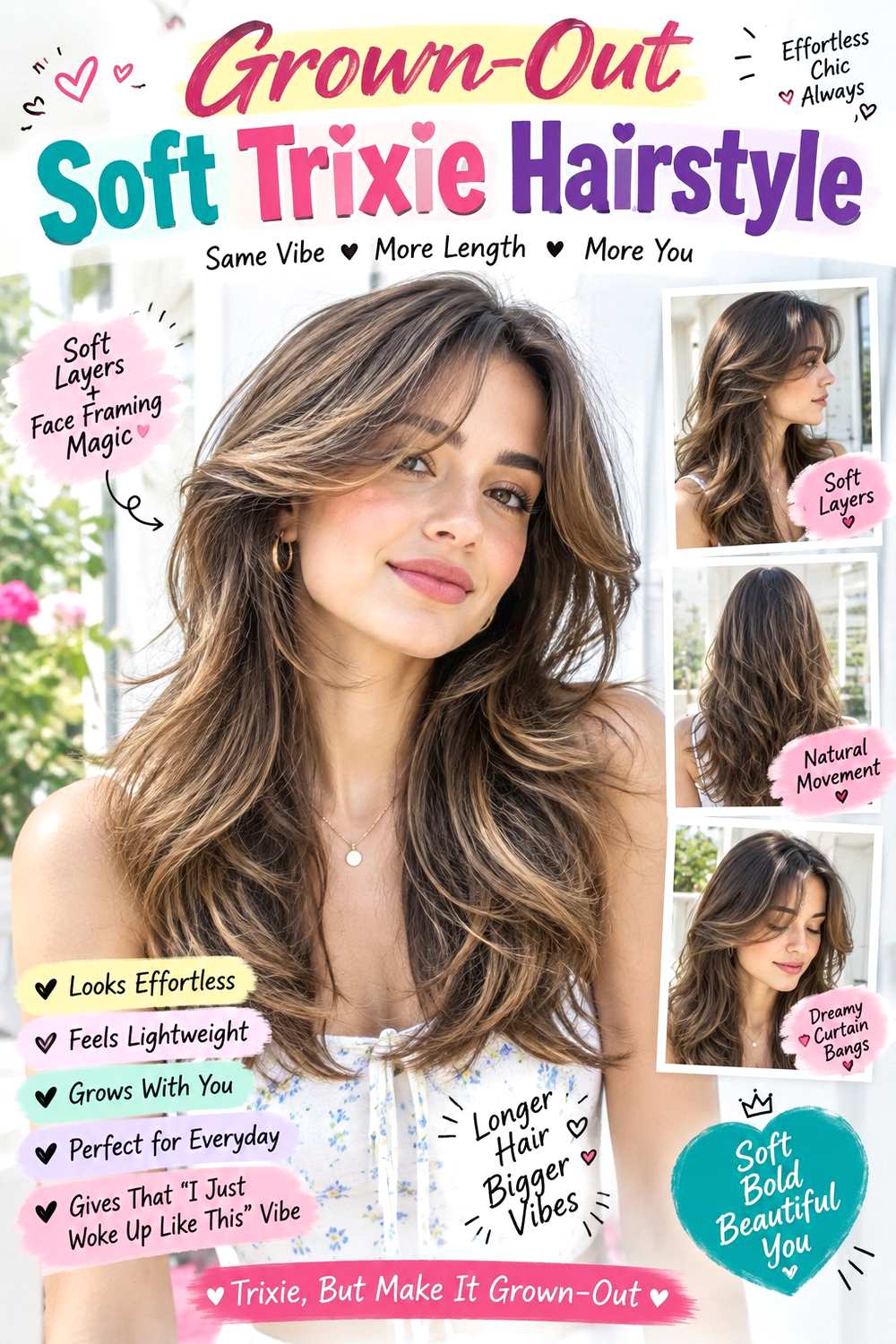
A grown-out version keeps the short layered identity while allowing the fringe, ear pieces, and nape to become longer and more fluid. The crown reaches farther toward the sides, the ears may be partly covered, and the fringe can fall around the brows or sweep into the temples. At the back, the nape blends gradually into the side length rather than looking sharply tapered. This shape suits readers who prefer fewer crisp edges or who are transitioning toward a bixie or short shag without losing all structure.
Use lightweight mousse through the crown for movement, apply heat protectant before refining the fringe with a round brush, and leave the nape softer rather than heavily set. A quick refresh can focus on the front and crown, while a complete blow-dry takes longer depending on density and natural texture.
At the salon, explain which length you are intentionally growing and ask for reshaping rather than automatically returning every section to a short crop. Preserving temple and nape length can maintain progress while excess bulk is reduced through the crown. Maintenance becomes useful when the top feels heavy enough to collapse or the sides lose their intended flow. A grown-out Trixie should still show deliberate differences between crown, fringe, and perimeter instead of becoming shapeless.
Pro tip:
Refresh crown lift before deciding a grown-out section needs cutting. Restoring movement at the roots can make extra length feel intentional without sacrificing your progress.
Make It Work for You:
If you are growing toward a short bob, retain the temple and nape pieces while lightly reshaping the crown. This supports length gain without losing all definition.
Watch Out For:
Letting every section grow untouched can create bulky areas before the perimeter catches up. Small shape adjustments can redistribute weight while preserving the length you want.
Conclusion
Soft Trixie haircut ideas range from airy and feathered to curly, choppy, ear-tucked, or gently grown out. Wispy and curtain fringe keep the front light, while a side sweep creates more direction. A rounded crown adds controlled fullness; longer nape pieces make the back softer and more fluid. Fine hair generally benefits from preserving perimeter weight, whereas dense hair may need targeted internal bulk removal. Waves, curls, and coils can supply much of the movement naturally when shrinkage is considered before cutting. The most practical version depends on how much ear exposure, fringe upkeep, crown volume, and daily styling you want. A softer outline can make grow-out easier, but the cut still needs reshaping once its short-to-long proportions stop looking intentional.
Before Your Salon Visit
Choose one or two favorites and save references that show the front, sides, crown, and nape clearly. Discuss your natural texture, density, face shape preferences, usual part, desired fringe length, ear coverage, upkeep tolerance, and normal styling routine. Point to the exact crown volume, side length, fringe density, nape finish, or texture you like. If you want the front from one reference and the softer back from another, explain those preferences separately so the haircut can be planned around both.
FAQs
What makes a soft Trixie different from a very short pixie?
The softer version keeps more usable length through the fringe, sides, and often the nape, so the perimeter can sweep, tuck, bend, or feather rather than looking tightly cropped. The crown still has short-cut structure, but the transitions are gentler and the grow-out can feel less abrupt.
Can curly hair wear a soft Trixie haircut?
Yes. Curly and coily hair can create natural crown volume and soft framing, but the fringe, sides, and nape should be judged in their finished dry state. Shrinkage may differ between sections, so layer lengths should respond to the actual curl pattern rather than one fixed wet measurement.
Is a soft Trixie suitable for fine hair?
It can be. Fine strands often benefit from keeping more weight through the crown, temples, and nape instead of using heavy texturizing everywhere. Because fine hair can still be dense, the exact layer amount should depend on both strand thickness and overall density.
How often should a soft Trixie be reshaped?
There is no single schedule for everyone. A reshaping becomes useful when fringe starts entering the eyes, crown layers stop separating, side growth changes the ear coverage, or the nape loses its intended taper. Softer, longer versions usually tolerate more grow-out than tightly cropped ones.