11 Soft Flick Bob Hairstyle Ideas

A soft flick bob keeps the recognizable weight and compact length of a bob while allowing the ends to turn gently outward. The flick may begin only through the final inch or travel higher through light layers, but it should read as broad movement rather than a sharp, rigid flip. Length can range from the jaw to the collarbones. Fringe is optional, and the crown usually stays softly lifted so the outward ends remain the main feature.
Straight and wavy textures show the flick clearly, while hair with stronger curls needs a different approach because its natural pattern can overpower a small outward turn. Fine hair often benefits from a stronger perimeter and restrained layering, especially when density is low. Dense hair may need targeted internal weight adjustment. Cheekbone or jaw-level framing can also shift movement around the face.
A quick refresh may involve reshaping only several ends, whereas a full blowout from wet takes longer. Cut maintenance matters when growth changes shoulder contact, layers become heavy, or the perimeter loses the weight needed to support a clean, soft flick.
Quick List
- Chin-Length Soft Flick Bob Hairstyle
- Jawline Soft Flick Bob Hairstyle
- Wispy Fringe Soft Flick Bob Hairstyle
- Curtain Fringe Soft Flick Bob Hairstyle
- Side-Parted Soft Flick Bob Hairstyle
- Wavy Soft Flick Bob Hairstyle
- Fine-Hair Soft Flick Bob Hairstyle
- Dense-Hair Soft Flick Bob Hairstyle
- Face-Framing Soft Flick Bob Hairstyle
- Collarbone Soft Flick Bob Hairstyle
- Airy Blowout Soft Flick Bob Hairstyle
Chin-Length Soft Flick Bob Hairstyle

A chin-length perimeter makes the outward flick easy to see because the ends sit clear of the shoulders. The bob stays relatively full through the lower section, with restrained layers above so the edge can move without becoming wispy. A center or slightly off-center part keeps the front simple. The final inch turns softly away from the neck, while the crown carries only enough volume to stop the short shape from appearing flat.
Straight and gently wavy hair are practical starting points. Fine hair benefits from keeping the lower edge substantial, while medium or dense hair can support a little more internal movement. Use heat protectant before heated drying, a medium round brush to direct the ends outward, and flexible hairspray for light hold. Refreshing several flattened ends may take only minutes; washing, drying, and shaping the entire bob takes longer.
At the salon, identify the exact dry chin-level perimeter and explain that you want movement mainly at the ends rather than short layers throughout. Reshape when growth drops the edge noticeably below the chin or makes the lower section too heavy to flick easily.
Pro tip:
Turn the brush only during the final part of each section. Keeping the roots and mid-lengths straighter makes the small outward movement at the chin look softer and more deliberate.
Make It Work for You:
If your hair naturally bends outward at this length, use that movement instead of fighting it. A fuller perimeter can organize the existing flip while reducing daily heat styling.
Watch Out For:
Avoid heavily thinning the bottom edge to encourage movement. Sparse ends can separate unpredictably, while a connected perimeter gives the flick enough shared weight to form a broad curve.
Jawline Soft Flick Bob Hairstyle

The jawline version creates a compact silhouette with the outward movement positioned close to the lower face. The perimeter follows the jaw before turning gently away, and subtle upper layers prevent the shape from feeling like one rigid block. Face-framing pieces can remain close to the overall length, while a soft center or side part controls where the front separates. Crown volume stays moderate.
Straight and softly wavy textures show the short flick clearly. Fine or lower-density hair usually needs minimal layering, while dense hair may require targeted internal weight adjustment above the perimeter. Use heat protectant before heated styling, a small round brush for controlled end direction, and lightweight styling cream to soften flyaways. A quick end refresh can take several minutes; a complete wash-day style takes longer.
At the salon, specify where the dry perimeter should meet your jaw and how much outward movement you expect from styling. Ask for enough lower weight to maintain a bob shape. Reshape when the edge grows below its intended landmark or the upper sections become too heavy to move independently.
Pro tip:
Use a smaller brush movement around the jaw rather than tightly wrapping the hair. A broad quarter-turn is usually enough to create a visible flick without producing a curled-under-then-out shape.
Make It Work for You:
If you prefer more lower-face coverage, place the perimeter slightly below the jaw. The ends can still turn outward while the longer length keeps more hair beside the cheeks.
Watch Out For:
Do not place excessive volume directly beside the jaw. Keeping the mid-lengths relatively calm lets the outward ends provide movement without making the compact bob disproportionately wide.
Wispy Fringe Soft Flick Bob Hairstyle

A wispy fringe introduces light forehead texture above the fuller, outward-moving bob. Fine center pieces can skim the brows with small spaces between them, while longer corners blend toward the temples. The bob itself can sit near the chin or lower neck, with enough perimeter weight to support a soft flick. The contrast between delicate fringe and fuller ends keeps the haircut visually balanced.
Straight and softly wavy hair display both elements clearly. Dense hair needs a shallow fringe section, while lower-density hair benefits from preserving fullness around the temples and perimeter. Use lightweight mousse for flexible fringe support, heat protectant before heated end styling, and a medium round brush for the flick. Fringe-only refreshing may take minutes; styling the entire bob takes longer.
At the salon, specify the dry fringe length, section depth, and desired amount of visible forehead. Discuss the bob perimeter separately so creating wispy bangs does not lead to unnecessary thinning elsewhere. Fringe maintenance may be needed before the bob itself requires reshaping once growth pushes shorter pieces into your eyes.
Pro tip:
Style the fringe first and keep its movement relatively calm. The outward ends already create a strong direction, so a lighter forehead finish prevents competing curves around the face.
Make It Work for You:
If your hair is low density, keep the fringe particularly shallow. A few deliberate pieces can soften the forehead while leaving more hair available for the bob’s substantial perimeter.
Watch Out For:
Avoid repeatedly thinning the fringe at every maintenance visit. An already wispy section can become sparse quickly, while the fuller flicked ends make large forehead gaps even more noticeable.
Curtain Fringe Soft Flick Bob Hairstyle
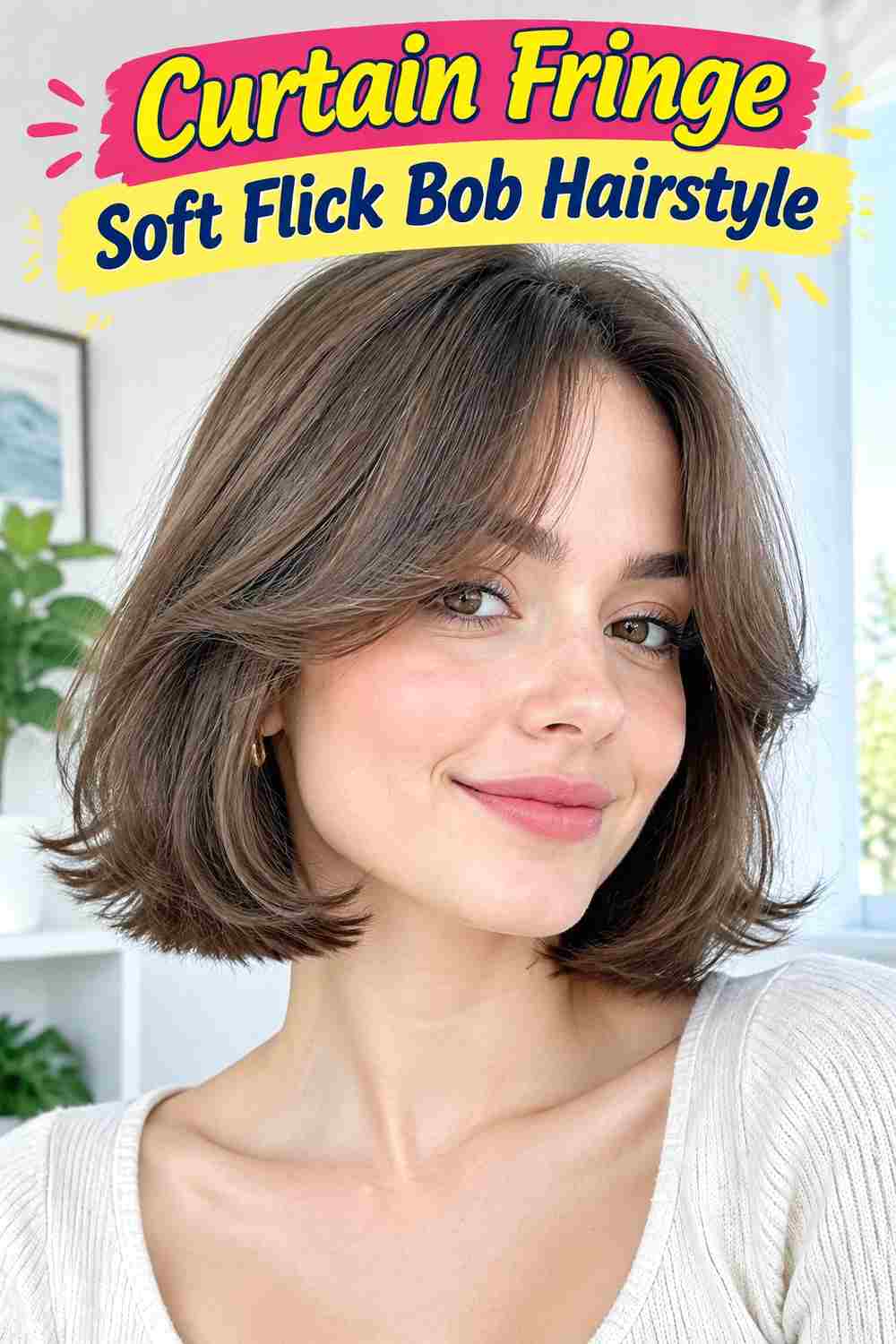
Curtain fringe creates inward-to-outward movement around the face before the bob ends flick away lower down. Shorter center pieces can sit around the brows, then lengthen toward the cheekbones. The perimeter may finish near the jaw or lower neck, with restrained layers connecting the fringe corners to the sides. A center part emphasizes the open front, while the ends provide a second, broader outward curve.
Straight and wavy textures make the layered directions easy to see. Fine hair generally benefits from a narrow curtain section, while dense hair can support fuller outer corners. Use heat protectant before heated drying, a medium round brush for the fringe and ends, and flexible hairspray for movable control. Refreshing only the front may take minutes; recreating the complete finish after washing takes longer.
At the salon, specify the dry center fringe length, outer-corner position, and bob perimeter separately. Ask for a gradual connection without removing excessive side weight. Fringe upkeep may be needed sooner than reshaping the perimeter because small amounts of growth can close the center opening.
Pro tip:
Open the curtain fringe with a smaller curve than the bob ends. Different curve sizes keep the front connected while preventing the haircut from looking uniformly flipped at every level.
Make It Work for You:
If frequent fringe trims are inconvenient, keep the center longer and the outer corners tuckable. The front can grow gradually while the flicked bob remains the dominant feature.
Watch Out For:
Avoid taking an overly deep fringe section from the crown. Removing too much hair forward can weaken the sides and reduce the lower fullness needed for a balanced flick.
Side-Parted Soft Flick Bob Hairstyle

A side part shifts volume toward one side while the lower edge flicks outward around the entire bob. The heavier front section can sweep across the forehead or away from the face, while the lighter side stays closer to the temple. A chin- to neck-length perimeter keeps the silhouette compact. The ends move outward softly rather than forming a dramatic kick, and crown lift follows the directional part.
Straight and softly wavy hair can hold this asymmetric volume easily. Fine hair may gain useful root lift from changing the part, while dense hair generally needs less added height. Use heat protectant before heated styling, a medium round brush for the ends, and lightweight styling cream for the sweep. Resetting the part and several tips can be quick; styling the complete bob from wet takes longer.
At the salon, show where you normally wear your part and identify your dry perimeter. Mention whether you regularly tuck the lighter side. Reshape when the heavy side begins collapsing or growth makes the lower edge too long to maintain its soft outward direction.
Pro tip:
Dry the heavier front briefly against its final direction before placing it over the part. That root movement creates lift while allowing the flicked ends to remain the main focus.
Make It Work for You:
If a deep side part fights your natural growth, move only slightly away from center. You can keep directional fullness without adding unnecessary effort to every styling session.
Watch Out For:
Avoid creating identical root volume on both sides. The side part works through controlled imbalance, while the consistent outward ends provide enough visual connection around the perimeter.
Wavy Soft Flick Bob Hairstyle

Natural waves give the flicked bob a less uniform finish, with some ends turning clearly outward and others following softer bends. The perimeter can sit between the chin and shoulders, while longer layers allow existing waves to form without creating excessive bulk. A natural center or off-center part keeps the surface relaxed. The flick is concentrated near the lower edge instead of forcing every wave into the same direction.
Naturally wavy hair can make this version relatively practical because existing bends provide much of the movement. Use lightweight mousse for flexible wave support and styling cream to encourage selected ends outward. A quick refresh may involve dampening only flattened or inward-turning pieces; a complete wash and wave reset takes longer.
At the salon, show where your waves naturally change direction and where unwanted width tends to collect. Ask for enough perimeter weight to keep the bob recognizable while allowing the ends to move. Reshape when growth stretches the upper waves or makes the lower section too heavy to retain a visible flick.
Pro tip:
Work with naturally outward-turning ends first, then adjust only the pieces that fall inward or flat. Selective refinement keeps the result softer than forcing every wave into one pattern.
Make It Work for You:
If your waves expand strongly around the cheeks, keep the shortest layers lower. This preserves natural movement while shifting the fullest area closer to the perimeter and flicked ends.
Watch Out For:
Avoid brushing the finished waves repeatedly to create a cleaner flip. Too much manipulation can separate natural groups, producing fuzz instead of the soft directional movement you want.
Fine-Hair Soft Flick Bob Hairstyle

Fine strands can show a soft flick clearly when the bob keeps enough weight along its lower edge. A chin- or neck-length perimeter provides a substantial base, while only restrained layering is used through the crown and face frame. The ends turn outward gently, and root lift stays light so the overall shape does not depend on large volume. A simple part keeps the finish uncluttered.
Fine hair refers to strand diameter, not the amount of hair present. Fine, high-density hair can support more layering than fine hair with low density. Use lightweight mousse for flexible body, heat protectant before heated styling, and a medium round brush for the ends. Refreshing the front and perimeter may take several minutes; full styling time varies with density and natural texture.
At the salon, explain whether your concern is fine strands, low density, flatness, or a combination. Ask to preserve perimeter weight and keep internal layering controlled. Reshape when the lower edge becomes uneven or the crown grows too heavy to support the desired movement.
Pro tip:
Apply mousse mainly near the roots and through the mid-lengths, using only residue at the ends. Fine tips can clump when overloaded, making the perimeter appear less substantial.
Make It Work for You:
If your fine hair is also low density, use styling rather than extra layers to create most of the flick. A connected perimeter can maintain coverage while still moving outward.
Watch Out For:
Fine strands do not automatically require aggressive texturizing. Removing too much internal weight can expose gaps and leave the flicked perimeter looking sparse instead of light and full.
Dense-Hair Soft Flick Bob Hairstyle

Dense hair can create a substantial flicked bob, but internal weight needs thoughtful placement so the lower edge moves rather than forming a heavy block. The perimeter may sit near the jaw or lower neck, with longer surface layers preserving a smooth outline. Targeted shaping underneath reduces concentrated bulk, while the ends turn outward in broad sections. Crown volume stays controlled to avoid unnecessary width.
Straight and wavy dense hair can show the movement clearly. Hair with substantial natural texture may need a longer version so the flick is not overwhelmed by expansion. Use heat protectant before heated styling, a large round brush for broad end movement, and lightweight smoothing cream for surface control. Refreshing the visible perimeter can be quick; fully drying and shaping dense hair takes considerably longer.
At the salon, point out where your bob becomes widest or heaviest as it grows. Ask for targeted internal weight adjustment rather than uniform thinning. Reshape when new growth restores excessive bulk or makes the ends difficult to direct outward.
Pro tip:
Style dense hair in broader sections rather than many narrow ones. Larger groups create a softer shared flick and prevent dozens of separated ends from increasing visual width.
Make It Work for You:
If your dense hair has natural wave, allow existing outward bends to contribute to the finish. Cutting can focus on weight distribution instead of making every section depend on heat styling.
Watch Out For:
Avoid indiscriminate thinning from roots through ends. Random short hairs can expand during grow-out, creating fuzz and width rather than helping the lower perimeter form a controlled flick.
Face-Framing Soft Flick Bob Hairstyle

Face-framing pieces add movement above the bob’s outward perimeter. The shortest layer can begin around the cheekbone or jaw, then blend gradually into a chin- to shoulder-level edge. Those front sections can sweep away softly while the final ends flick outward, creating two levels of movement without heavy layering through the back. A center or slightly offset part keeps the framing visible.
Straight and wavy textures show the progression clearly. Fine or lower-density hair generally needs a narrow face-framing section, while dense hair can support a broader transition. Use heat protectant before heated styling, a medium round brush for broad curves, and flexible hairspray for light control. Refreshing the visible front can take minutes; styling the complete bob takes longer.
At the salon, point to the exact dry landmark for the shortest front layer and explain how gradually it should connect to the perimeter. Reshape when the face frame grows long enough to merge into the bob or the lower edge becomes too heavy to flick.
Pro tip:
Give the face-framing pieces a gentler outward curve than the perimeter. The difference keeps both movements visible instead of creating one continuous, exaggerated flip from cheek to ends.
Make It Work for You:
If you prefer more cheek coverage, begin the shortest front layer near the jaw. You can preserve the framing effect while keeping most movement lower around the face.
Watch Out For:
Avoid cutting a thick front section to one short length. A gradual transition preserves side density and prevents a shelf between the face frame and the flicked perimeter.
Collarbone Soft Flick Bob Hairstyle

At collarbone length, natural shoulder contact can help create the outward movement that defines this bob. The perimeter sits around the collarbones, while restrained layers through the front and upper sides prevent the longer shape from feeling heavy. Ends can turn outward in broad, loose sections, and a center or side part changes where the upper volume sits. The finish remains closer to a long bob than a layered medium cut.
Straight and wavy textures are practical because the ends can respond naturally to the shoulders. Fine hair benefits from a substantial perimeter, while dense hair may need targeted internal shaping. Use heat protectant before heated styling, a large round brush for broad flicks, and lightweight styling cream for flyaway control. Refreshing several ends can be quick; fully drying collarbone-length hair takes longer.
At the salon, specify exactly where the dry perimeter should sit relative to your shoulders. Ask for enough weight to retain a clear bob outline. Reshape when growth changes shoulder contact or pulls the flick below its most effective position.
Pro tip:
Check how your dry ends naturally react to your shoulders before reshaping them. Existing contact may already produce useful outward movement, reducing the amount of heat needed.
Make It Work for You:
If shoulder contact creates an unpredictable flip, move the perimeter slightly above or below the strongest contact point. The soft flick remains while the lower shape becomes easier to manage.
Watch Out For:
Avoid heavily thinning the collarbone edge to make it lighter. Shoulder movement already gives the ends flexibility, and sparse tips can become more difficult to control.
Airy Blowout Soft Flick Bob Hairstyle

An airy blowout combines moderate root lift with broad outward movement at the ends. The bob can sit between the chin and shoulders, with connected layers that support fullness without hiding the perimeter. Face-framing sections sweep gently away, while the lower edge flicks outward in loose sections rather than one rigid line. The crown remains touchable, and the finish should move when the hair moves.
Straight and softly wavy hair are practical starting points. Fine hair benefits from lightweight support, while dense hair requires more sectioning and drying time. Use heat protectant before styling, a medium round brush for root lift and outward ends, and flexible hairspray for movable hold. Refreshing the crown and several perimeter sections may take minutes; creating the complete blowout from wet takes considerably longer.
At the salon, specify the dry perimeter and layer placement independently of the blowout. The haircut should still hold a recognizable bob shape without styled volume. Reshape when growth makes the crown difficult to lift or the ends too heavy to flick.
Pro tip:
Let each outward bend cool before loosening it with your fingers. Cooling helps the flick last while reducing the need for repeated heat passes or heavy finishing spray.
Make It Work for You:
If full blowouts do not suit your routine, style only the face frame and visible perimeter. Those sections can create most of the airy flick while the crown stays natural.
Watch Out For:
Avoid tightly wrapping every section around the brush. Strong curls can hide the clean bob perimeter; broad, partial turns create the lighter outward movement that defines this finish.
Conclusion
Soft flick bob hairstyle ideas can range from compact jawline cuts to collarbone bobs that use shoulder contact for natural movement. Fine or low-density hair often benefits from restrained layers and a stronger perimeter, while dense hair can use targeted internal weight adjustment. Wispy and curtain fringe add forehead detail, while side parts shift upper volume. Waves create varied flicks, whereas straighter textures show a cleaner outward edge. Face framing adds movement above the perimeter, and an airy blowout creates the fullest finish. Consider natural texture, density, face shape, preferred length, parting, upkeep, and heat-styling routine together. A successful soft flick should keep enough bob weight to look substantial while allowing the ends to move freely.
Before Your Salon Visit
Choose one or two favorites and save clear references showing the front, sides, and perimeter. Discuss your natural texture, density, face shape, preferred length, upkeep, and everyday styling routine. Point out the exact fringe, layer starting point, volume, perimeter weight, and amount of outward flick you like. Mention whether your ends naturally turn at the jaw or shoulders and whether you usually air-dry or heat-style, since some visible flick may come from styling rather than the haircut alone.
FAQs
Does a soft flick bob need layers?
Not always. A mostly one-length bob can develop an outward flick through natural bend, shoulder contact, or styling. Light layers can make movement easier, but excessive layering may weaken the perimeter. The useful amount depends on your density, texture, length, and preferred finish.
Can fine or low-density hair wear a soft flick bob?
Yes. Fine strands and low density are different characteristics, so the cut should account for both. When overall density is limited, preserving a fuller perimeter and using restrained layering can maintain coverage while styling creates the outward movement.
Can I wear a soft flick bob without daily heat styling?
Natural waves, bends, and shoulder contact can create an outward turn without daily heat. A quick refresh may only require dampening misplaced ends. If your hair naturally dries very straight or inward, a more pronounced flick may require occasional heated styling with heat protectant.
How do I keep the flick from becoming too dramatic?
Concentrate the bend near the final section of the hair instead of curling from the mid-lengths. Broad brush movements and lighter hold also help. Keeping the roots and middle relatively calm makes the outward ends read as a soft flick rather than a strong retro flip.