12 Stacked Angled Bob Hairstyles

Stacked angled bob hairstyles combine two strong pieces of geometry: shorter, graduated layers through the back and a perimeter that becomes longer toward the front. The stack can be compact and noticeable or subtle enough to create only gentle crown lift. Front sections may stop at the chin or extend below it, while the back usually exposes more of the nape. Straight finishes emphasize the angle, whereas waves and curls soften the line and introduce movement.
The shape can be adapted for straight, wavy, curly, fine, coarse, sparse, or dense hair, but the cutting approach should respond to the actual texture and density. A fuller bottom edge can help preserve the appearance of density, while controlled internal weight removal may make a dense bob easier to manage. Face framing can also change through the part, fringe, front length, and amount of volume beside the cheeks or jaw.
Styling effort varies considerably. A naturally straight bob may need a short morning reset, while a sleek finish on curly hair can require a longer wash-day routine. The stacked back also needs reshaping once its graduation loses definition. Comparing the angle, stack height, texture, fringe, and finish is therefore more useful than choosing by length alone. hairstyle_caption_depth_knowled…
Quick List
- Classic Graduated Stacked Angled Bob Hairstyle
- Long Front Stacked Angled Bob Hairstyle
- Side Part Stacked Angled Bob Hairstyle
- Soft Wavy Stacked Angled Bob Hairstyle
- Curly Stacked Angled Bob Hairstyle
- Chin Length Stacked Angled Bob Hairstyle
- Wispy Fringe Stacked Angled Bob Hairstyle
- Deep Nape Stacked Angled Bob Hairstyle
- Textured Piecey Stacked Angled Bob Hairstyle
- Sleek Precision Stacked Angled Bob Hairstyle
- Subtle Stacked Angled Bob Hairstyle
- Voluminous Crown Stacked Angled Bob Hairstyle
Classic Graduated Stacked Angled Bob Hairstyle
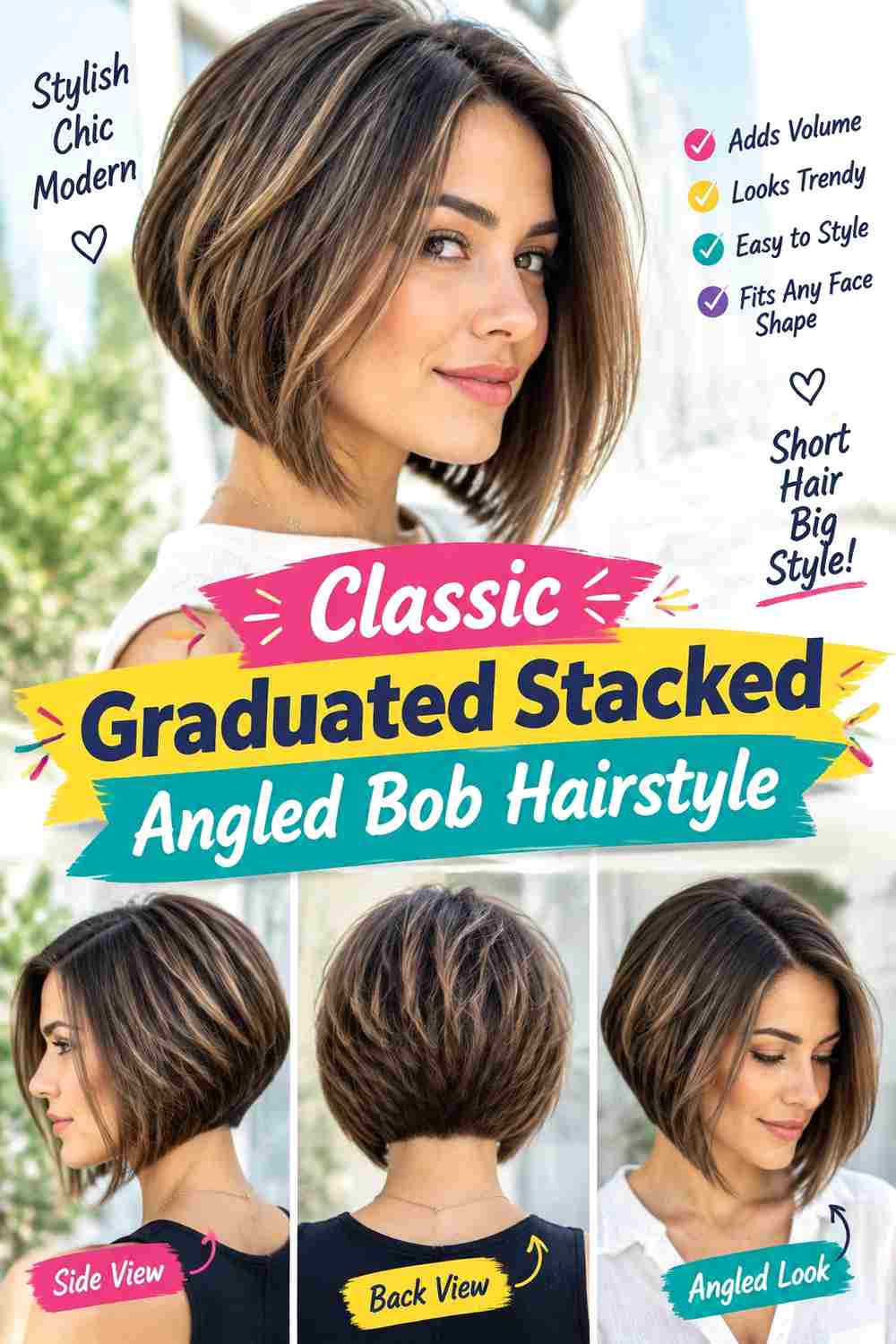
A clearly graduated back gives this bob its recognizable rounded profile. The shortest area sits close to the nape, then progressively longer sections build toward the crown before flowing into chin-length front pieces. Keeping the front clean and largely free of short face-framing layers makes the forward angle easy to see. A center or slightly off-center part keeps the shape balanced, while smooth ends show the graduation most clearly.
Straight and gently wavy textures can display this structure with relatively little manipulation. Dense hair may need carefully placed internal weight reduction so the stacked area does not become excessively wide, while lower-density hair often benefits from keeping enough weight around the outer edge. For styling, a heat protectant, round brush, and lightweight smoothing cream can protect during blow-drying, shape the back, and control flyaways without making the layers rigid.
A quick refresh can mean redirecting the crown and smoothing the front, whereas a complete wash-day blow-dry takes longer, especially with dense hair. Ask your stylist where the graduation should begin and how much fullness you want at the back. Reshaping becomes useful when the nape grows heavy and the rounded stack starts collapsing.
Pro tip:
During drying, direct the back sections upward and slightly forward before letting them settle. This supports the graduation at its base instead of relying on heavy styling product to create artificial crown height.
Make It Work for You:
If your ends are relatively sparse, request gentler graduation and retain more weight along the lower edge. You can still get the angled profile without removing so much hair that the perimeter appears thin.
Watch Out For:
Avoid making the crown excessively short simply to produce volume. Too much separation between the top and nape can create a disconnected shape; ask for graduation that blends smoothly through the back.
Long Front Stacked Angled Bob Hairstyle
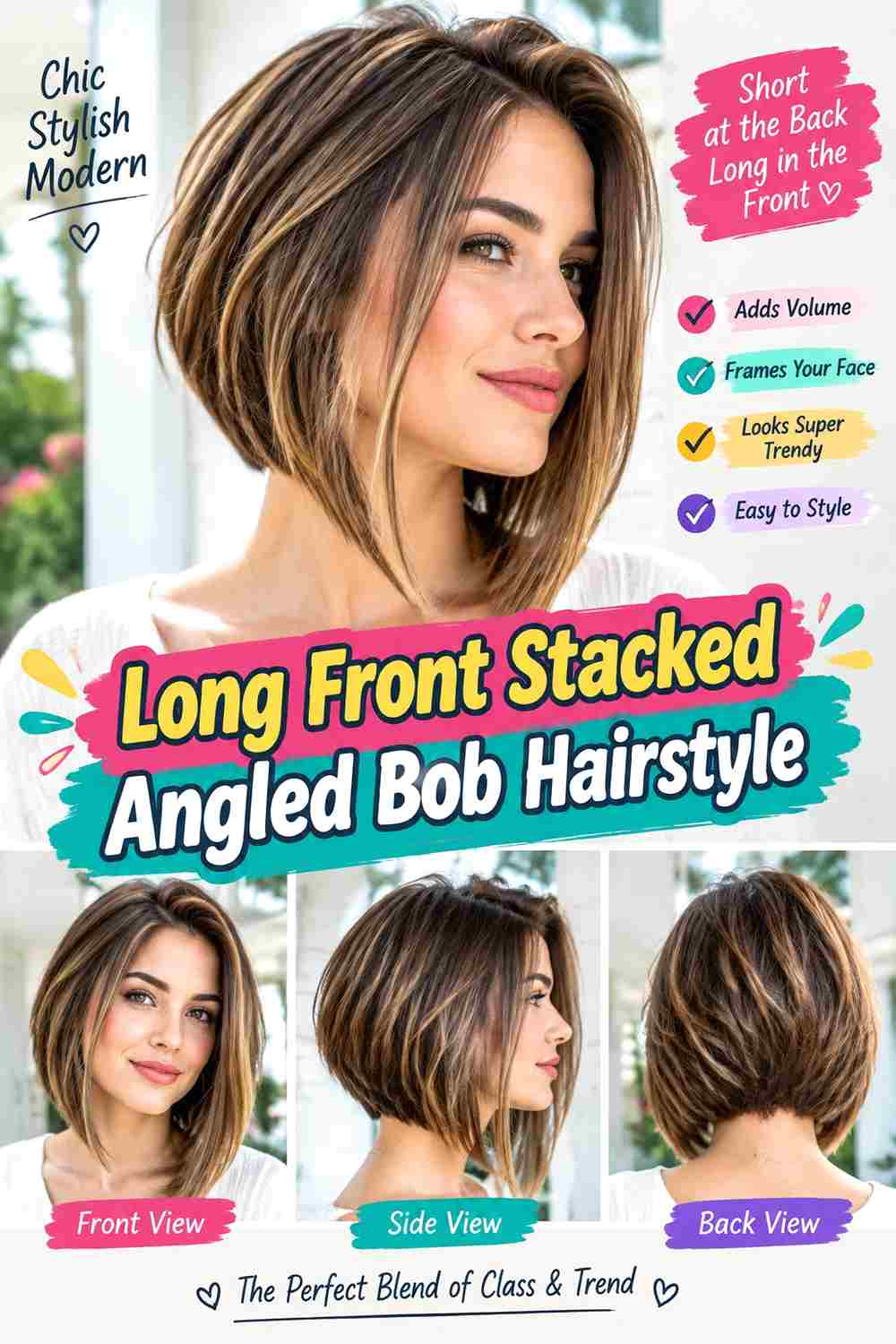
Extra length in front creates a stronger contrast with the compact stacked back. The rear can finish around the upper or middle nape, while the longest pieces reach below the chin and approach the upper neck. That extended diagonal gives the bob a sweeping profile without requiring short layers around the face. A center part emphasizes symmetry, although a slight offset can soften the front placement.
This variation is useful when you want a short back but prefer enough front length to tuck behind the ears or frame the jaw. Straight and loose wavy textures show the angle readily. Dense hair may need bulk managed inside the back while preserving the longer front corners. Use a heat protectant, paddle brush, and lightweight serum when creating a smooth finish; they help protect during heat styling, guide the hair downward, and reduce fuzzy ends.
Between washes, a short brush-through and front-section reset may be enough. A complete smooth blow-dry takes more time when your natural texture differs from the intended finish. At the salon, point to the exact finished front length you want rather than asking only for an angled bob. The shape needs reshaping when the back becomes bulky or the diagonal begins looking level.
Pro tip:
Dry the two long front sections downward rather than curling them strongly underneath. Keeping their ends straighter makes the forward length more visible and prevents the bob from becoming overly rounded beside the jaw.
Make It Work for You:
For wavy hair, allow a little extra finished length at the front so natural bends do not visually shorten the angle. The stacked back can remain defined while the longer sections keep their movement.
Watch Out For:
Do not let excessive thinning weaken the elongated front corners. If those pieces become wispy, the strongest part of the silhouette disappears; preserve enough perimeter weight for a clear diagonal line.
Side Part Stacked Angled Bob Hairstyle
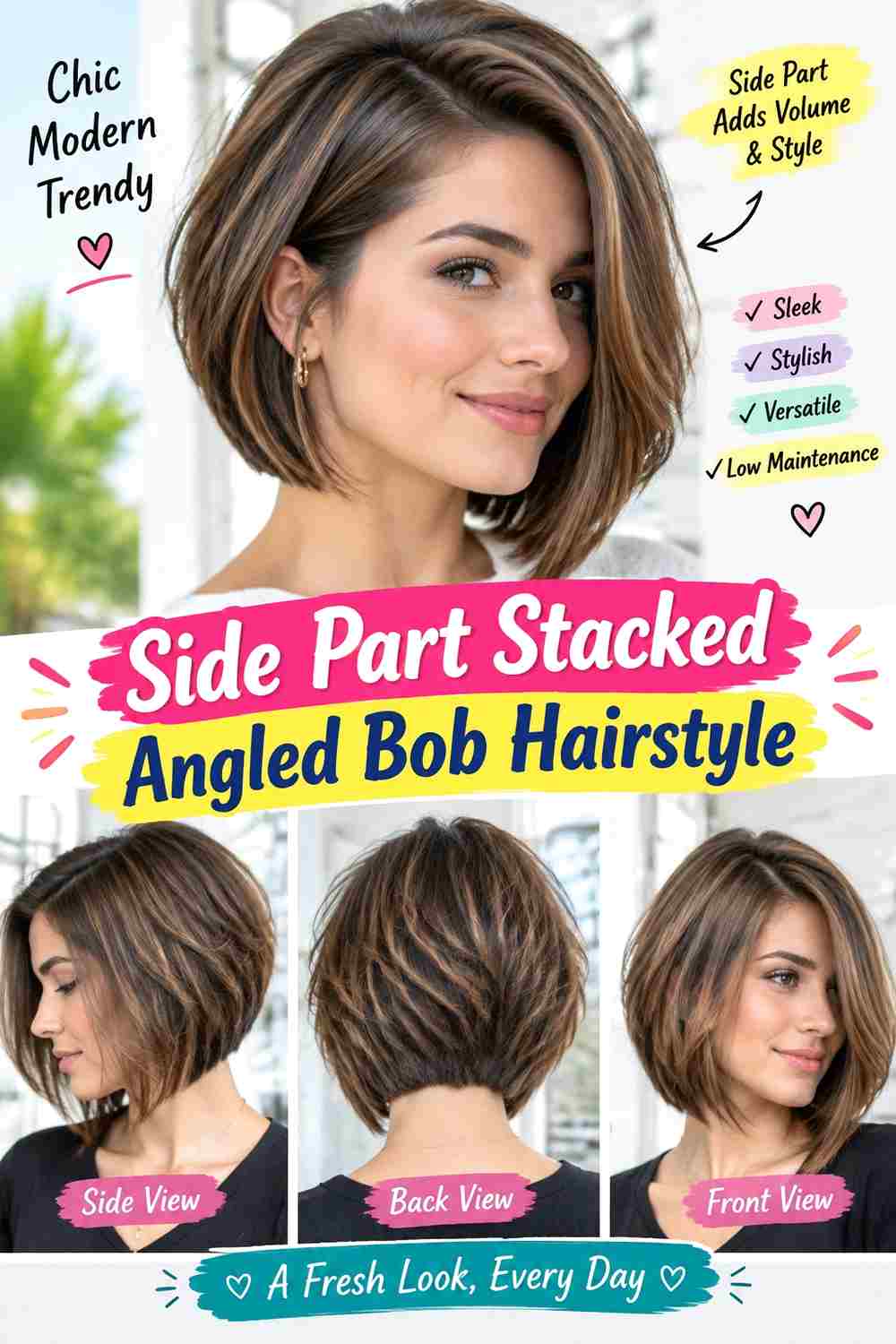
A deep side part shifts the visual weight of a stacked bob and creates a longer sweep across one side of the forehead. The back remains graduated and shorter at the nape, but the asymmetrical styling makes one front section appear fuller and more prominent. Keeping the front near chin length and the ends softly curved creates movement without hiding the angled perimeter.
The side part can be particularly useful for hair that naturally prefers one direction, since working with the growth pattern may require less daily correction. Straight or gently wavy hair can hold the sweeping front easily, while dense hair may need careful bulk control beneath the heavier side. A root-lift spray, heat protectant, and round brush can support the part, protect during blow-drying, and shape the front without requiring stiff hold.
A morning refresh is often limited to resetting the part and lifting the heavier side. A full wash-day style takes longer because the roots must be dried in the intended direction. Ask your stylist to evaluate how the front falls with your preferred part before deciding where face-framing pieces should begin. As the cut grows, refresh the stack when the back loses its graduated curve rather than trimming only the front.
Pro tip:
While the roots are damp, dry the heavier side briefly in the opposite direction, then return it to the intended part. That change of direction can create lift without teasing the crown.
Make It Work for You:
If your hair is lower in density, choose a moderately deep part rather than moving a very large section across the head. You keep the side-swept effect without leaving the opposite side noticeably sparse.
Watch Out For:
A part forced against a strong growth pattern may split repeatedly during the day. Instead of adding more product, adjust the part slightly and work with the direction your roots naturally prefer.
Soft Wavy Stacked Angled Bob Hairstyle

Broad bends through the mid-lengths soften the precise geometry of an angled bob while leaving the shorter stacked back visible. The most useful wave placement begins below the upper cheek area, with flatter roots and relatively relaxed tips. This keeps the silhouette controlled rather than turning the entire cut into a round mass of volume. Chin-to-neck-length front pieces provide enough space for one or two noticeable bends.
Naturally wavy hair can adapt particularly well, though the cut should be assessed in its usual texture because bends change apparent length. Straight hair can recreate the finish with a heat protectant, curling iron, and flexible hairspray. The protectant is important before heat, the iron forms broad bends, and flexible hold keeps movement without freezing individual sections.
On non-wash days, refreshing a few flattened front pieces can be quick; creating waves throughout freshly washed hair requires more time. The cut itself needs reshaping when the stacked back becomes too long to support its rounded profile. At your salon visit, explain where you want the front angle to finish when the hair is wavy, not merely when pulled straight. Keeping sufficient perimeter weight also helps the angle remain readable beneath the texture.
Pro tip:
Alternate the direction of a few bends through the sides, but keep the pieces immediately around the face controlled. This prevents the waves from merging into one bulky shape while retaining deliberate framing.
Make It Work for You:
For naturally stronger waves, choose a slightly longer front and a less aggressive back stack. The extra room lets your pattern form without making the overall bob appear dramatically shorter after it dries.
Watch Out For:
Starting every wave directly at the root can hide the angled outline beneath excessive width. Keep more lift at the crown and place the strongest bends through the middle lengths instead.
Curly Stacked Angled Bob Hairstyle
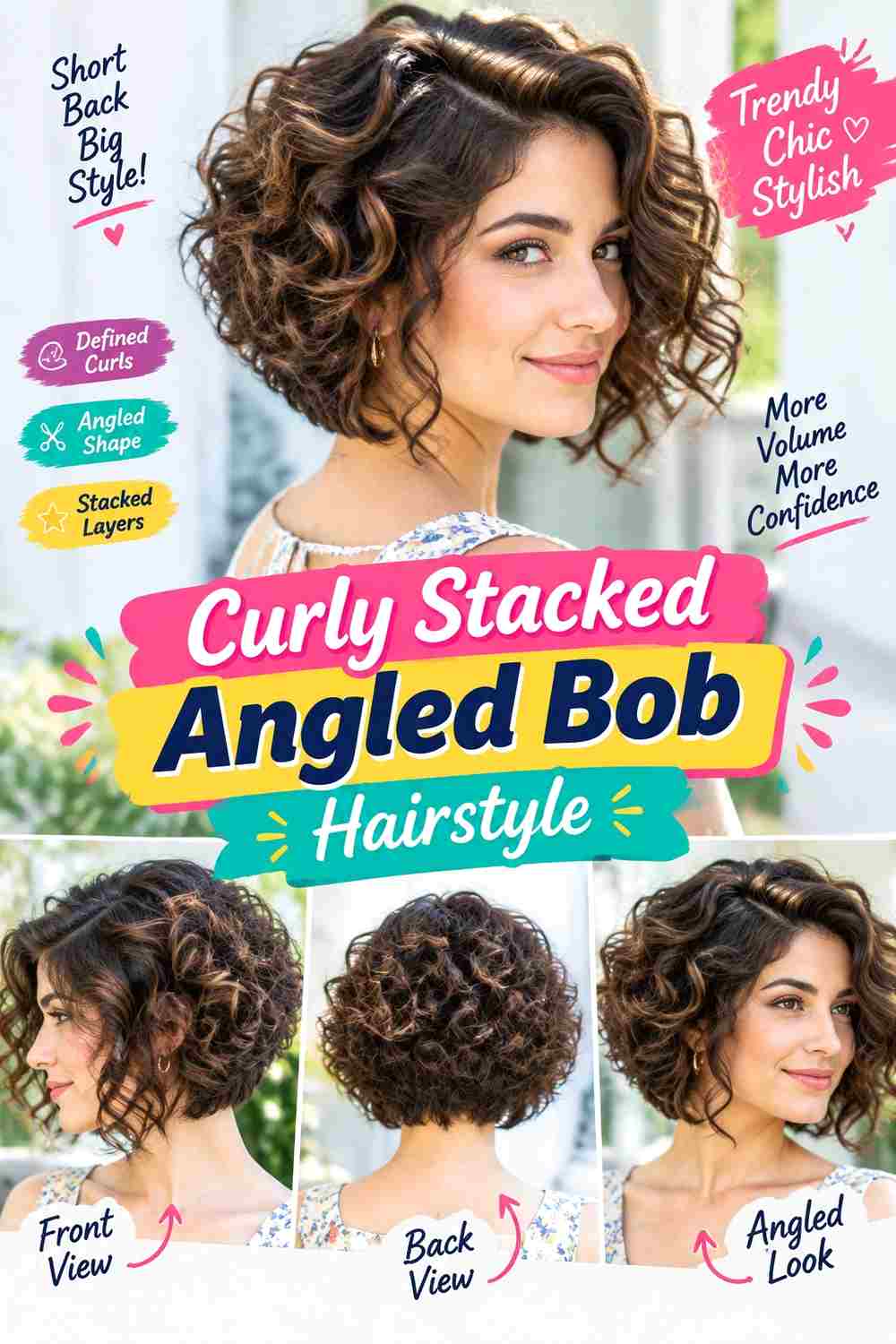
Natural curls turn the stacked silhouette into a softer, more dimensional shape. Rather than relying on a perfectly visible straight diagonal, this version uses shorter curls around the nape and gradually increasing length toward the front. Curl groups can create their own movement around the cheeks and jaw, while moderate crown lift reinforces the rounded back. The finished dry shape matters more than a rigid wet measurement.
Curly hair varies substantially in shrinkage and spring, so the front length and graduation need to reflect how your curls actually settle. Dense curls may need thoughtful bulk placement inside the silhouette, but indiscriminate thinning can disturb curl grouping. For styling, a lightweight leave-in conditioner, curl gel, and diffuser can add slip, encourage definition, and dry the shape with less disruption.
A non-wash-day refresh may involve reactivating only flattened curls, while complete cleansing, application, and drying will naturally take longer. Salon reshaping becomes useful when the nape expands, the crown loses balance, or the front no longer maintains the intended angle. Ask your stylist to assess the desired front length in its dry, curled state and discuss how much shrinkage you normally experience before deciding the graduation.
Pro tip:
Diffuse the stacked back with minimal disturbance until the curls begin setting, then adjust the roots gently. Moving the hair constantly while wet can separate curl groups and blur the rounded silhouette.
Make It Work for You:
If your curls shrink strongly, preserve more length through the front and keep the initial stack conservative. You can maintain the angled idea while allowing your natural pattern to determine its final visible length.
Watch Out For:
Avoid choosing the front measurement from stretched or soaking-wet hair alone. Once curls contract, the angle can become much shorter than intended; discuss the finished dry position before significant length is removed.
Chin Length Stacked Angled Bob Hairstyle
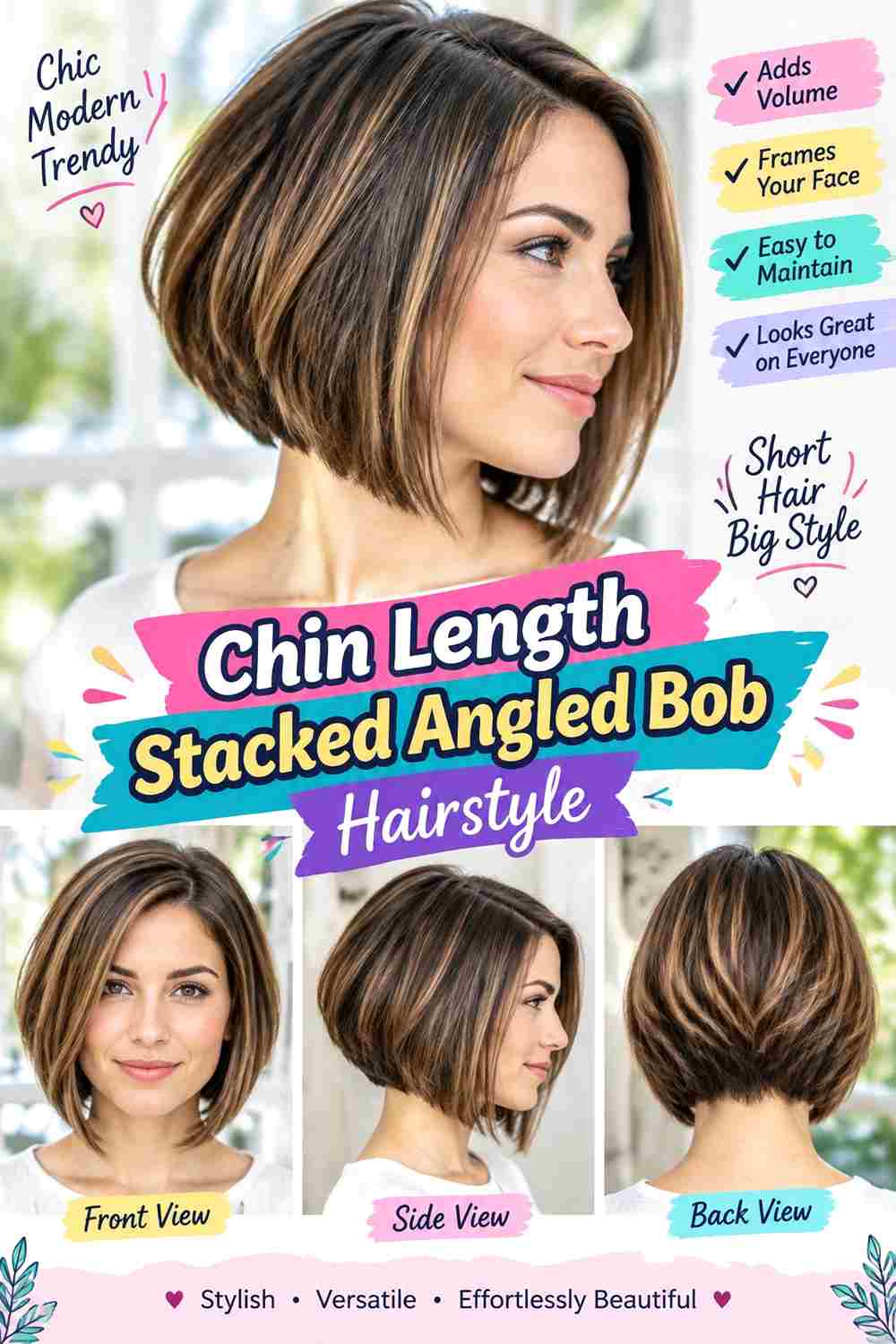
Keeping the longest pieces around the chin creates a compact angled bob that feels distinctly short without removing all framing around the face. The nape sits higher, the back builds into controlled graduation, and the sides travel forward into a crisp chin-level edge. A centered or softly offset part works well because the perimeter itself provides most of the visual structure.
This shorter proportion can suit straight and lightly wavy textures, but density affects how much stacking is useful. Fine strands with adequate density may gain visible lift from moderate graduation, whereas very dense hair can become wide through the back if too much weight remains in one area. A heat protectant, round brush, and lightweight mousse can support a shaped blow-dry by protecting from heat, guiding the ends, and adding manageable root lift.
A quick refresh usually focuses on the crown and any sections that bent during sleep. Full wash-day styling takes longer because the short back needs directional drying. Ask your stylist to show where the front will sit once dry, particularly if your texture has bend or shrinkage. Since the nape is exposed, growth can change this compact silhouette noticeably; reshape it when the lower back starts covering the intended graduation.
Pro tip:
When blow-drying, concentrate the strongest lift at the upper back rather than the sides. This keeps the chin-length perimeter visually narrow and allows the stacked profile to provide the fullness.
Make It Work for You:
If you prefer a little more coverage beside the jaw, let the front corners finish just below the chin while retaining the shorter back. The slight extension preserves the compact angled character.
Watch Out For:
Over-rounding every end can make the cut resemble a uniformly curved bob and hide its diagonal perimeter. Keep the front ends smoother so the difference between short back and longer front remains apparent.
Wispy Fringe Stacked Angled Bob Hairstyle
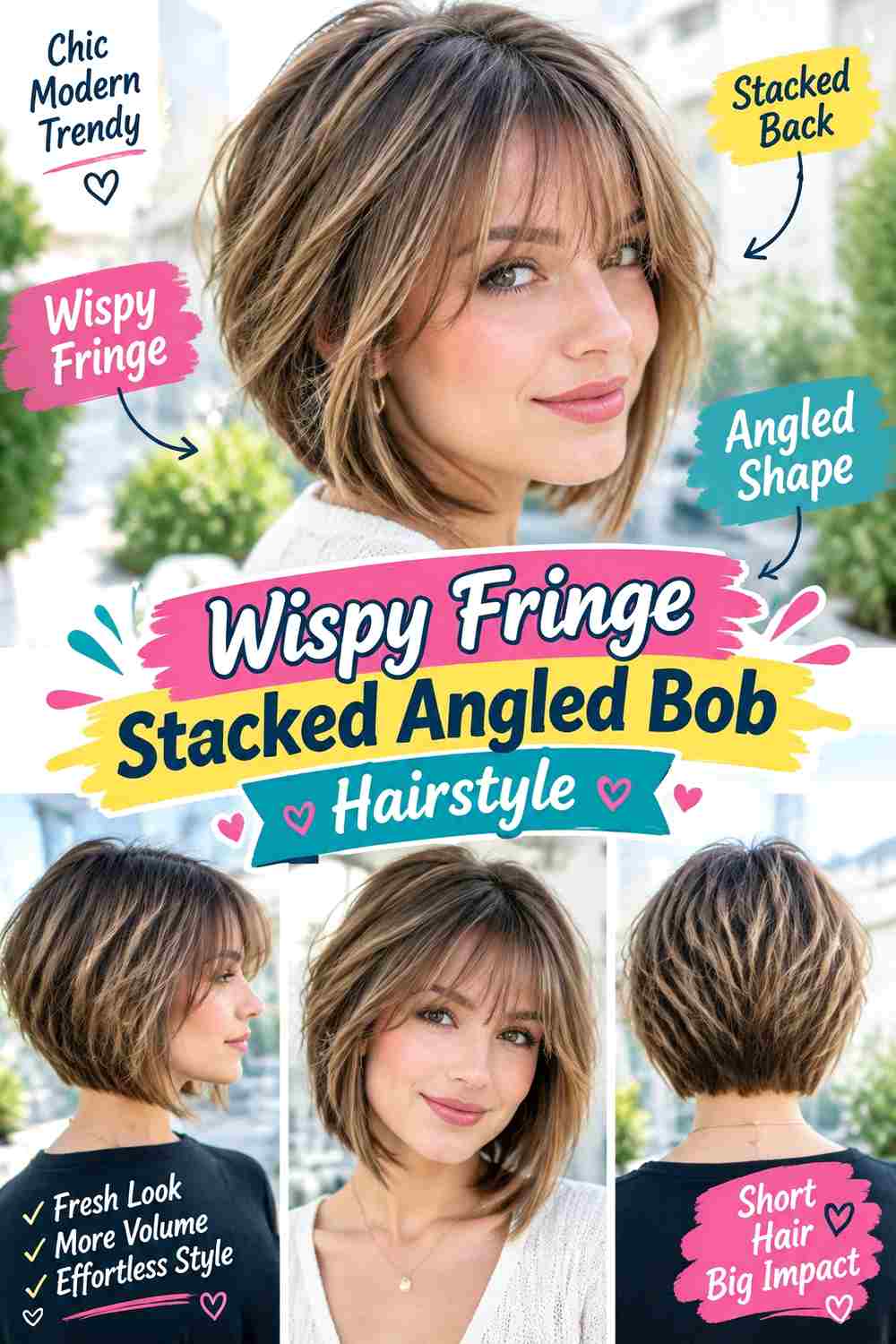
A light, separated fringe changes the front of a stacked bob without competing with its strong back profile. The fringe can skim the brows through the center with slightly longer outer corners, while the side lengths continue toward the chin. Behind that softer front, graduated nape layers create lift and the perimeter retains its forward angle. A relaxed fringe texture keeps the design from appearing too heavy around the forehead.
This approach works especially well when you want some forehead coverage without committing to a dense blunt bang. Straight and gently wavy textures can be relatively straightforward, although growth direction strongly affects how the fringe separates. Use a heat protectant, small round brush, and lightweight styling cream to protect during drying, guide the fringe, and control its tips without coating them heavily.
Refreshing only the fringe between washes can be brief, while washing and styling the entire stacked bob takes longer. Fringe upkeep is separate from reshaping the back and may be needed sooner when the center starts entering the eyes. Ask your stylist to discuss the finished dry fringe length, width, and longer outer corners rather than requesting generic bangs. The front should connect visually with the bob without becoming another heavy layer.
Pro tip:
Dry the fringe soon after wetting it, moving it gently from side to side before settling it forward. This can reduce unwanted separation caused by letting the roots dry in one fixed direction.
Make It Work for You:
For a strong front growth pattern, keep the fringe slightly longer and airier so it can move naturally. The outer corners can still blend toward the angled sides without requiring constant forced placement.
Watch Out For:
Too much styling cream can divide a wispy fringe into oily-looking sections. Start with very little product on the ends and keep the roots light so the intended separation remains soft.
Deep Nape Stacked Angled Bob Hairstyle
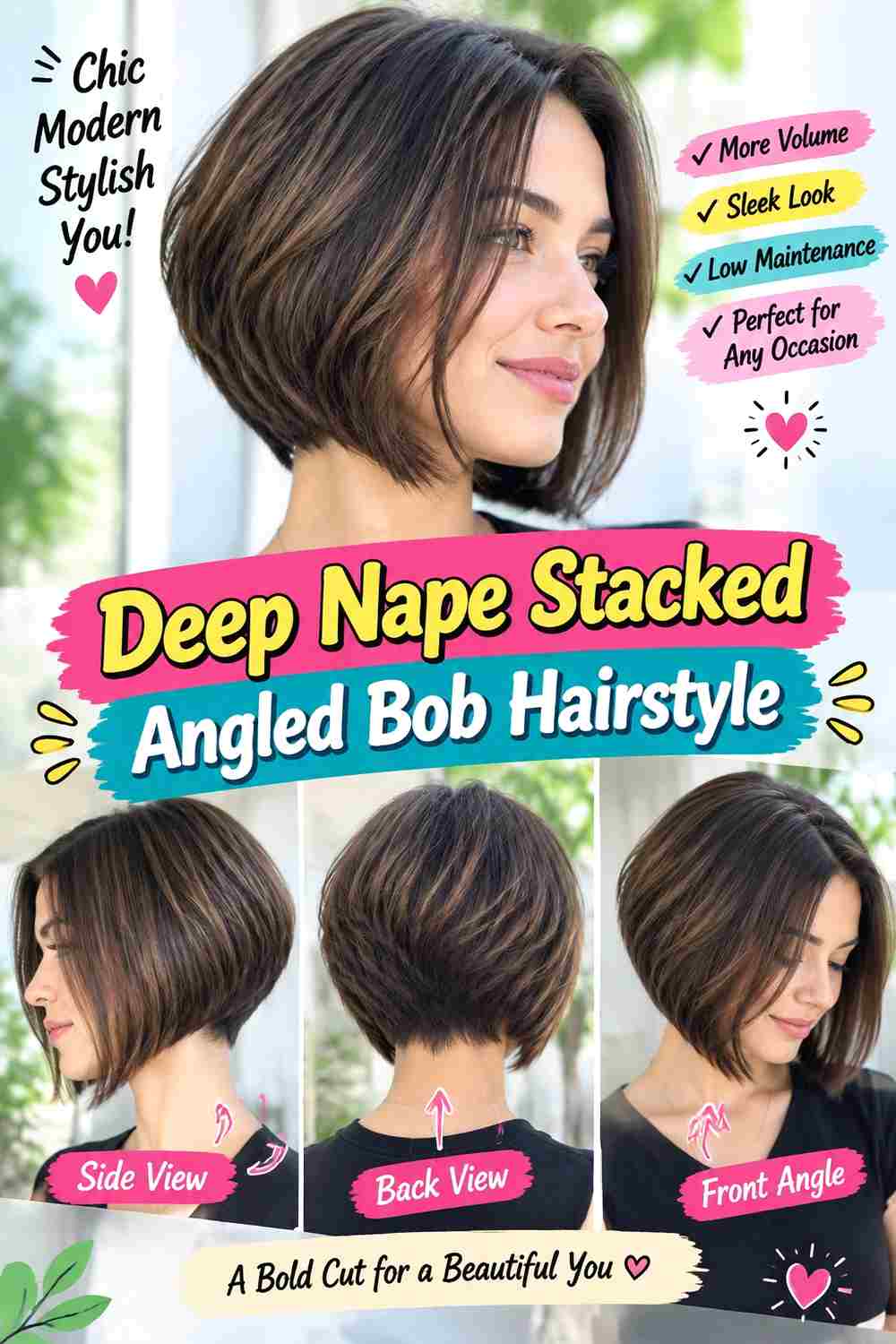
The stacked back becomes the main feature here, with close graduation at the lower nape building into a noticeably rounded upper-back section. Longer side panels then travel toward the jaw or slightly below it, creating a strong contrast between the compact rear and forward-reaching perimeter. Keeping the top relatively smooth prevents the pronounced stack from becoming unnecessarily tall.
Straight and softly wavy hair can show the layered architecture clearly. Dense hair may support the rounded profile readily, though internal bulk sometimes needs adjustment so the back does not spread outward. Lower-density hair generally benefits from a controlled rather than extreme stack. A root-lift spray, heat protectant, and round brush can encourage directional lift, protect during blow-drying, and shape the graduated layers.
A short refresh can focus on the crown and nape after sleeping, but a full blow-dry requires attention to several short back sections. Because the graduation is prominent, grow-out becomes visible when the nape lengthens and the rounded weight shifts downward. Ask your stylist exactly where you want the fullest point of the back to sit. That placement matters as much as the front angle and determines whether the silhouette feels compact or exaggerated.
Pro tip:
Direct the shortest nape sections close to the head while giving the layers immediately above them more lift. The contrast supports a clean stacked curve without creating unnecessary puffiness at the neckline.
Make It Work for You:
If you have dense hair but dislike a very round back, request a lower, more controlled fullness point. You retain clear graduation while reducing the amount of volume concentrated high on the head.
Watch Out For:
Aggressive thinning throughout the stacked area can leave short pieces unsupported and fuzzy. If bulk is a concern, discuss where it actually accumulates so weight can be managed without destroying the outer silhouette.
Textured Piecey Stacked Angled Bob Hairstyle
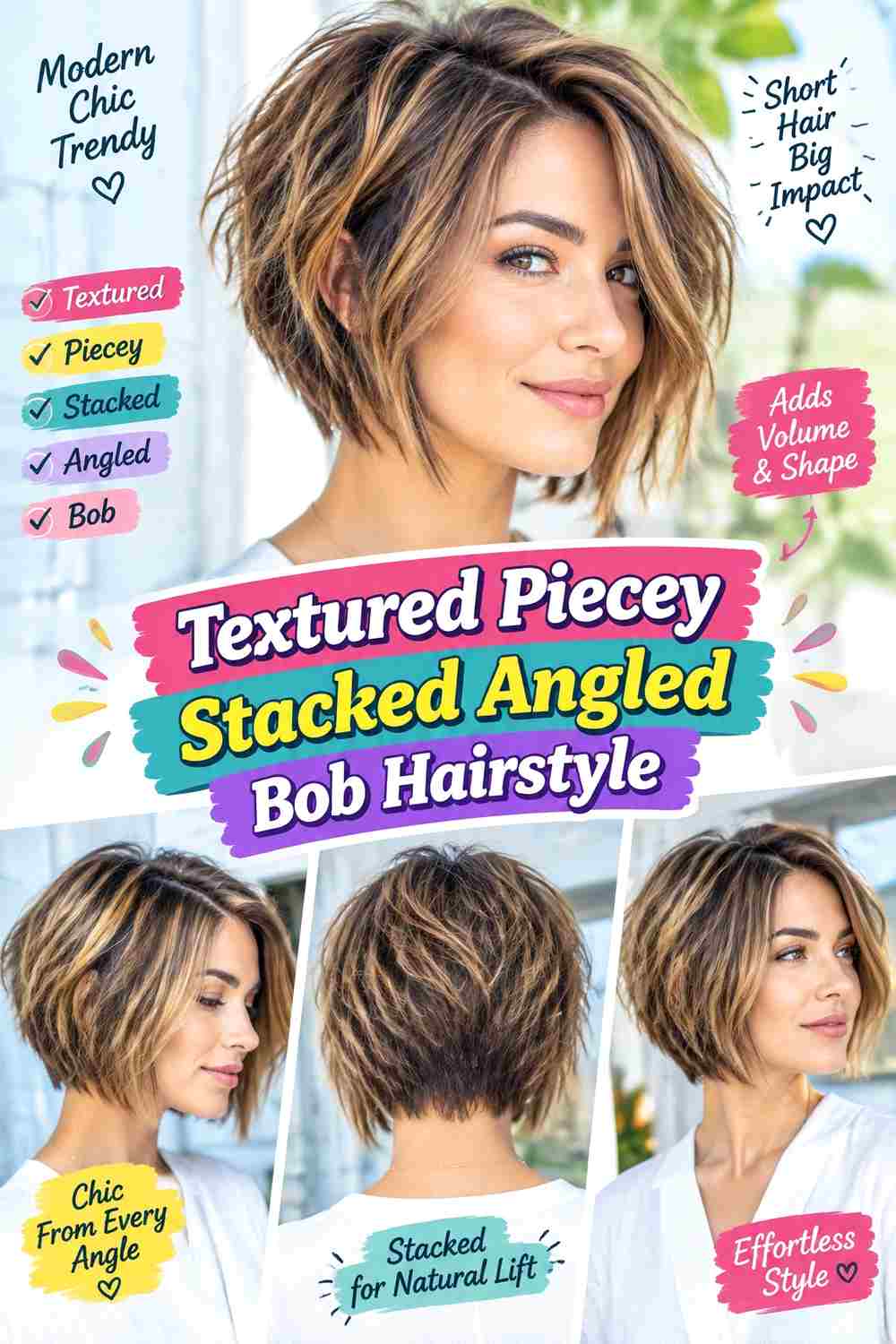
Separated ends and irregular movement give the angled bob a less polished finish while keeping its basic geometry intact. The nape remains shorter, the back retains moderate graduation, and longer pieces move toward the chin. Instead of smoothing every layer into one continuous surface, selected ends separate around the sides and crown. A slightly off-center part reinforces the relaxed finish without making the shape asymmetrical.
Straight, wavy, and mildly irregular textures can work well because the finish does not depend on perfect uniformity. Fine strands need restrained product amounts so separated ends do not become stringy, while dense hair may need controlled internal weight management. A lightweight mousse, heat protectant, and flat iron can provide root support, protect during heat use, and add selective bends or straighter tips rather than uniformly flattening the entire cut.
A morning refresh may require touching only a handful of pieces, whereas a full wash-day style takes longer because the base shape must be dried before texture is added. Ask your stylist to preserve a recognizable angled perimeter instead of texturizing every edge equally. As it grows, reshaping is useful once the stacked back becomes heavy and the intentionally piecey finish starts looking simply overgrown.
Pro tip:
Change the direction of only a few surface pieces near the crown and sides. Leaving surrounding sections calmer creates visible separation and movement without turning the entire bob into a highly tousled shape.
Make It Work for You:
With lower-density hair, concentrate piecey movement through the surface and front rather than removing substantial weight everywhere. A fuller bottom edge can preserve density while still giving you a textured finish.
Watch Out For:
Do not repeatedly pass a flat iron over tiny sections trying to perfect every bend. Excessive heat defeats the relaxed effect; use deliberate placement and stop once the overall movement looks balanced.
Sleek Precision Stacked Angled Bob Hairstyle
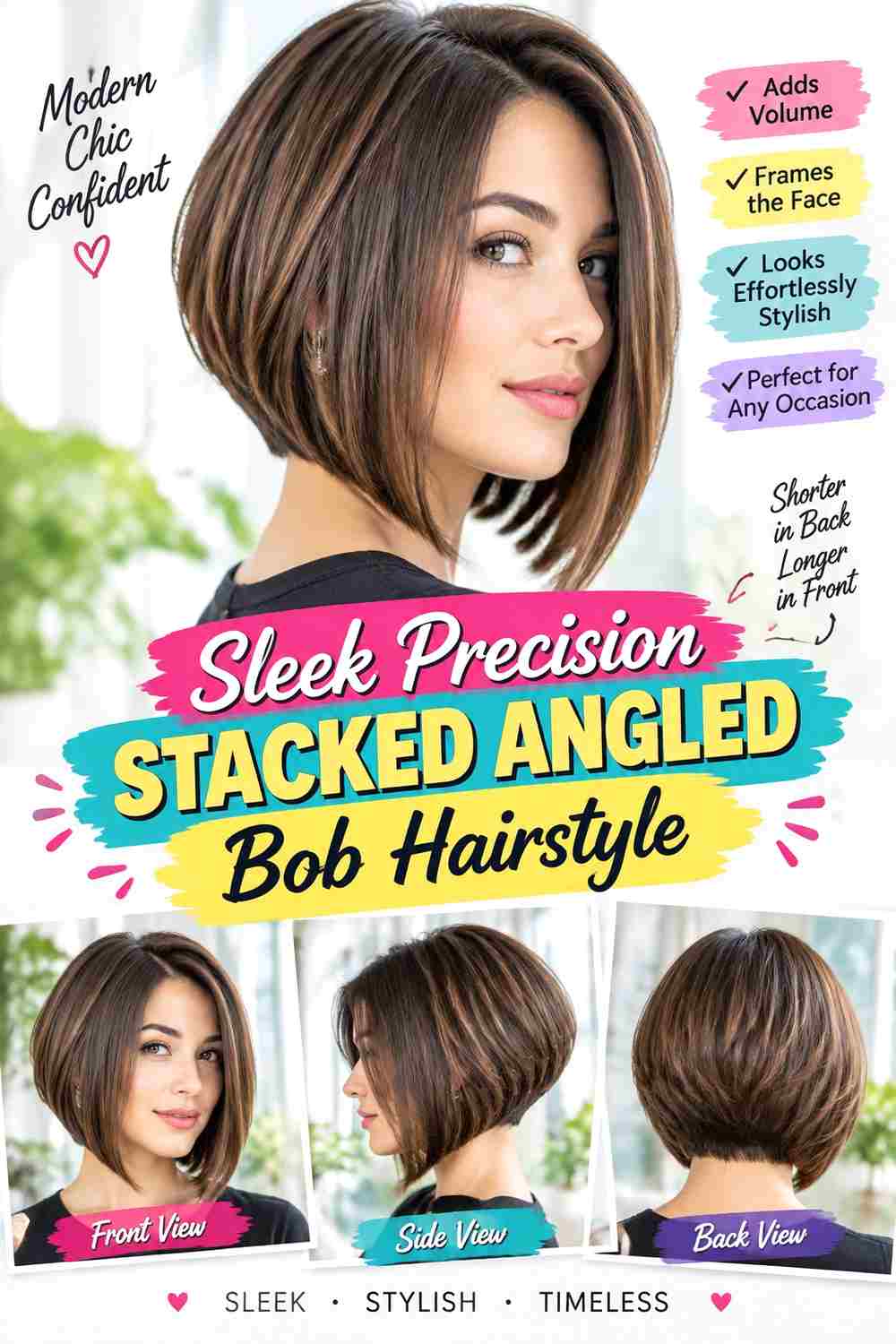
A smooth surface and sharply readable perimeter put the cutting lines at the center of this variation. The nape is neatly graduated rather than heavily feathered, the back follows a controlled rounded contour, and the front extends toward or slightly below the chin. Straighter ends and a clean center part make the diagonal especially noticeable, with minimal surface texture interrupting the line.
Naturally straight hair may need only modest smoothing, while wavy or curly textures require more styling if you want the same sleek finish. That difference matters when judging daily practicality. A heat protectant, paddle brush, and flat iron can protect before heat, create directional smoothness during drying, and refine only the sections that need extra control. Heat protection reduces risk but does not make frequent high-heat styling harmless.
A quick refresh can focus on bent ends or the front panels, whereas creating a fully straight finish after washing may take considerably longer depending on texture and density. At the salon, emphasize the perimeter weight and exact front length you want, since both make the precision angle readable. Reshaping becomes worthwhile when the nape grows beyond its clean line or the back graduation begins settling into a heavier block.
Pro tip:
After drying, refine only the visible surface and perimeter rather than automatically straightening every section again. Targeted finishing can maintain the clean outline while limiting unnecessary repeated heat through the hidden layers.
Make It Work for You:
If you prefer wearing natural waves most days, keep the angle slightly longer and less severe. You can occasionally create the precision finish without choosing proportions that depend on daily straightening to look balanced.
Watch Out For:
Avoid making the bottom edge too thin in pursuit of sharpness. A precise diagonal needs enough weight to remain visible, so ask for clean definition without sacrificing the strength of the front corners.
Subtle Stacked Angled Bob Hairstyle
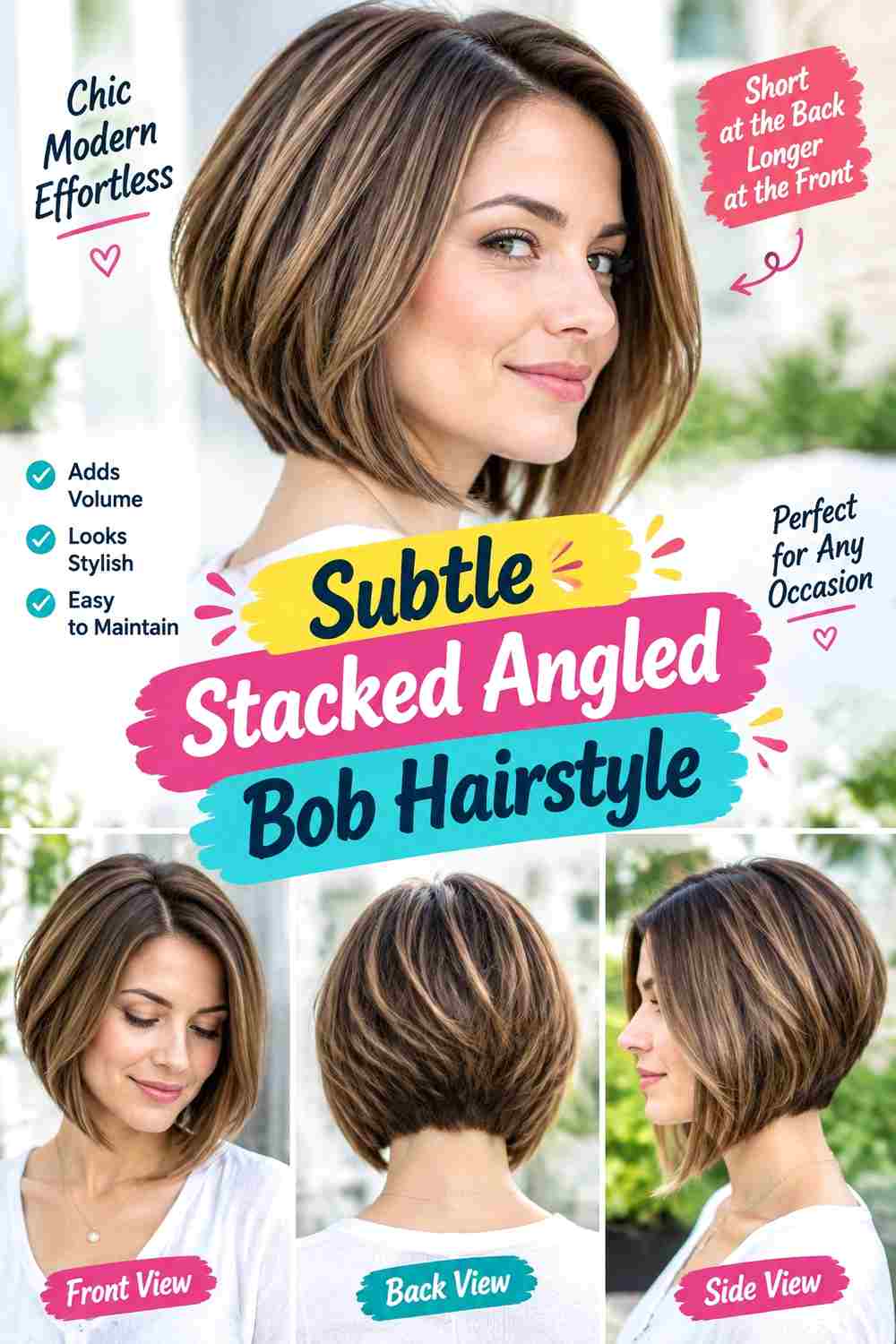
A restrained stack offers a softer route into the angled-bob family. Instead of a dramatic short nape and high rounded back, the graduation stays low and blends gradually into front pieces that finish around the jaw or upper neck. The angle is visible from the side but does not create a large difference between front and back. Minimal layering through the top helps maintain a calm, fuller outline.
This version can be practical for readers who want easier grow-out or do not want pronounced crown volume. Straight and wavy textures can show the gentle diagonal, while lower-density hair may benefit from the retained perimeter weight. Use a heat protectant, paddle brush, and lightweight smoothing cream when blow-drying; together they protect from heat, guide the hair into its natural fall, and control surface frizz without exaggerating volume.
A short refresh may need little beyond resetting the part and smoothing the ends. Full wash-day styling remains dependent on density and natural texture but generally does not require building a dramatic back shape. Ask your stylist to keep the graduation low and clarify how much difference you want between the nape and front. Grow-out can be forgiving, though reshaping is useful when the gentle angle becomes nearly level.
Pro tip:
Let the crown fall close to its natural position during drying instead of lifting every section aggressively. The quieter root area helps the low graduation remain the defining feature rather than accidental volume.
Make It Work for You:
If you have fine strands, keep the lower edge relatively solid and place most graduation at the back. This maintains the subtle stacked effect without spreading short layers through areas where you want fullness.
Watch Out For:
Requesting “just a little stacking” can mean different things to different people. Point to the desired fullness position and front-to-back length difference so the finished graduation does not become more dramatic than expected.
Voluminous Crown Stacked Angled Bob Hairstyle
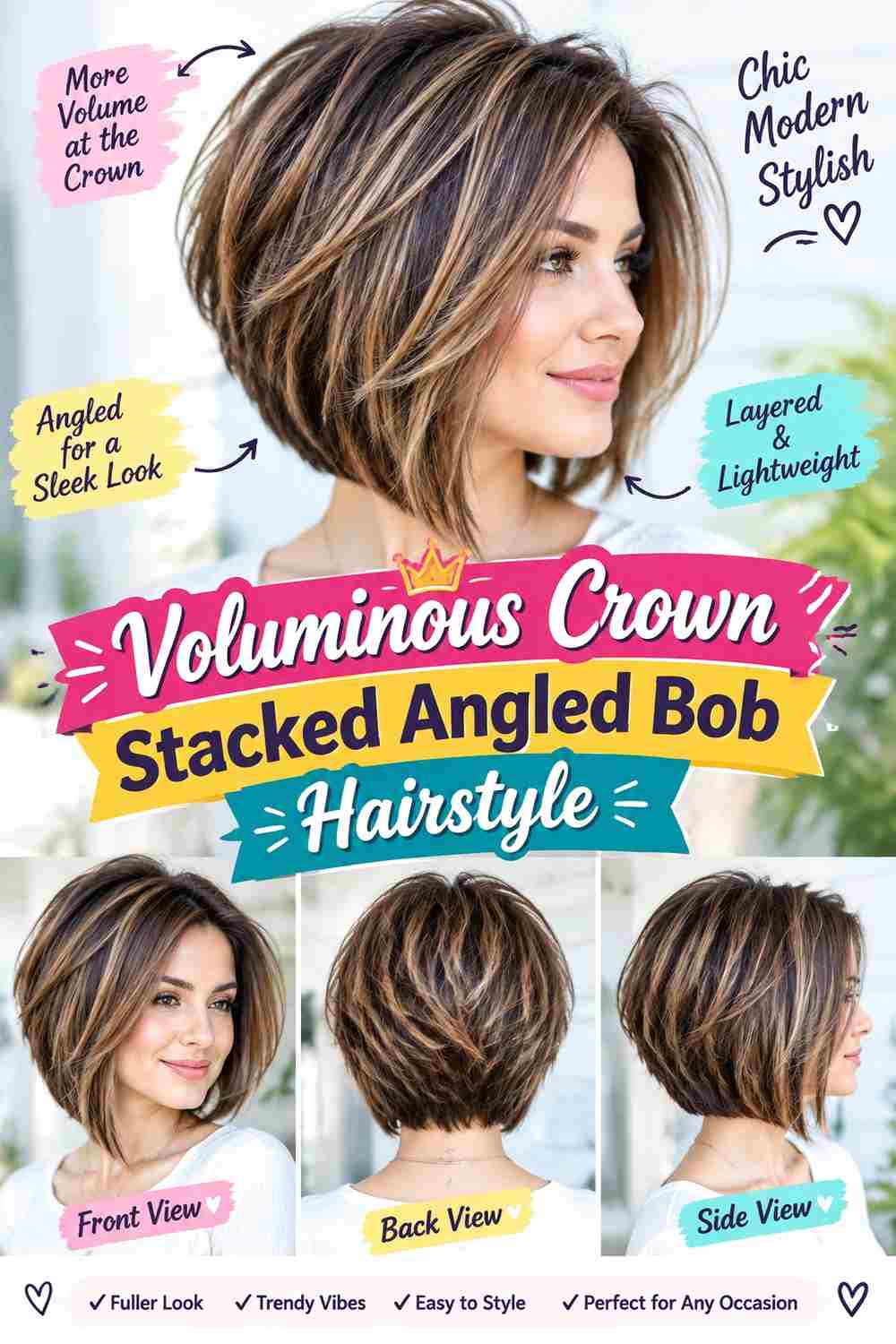
Crown lift gives the stacked shape a taller profile while the sides remain comparatively controlled. The nape is short and graduated, the upper back carries noticeable fullness, and longer front sections descend toward the chin. Rather than creating equal volume everywhere, the strongest lift stays around the crown and upper back. A side or slightly off-center part can complement that placement without hiding the forward angle.
Hair with enough density to support the upper shape may find this variation easier to maintain, although fine strands can also create lift with restrained styling. Very dense hair may need bulk assessed carefully so the crown does not become excessively wide. A root-lift spray, heat protectant, and round brush provide targeted support, heat protection, and directional shaping during the blow-dry.
Between washes, redirecting flattened crown sections can provide a relatively quick refresh. A full wash-day blowout takes longer because the roots need controlled drying before the ends are finished. Tell your stylist where you want the maximum fullness to sit rather than simply requesting “more volume.” As the cut grows, that balance can shift downward, so reshaping becomes useful when the crown no longer lifts easily and the nape starts feeling heavy.
Pro tip:
Apply root support primarily around the crown instead of coating every section. During drying, lift those roots away from their usual fall, then allow the longer surface pieces to settle naturally over the stack.
Make It Work for You:
If your hair is very dense, choose moderate crown elevation and keep the sides controlled. Strategic internal weight management can preserve the taller silhouette without creating equal expansion around the entire head.
Watch Out For:
Backcombing heavily every day can produce a stiff, uneven crown rather than controlled volume. Prioritize drying direction and appropriate graduation first, using styling support to enhance the cut instead of compensating for its balance.
Conclusion
Stacked angled bob hairstyles can range from a quiet, low graduation to a short nape with pronounced crown volume and long front corners. A straighter finish makes the perimeter and angle more obvious, while waves and curls introduce softer movement. Fringe changes the front commitment, and a side part can shift volume without altering the underlying cut. Density matters too: some hair benefits from preserving a fuller edge, while dense shapes may need carefully placed internal weight management. Consider your natural texture and how often you are willing to blow-dry, reshape waves, refresh curls, or maintain bangs. The most practical choice is the version whose length, stack, finish, and upkeep fit the way you normally wear your hair. hairstyle_human_writing_reader_…
Before Your Salon Visit
Choose one or two favorites and save clear references that show the side and back as well as the front. Explain your natural texture, density, usual part, preferred finished length, and how much styling you realistically do. Point specifically to the nape length, stack height, front angle, fringe, crown volume, or finish you want. If you like the back from one reference and the front from another, say so clearly, then discuss how those features can work with your hair and preferred upkeep.
FAQs
How often does a stacked angled bob need reshaping?
There is no single schedule for every bob because growth rate and stack height vary. A reshaping appointment becomes useful when the nape feels heavy, the rounded back drops lower than intended, or the front-to-back angle loses definition. More dramatic graduation usually shows grow-out sooner than a subtle stack.
Can fine or lower-density hair wear a stacked angled bob?
Yes, depending on the individual shape and density. A moderate stack with a fuller bottom edge can preserve visible weight better than excessive layering. Ask your stylist to assess how much graduation your hair can support rather than assuming that adding many short layers will automatically create lasting volume.
Can curly hair work with an angled stacked shape?
Yes, but the finished dry shape deserves special attention. Curl shrinkage can substantially change the apparent front length and graduation. Discuss how your curls normally settle, preserve useful curl groups, and decide the front position in its natural state instead of relying only on measurements taken while the hair is stretched.
Do stacked angled bobs require daily heat styling?
Not necessarily. The requirement depends on your natural texture and chosen finish. Straight hair may need only a quick reset, while a highly sleek result on curls can involve much more heat styling. Choosing a wavy or curly interpretation can reduce the need to force your natural texture into a different finish.