20 Baby Bangs Haircut Ideas
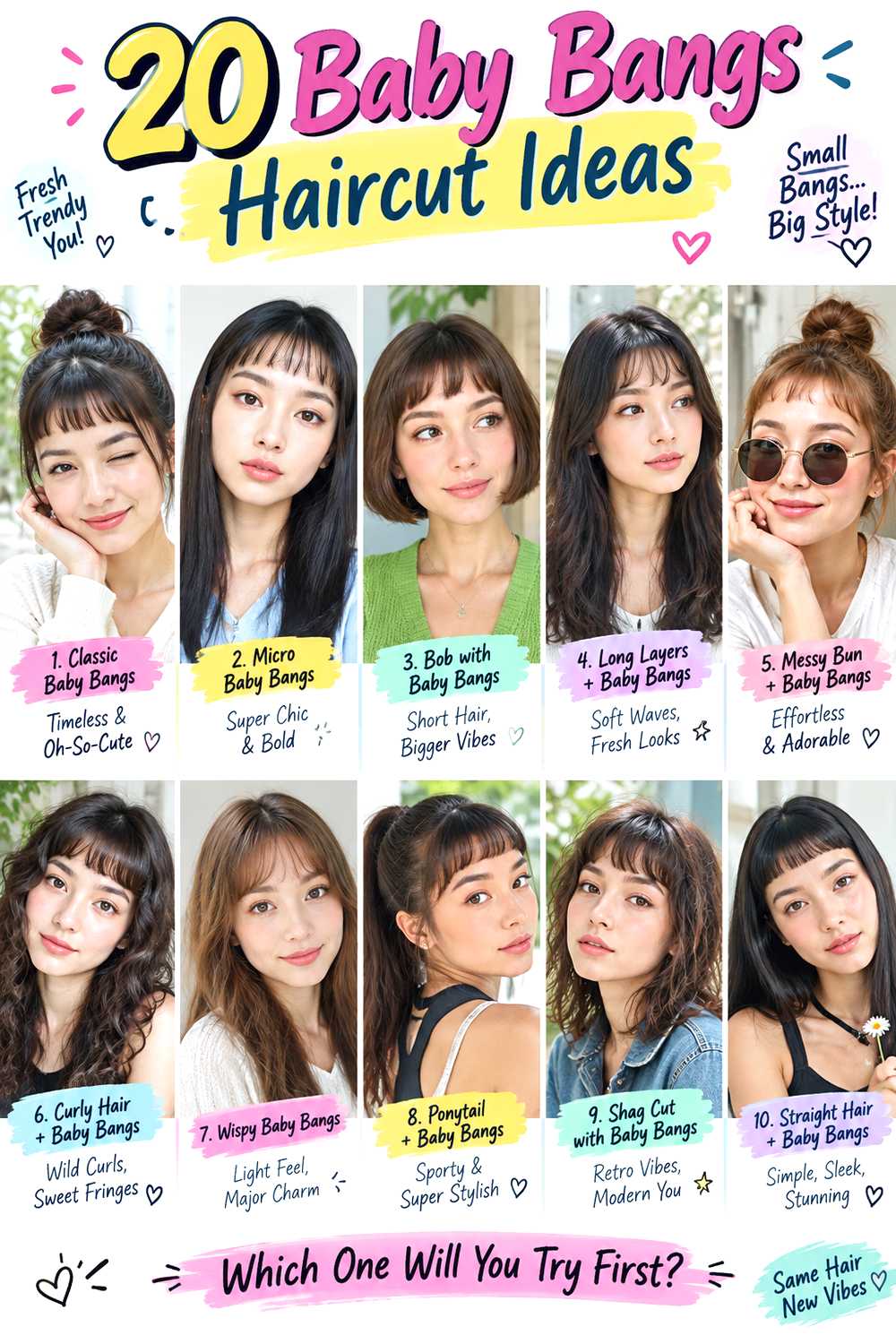
Baby bangs are a short fringe that usually finishes noticeably above the eyebrows, but the exact length, width, density, and edge can change the entire haircut. They may be cut blunt and graphic, broken into wispy pieces, curved softly across the forehead, or shaped around natural curls. Because the fringe is short, small cutting differences are easy to see. The surrounding layers, face-framing pieces, texture, and overall length therefore matter just as much as the bangs themselves.
These 20 baby bangs haircut ideas cover everything from cropped pixies and compact bobs to long layers, waves, curls, shags, and shoulder-length cuts. Fine hair often benefits from keeping enough density through the fringe and perimeter, while thick hair may need internal bulk removal. Straight textures can create a precise finish, whereas wavy and curly hair can make short bangs softer and more irregular. Fringe width and side pieces can also be adjusted for different face shapes.
Daily styling ranges from a very quick fringe refresh to a fuller blow-dry or curl routine. Baby bangs usually need attention sooner than the rest of the haircut, so consider natural growth patterns, shrinkage, humidity, heat-styling preferences, and how often you are comfortable reshaping the fringe before committing.
Quick List
- Wispy Baby Bangs
- Blunt Baby Bangs Bob
- Curly Baby Bangs
- Baby Bangs With Long Layers
- Choppy Baby Bangs Shag
- Micro Baby Bangs Pixie
- Baby Bangs With Soft Waves
- Rounded Baby Bangs Bob
- Feathered Baby Bangs
- Baby Bangs With French Bob
- Textured Baby Bangs Lob
- Baby Bangs With Curtain Layers
- Piecey Baby Bangs
- Baby Bangs With Sleek Straight Hair
- Baby Bangs With Voluminous Curls
- Asymmetrical Baby Bangs
- Baby Bangs With Wolf Cut
- Soft Arched Baby Bangs
- Baby Bangs With Shoulder-Length Layers
- Baby Bangs With Tousled Bob
Wispy Baby Bangs

Wispy baby bangs keep the fringe short without creating a heavy horizontal line. Fine sections of hair sit above the brows with tiny spaces between them, while slightly longer pieces near the temples help the fringe merge into the rest of the haircut. The lighter density works particularly well on fine to medium hair and can soften the transition into straight, gently wavy, or lightly layered lengths. Because the individual pieces matter, oily roots can make the fringe separate more than intended. Refresh it with lightweight mousse, a small round brush, and flexible hairspray rather than heavy creams. Morning styling is usually quick; concentrate on directing the fringe forward before it dries in its natural part. Short bangs may require more frequent trims than the surrounding hair. At the salon, ask for a light fringe with visible separation while preserving enough density at the temples instead of thinning the whole section.
Pro tip: Ask your stylist to cut the central pieces first and soften only selected ends; excessive thinning can make fine baby bangs disappear.
Blunt Baby Bangs Bob

A blunt bob creates a strong frame for short, straight-across baby bangs. Keeping the jaw-length or slightly shorter perimeter solid gives the haircut visual weight, while the compact fringe adds another clean line above the eyebrows. Straight and medium-density hair can hold this shape with relatively little manipulation, although thicker hair may need subtle internal bulk removal so the bob does not become triangular. A flat or slightly beveled finish shows the geometry most clearly. Use heat protectant, a paddle brush, and a flat iron for controlled ends and a smooth fringe. Styling takes moderate effort after washing but can be refreshed quickly on following days. The fringe will show growth early, so it usually needs reshaping before the main bob does. Tell your stylist you want a firm perimeter and a dense baby fringe rather than heavily textured ends; removing too much weight can weaken the graphic effect.
Pro tip: Check your preferred baby-bang length when the hair is completely dry, because even straight hair can lift slightly after tension from cutting is released.
Curly Baby Bangs

Curly baby bangs turn short fringe into a collection of compact bends and coils rather than one straight edge. The most important detail is allowing for shrinkage. Bangs that look eyebrow-length when wet can spring considerably higher as they dry, so a conservative cutting approach is useful. This shape works especially well when the rest of the haircut also respects the natural curl pattern through rounded layers or controlled face-framing. Medium and thick curly hair can support fuller fringe, while finer curls may look better with a narrower section. Styling is usually easier when the natural texture does the work: apply leave-in conditioner and curl cream, then use a diffuser if more definition is needed. Wash-day styling may take longer, but daily refreshes can be simple. At the salon, request that the fringe be assessed in its dry, naturally contracted state and that the shortest curls remain at a comfortable height above the brows.
Pro tip: Photograph your fully dried fringe on a good curl day so your stylist can see the amount of shrinkage you actually get.
Baby Bangs With Long Layers
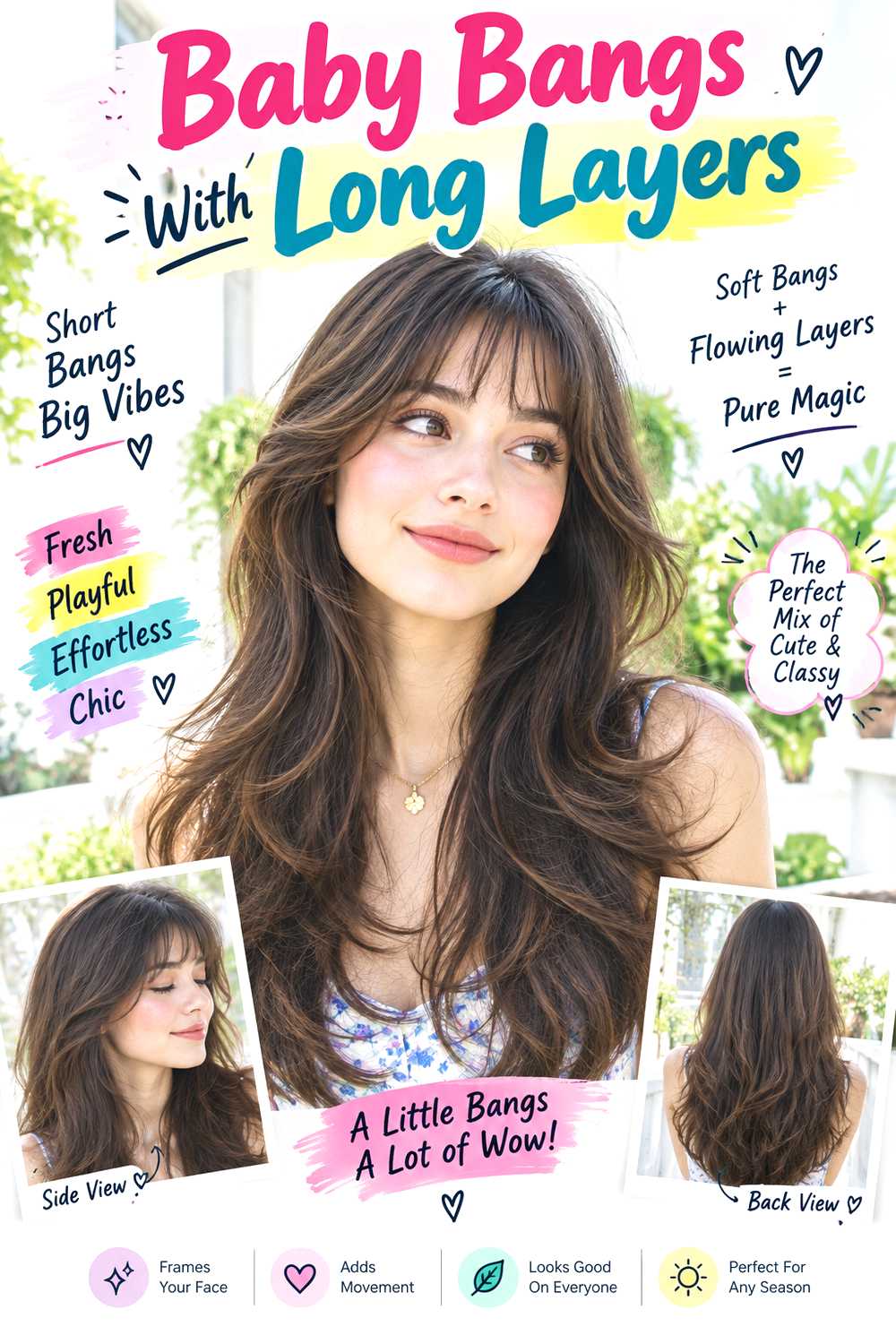
Short baby bangs create a noticeable contrast against long, flowing hair, making the front of the haircut feel defined without sacrificing length. Long layers starting below the chin or around the collarbone add movement while leaving enough density through the bottom. This combination suits medium to thick hair particularly well because the longer layers can remove excess weight without making the ends sparse. Fine hair can also wear it when the layering stays restrained. Straight and wavy textures show the contrast clearly, and loose bends can help connect the short fringe with the longer face frame. Use a volumizing spray, large round brush, and light smoothing serum for a polished blowout. Styling is moderate rather than instant because the lengths need attention as well as the fringe. Ask the salon to keep the baby bangs distinct while beginning the first longer face-framing layer well below them, avoiding an awkward staircase of short pieces.
Pro tip: Keep the face frame longer than the bangs by a clear margin; too many intermediate pieces can make the front look unintentionally choppy.
Choppy Baby Bangs Shag

A shag gives baby bangs a deliberately irregular setting. Short, uneven fringe pieces lead into lifted crown layers, textured sides, and lighter ends, creating movement instead of a neat geometric outline. Naturally wavy hair is especially suited to this haircut because bends emphasize the broken layers, though straight hair can gain similar texture with styling. Medium to thick density gives the layers enough material to work with; very fine hair usually needs less aggressive removal around the perimeter. A texturizing spray, lightweight mousse, and diffuser or blow-dryer attachment can build separation without forcing every strand into place. Styling is fairly quick when natural texture already exists, while straighter hair may need extra scrunching or bending. Maintenance focuses on reshaping the crown before it becomes heavy and keeping the fringe intentionally choppy. Tell your stylist where you want the shortest crown layer and ask them to preserve enough fullness at the ends.
Pro tip: Instead of curling every section, bend a few random mid-length pieces in alternating directions to keep the shag from looking too polished.
Micro Baby Bangs Pixie

Micro baby bangs sit very high on the forehead and pair naturally with a cropped pixie because both elements depend on precise proportions. The fringe may be only a few centimeters long, with close sides and slightly more texture through the crown for balance. Straight, slightly wavy, and fine-to-medium hair often makes daily styling simple, while very thick hair may need internal removal so the top does not feel bulky. Because so much of the hairline is visible, cowlicks and growth direction should be discussed before cutting. A small amount of styling paste, lightweight root spray, and a fine-tooth comb are enough for most mornings, making the routine quick. The trade-off is frequent shape maintenance as both the fringe and short sides grow noticeably. Ask your stylist to map the natural hairline first and decide how much softness to leave along the edge rather than automatically cutting a severe straight line.
Pro tip: If you have a strong front cowlick, keep a little extra length in that spot so the fringe settles rather than standing upright.
Baby Bangs With Soft Waves

Soft waves balance the sharper visual break of baby bangs by adding relaxed movement through the mid-lengths and ends. The fringe can remain fairly straight or carry a slight bend, while broad waves begin around the cheekbones or lower so the hair does not become overly wide near the temples. Medium-density straight or wavy hair is particularly easy to adapt to this shape, although fine hair can benefit from keeping the ends fuller. Heat protectant, a large-barrel curling iron, and a wide-tooth comb help create loose bends rather than tight curls. Styling takes moderate time on wash day, but the waves are easy to refresh by reworking only the front sections. Bang trims will usually be needed sooner than layer maintenance. At the salon, ask for a short fringe with softly broken ends and long layers that support broad movement without taking excessive weight from the perimeter.
Pro tip: Curl the two front wave sections slightly away from the face, then loosen them once cool so they connect naturally with the short fringe.
Rounded Baby Bangs Bob

A rounded bob replaces the sharp edge of a blunt cut with a softer, curved silhouette. Baby bangs follow that idea by bending gently across the forehead, often sitting slightly longer near the outer corners. The bob itself can finish around the jaw with controlled fullness through the sides and ends that turn subtly inward. Straight to lightly wavy hair is easiest to shape this way, and medium or thicker density provides enough weight for the rounded outline. Fine hair can still work if the stylist avoids too much graduation. For home styling, use heat protectant, a medium round brush, and a lightweight anti-frizz cream. The blow-dry requires moderate effort because both the fringe and perimeter need direction. Humidity may loosen the smooth curve, so a quick fringe refresh can help. Ask your stylist for soft graduation through the lower bob while keeping the outer perimeter visibly full.
Pro tip: Blow-dry the baby bangs from side to side first, then curve them lightly under; starting with a strong round-brush bend can make them look too rolled.
Feathered Baby Bangs

Feathered baby bangs are short but intentionally softened at the ends, so the fringe moves rather than sitting as one solid block. Slightly longer outer pieces can angle toward the temples, creating an easier transition into face-framing layers. Fine and medium-density hair can carry this shape without losing too much fullness, and straight or gently wavy textures reveal the feathering clearly. Thick hair may need careful debulking within the fringe, but over-thinning can make the pieces stick out. A small round brush, lightweight mousse, and dry texturizing spray provide enough lift and separation without making the fringe stiff. Styling is quick once the growth direction is controlled, usually requiring most attention immediately after washing or sleeping. Plan to reshape the fringe when its airy edge starts dropping toward the brows. In the salon, request point-softened ends with a little more length at both corners rather than a uniformly blunt micro fringe.
Pro tip: Direct the outer fringe pieces slightly toward the temples while blow-drying; this keeps the short center airy and makes the sides blend more naturally.
Baby Bangs With French Bob

The French bob and baby bangs share a compact shape that makes the combination feel intentional. The bob usually sits around the jaw or chin, while the fringe finishes clearly above the brows and may have a slightly imperfect, natural edge. A subtle bend through the lengths prevents the cut from looking too rigid. Straight and wavy hair can both work well, especially at medium density; thick hair may need hidden weight removal without thinning the visible perimeter. Fine hair often benefits from the short length because the ends remain concentrated. Use a light styling cream, small round brush, and flexible hairspray to control the fringe while leaving the bob softly movable. Styling can be quick if your natural texture already has a bend. The fringe will need more frequent attention than the main cut. Ask the stylist to keep the bob one-length or minimally layered and maintain weight around the jaw.
Pro tip: Save a reference photo showing both the exact jaw-length perimeter and fringe height; changing either measurement can noticeably alter the French-bob proportion.
Textured Baby Bangs Lob

A lob gives baby bangs more breathing room by extending the main haircut to the collarbone or just above it. Lightly textured ends and subtle layers add movement through the middle without turning the haircut into a shag. The short fringe becomes the strongest detail at the front, especially when its ends are softly separated rather than perfectly blunt. Medium to thick hair handles the textured shape well, while fine hair should keep extra weight through the lower perimeter. Straight hair can be bent with heat, and naturally wavy hair may need little more than product. Try sea-salt or texturizing spray, heat protectant, and a flat iron used for loose bends. Styling is moderate, but second-day refreshes are easy. When the lob begins to feel heavy, layer reshaping restores movement. At the salon, ask for internal texture through the mid-lengths while keeping the collarbone perimeter substantial and the fringe visibly short.
Pro tip: Create bends in alternating directions and leave the last inch of the ends straighter; that detail keeps a textured lob from turning into uniform curls.
Baby Bangs With Curtain Layers

Baby bangs and curtain layers use two very different lengths at the front, which makes their placement important. The short fringe sits above the brows, while longer face-framing sections sweep away near the cheekbones or jaw instead of blending immediately into the bangs. That separation creates a clear, layered frame without requiring a traditional curtain fringe. Medium or thick hair offers enough density to support both zones, though fine hair can wear the idea with a narrower baby-bang section. Straight and wavy textures are easiest to direct. A root-lifting spray, medium round brush, and light hairspray help the longer pieces sweep outward while the short fringe stays controlled. Expect moderate styling effort, mainly around the front. Grow-out is manageable because the side layers already provide transition points. Tell your stylist to preserve density around the temples and begin the curtain-like face frame well below the baby bangs.
Pro tip: Point out the gap you want between the shortest fringe and cheekbone layer in your reference photo; that spacing keeps the cut intentional rather than disconnected.
Piecey Baby Bangs

Piecey baby bangs are designed to separate into small, visible sections, giving a short fringe more texture than a smooth blunt edge. The effect works with bobs, pixies, and medium lengths, but it is especially useful when you prefer a casual finish that does not require every hair to sit perfectly. Straight and slightly wavy textures show the individual pieces well. Fine hair needs very little product, while medium or thicker fringe may need selective texturizing so it separates instead of forming one dense block. Use a tiny amount of matte paste, a fine-tooth comb, and light dry shampoo for grip. Daily styling is quick, although the fringe may need resetting after sleep. Avoid heavy oils close to the forehead because they can collapse the definition. Ask your stylist to create separation at the ends while retaining density closer to the roots, rather than thinning the whole fringe from top to bottom.
Pro tip: Warm a pinhead amount of paste between your fingertips and touch only the final half-inch of selected pieces to avoid greasy, stringy bangs.
Baby Bangs With Sleek Straight Hair
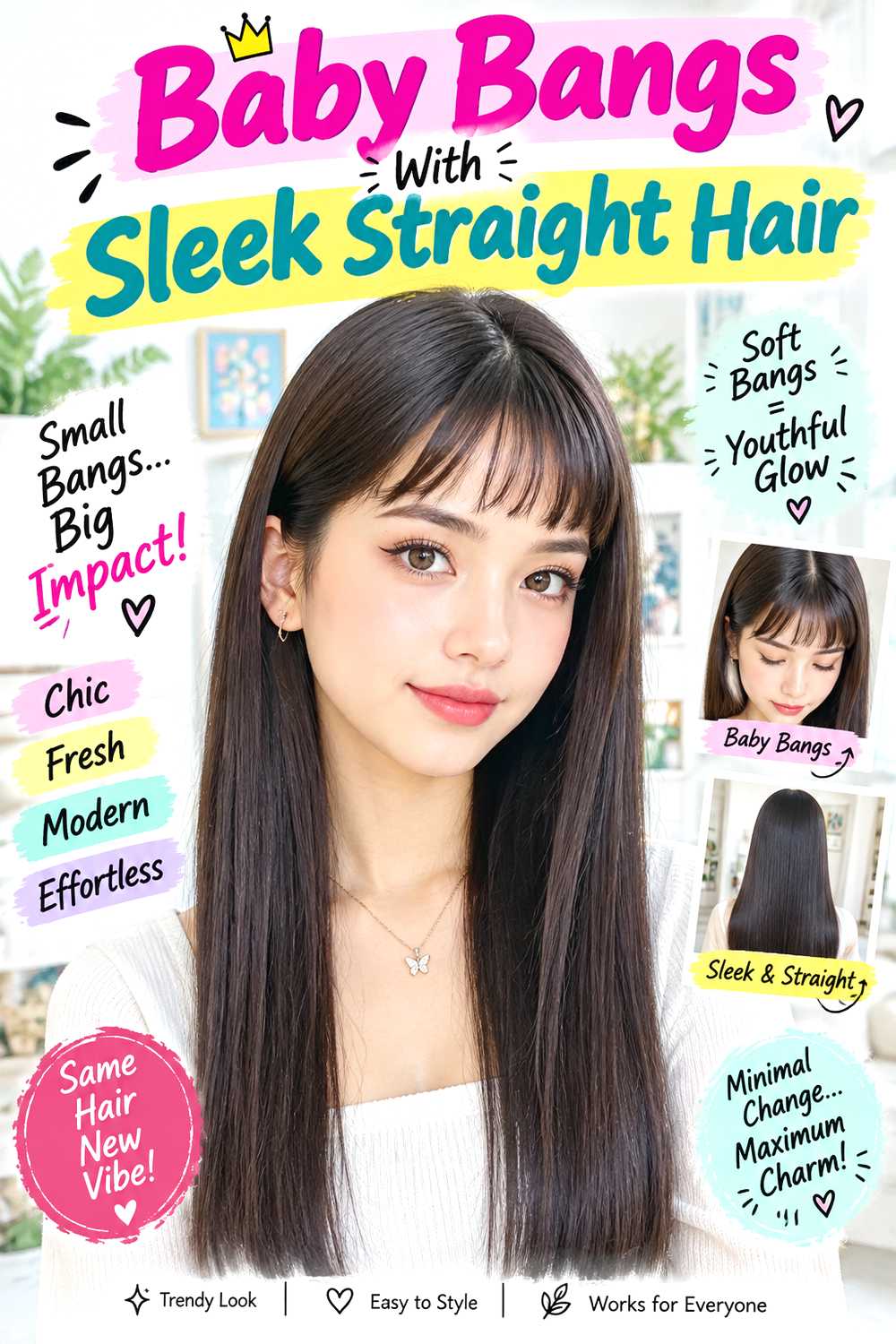
Sleek straight lengths place all the attention on the exact outline of baby bangs, so precision becomes the defining feature. The fringe can be blunt or very lightly softened, while the rest of the hair falls in a smooth line with minimal visible layering. This combination works naturally on straight hair and can also be created on wavy textures that tolerate regular heat styling. Fine to medium density keeps the silhouette light, whereas thick hair may need discreet internal weight removal so the lengths lie flatter. Heat protectant, a paddle brush, and a flat iron are the most useful tools, with styling ranging from quick on naturally straight hair to more time-consuming on textured hair. Humidity control matters because flyaways are more visible against a polished finish. At the salon, request a clean fringe line and minimal surface layering, keeping any bulk removal hidden underneath the outer shape.
Pro tip: Straighten the fringe with minimal passes and low tension; repeatedly clamping very short bangs can make them stick rigidly away from the forehead.
Baby Bangs With Voluminous Curls
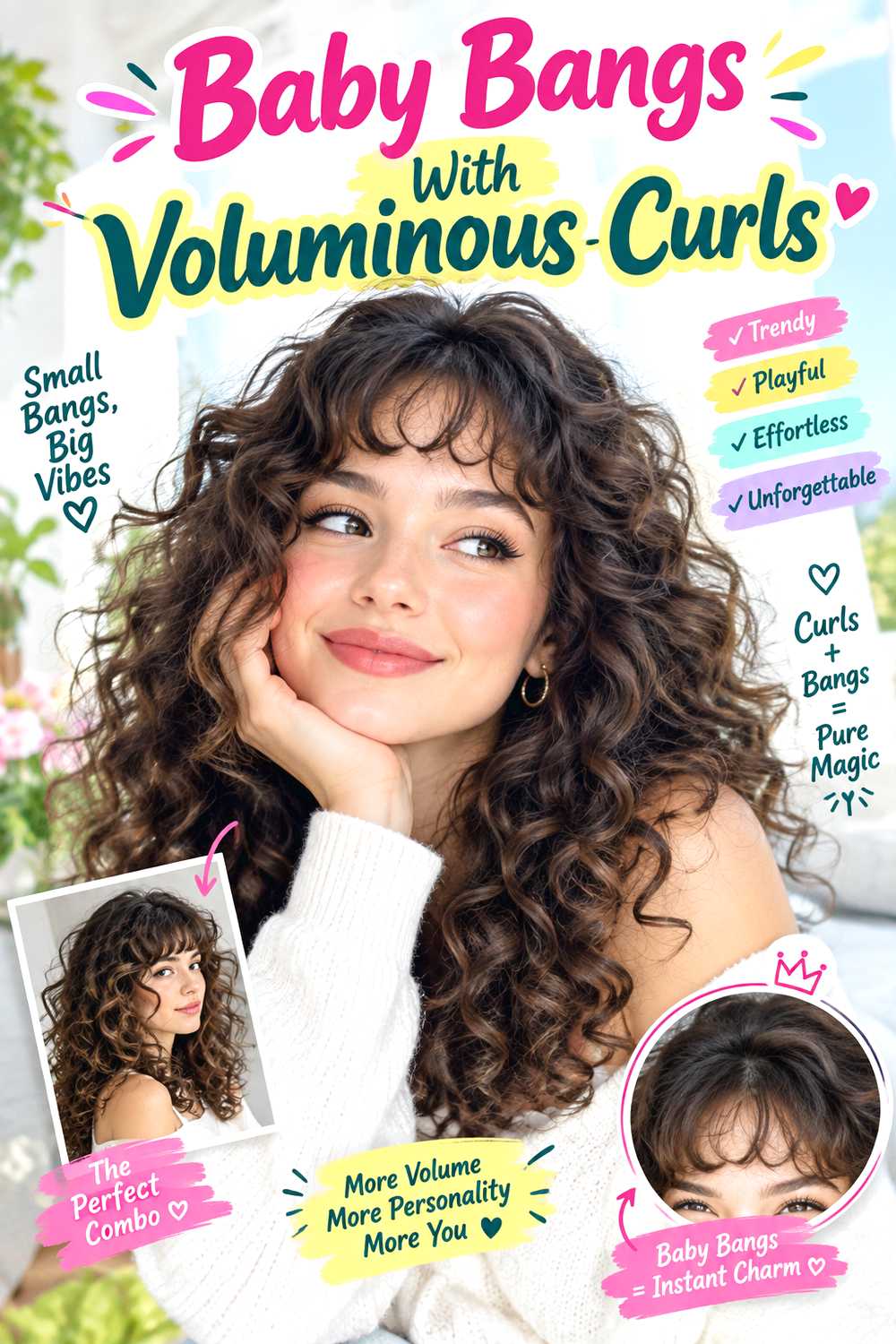
Full curls give baby bangs a rounded, dimensional setting rather than a flat frame. Short curls at the forehead can sit above the brows while progressively longer curls build width through the sides and volume around the crown. The shape works especially well for naturally curly, medium-to-thick hair because there is enough density to maintain a full silhouette. Fine curls can use fewer layers to preserve body. Styling usually takes more time on wash day but less effort afterward when the curl pattern is properly set. Apply leave-in conditioner and curl cream, then diffuse with controlled airflow to reduce frizz while encouraging root lift. A salon reshaping becomes useful when the outer form starts losing balance even if individual curls remain healthy. Ask the stylist to cut with shrinkage in mind and remove bulk selectively from the interior rather than thinning the visible curl ends.
Pro tip: Diffuse the roots before repeatedly touching the fringe; handling short curls while they are still wet can break up clumps and create unnecessary frizz.
Asymmetrical Baby Bangs

Asymmetrical baby bangs replace a level fringe line with a deliberate angle, moving from shorter on one side to slightly longer on the other. The rest of the haircut can stay simple—a bob, lob, pixie, or straight medium length—so the fringe remains the main design feature. Straight and mildly wavy hair shows the angle most clearly, while strong curls can soften it enough that the asymmetry becomes less obvious. Medium density offers good control without making the short edge too bulky. Styling requires little time: use heat protectant, a mini flat iron, and flexible hairspray to maintain the direction when needed. Because the line is intentional, uneven growth can change its proportions relatively quickly. Ask the stylist to establish the highest and lowest points before cutting and make sure the longer corner connects cleanly with the temple area instead of ending abruptly.
Pro tip: Decide which side should be shortest according to your natural growth pattern; working with the hair’s direction usually makes the angle easier to maintain.
Baby Bangs With Wolf Cut
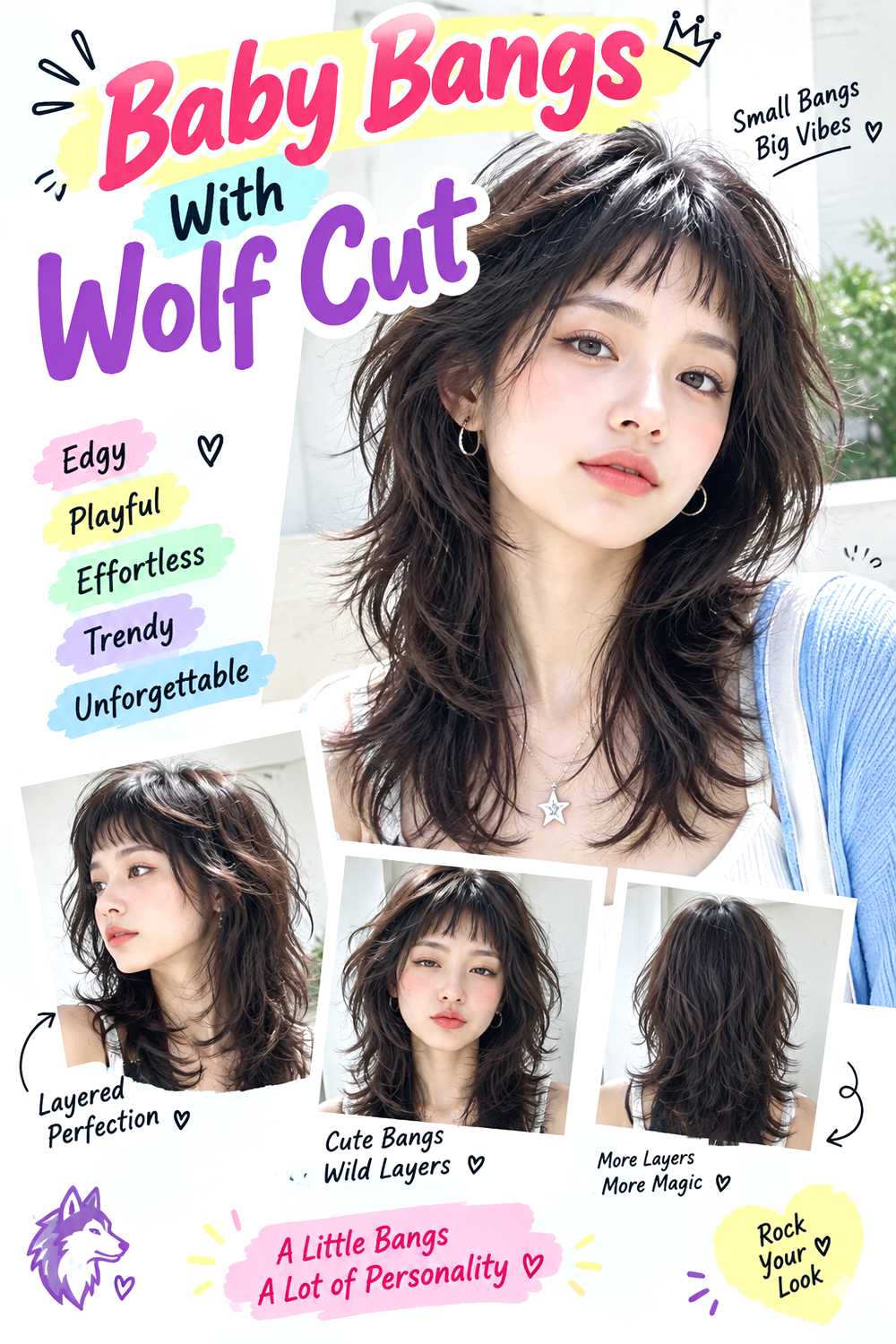
A wolf cut gives short baby bangs a heavily layered background, with volume concentrated near the crown and lighter, narrower lengths below. The fringe can be choppy or softly broken, connecting visually to short layers around the temples without fully disappearing into them. Wavy and medium-to-thick hair often brings out the shape with the least styling, while straight hair may need extra texture to show the separation. Very fine hair benefits from a gentler version so the lower lengths do not become sparse. Use lightweight mousse, texturizing spray, and a diffuser or blow-dryer to encourage lift at the roots. Styling is moderate on wash day and usually easy to refresh afterward. The cut needs reshaping when crown layers collapse or the bottom loses its tapered contrast. At the salon, specify how short you want the crown and ask that enough density remain through the lower perimeter.
Pro tip: Concentrate volume at the crown rather than the sides; too much side width can hide the tapered outline that distinguishes the wolf cut.
Soft Arched Baby Bangs
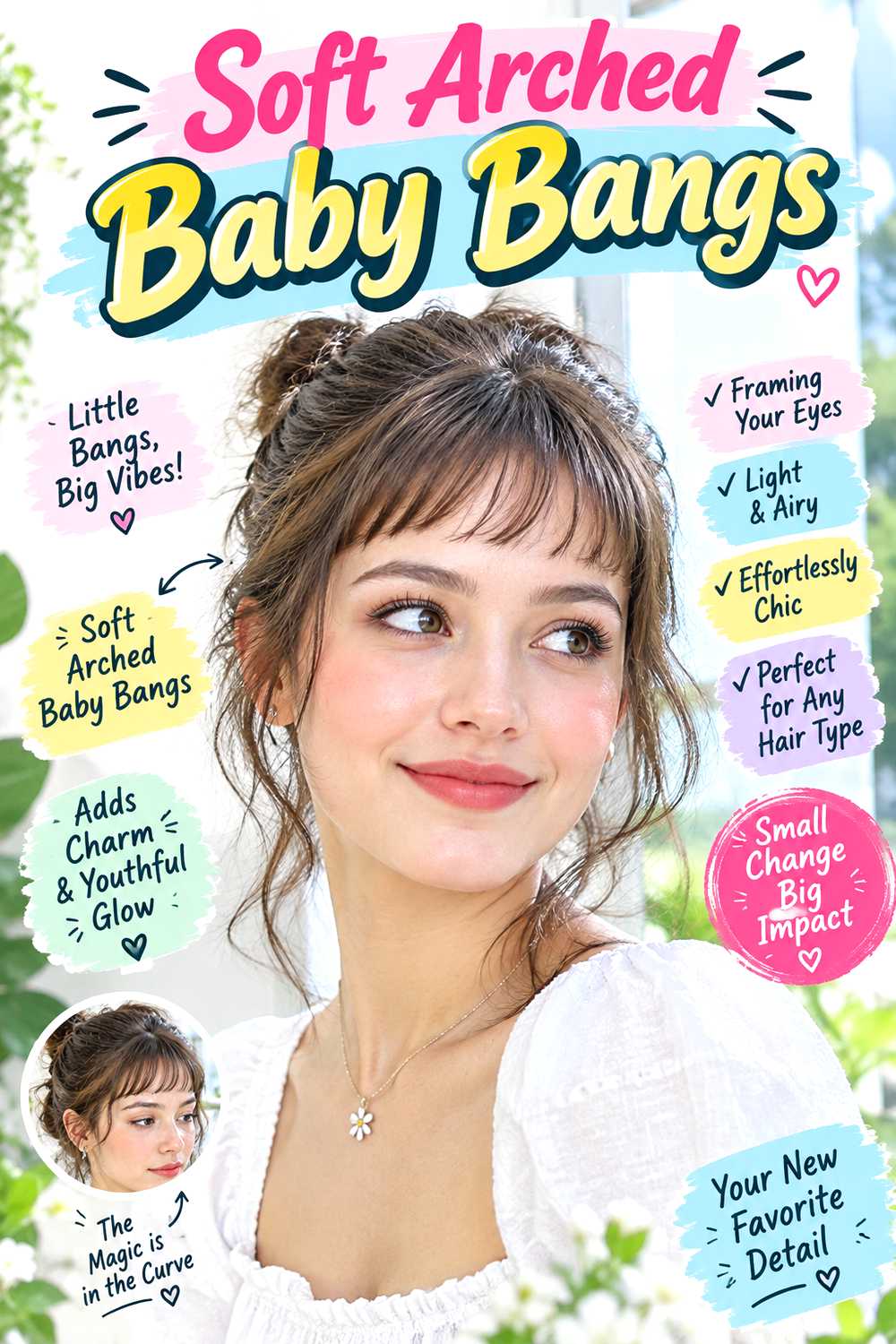
Soft arched baby bangs sit shortest near the center and become slightly longer toward the outer forehead, creating a gentle curve instead of a straight line. That subtle change can make a short fringe easier to blend with temple pieces and face-framing layers. Straight to lightly wavy hair displays the arch clearly, and medium density provides enough fullness for a smooth outline. Fine hair can wear it too, as long as the fringe section is not cut excessively wide. A small round brush, lightweight smoothing cream, and flexible hairspray are useful for keeping the curve controlled without creating a rolled-under effect. Styling is generally quick, with the front requiring only a few minutes after washing. Because the curved proportions matter, home trimming can easily flatten the arch. Ask the stylist to keep the center visibly short while preserving extra length toward both corners and avoiding aggressive thinning.
Pro tip: When blow-drying, direct the fringe downward first and shape only the outer corners; curling the entire section under can exaggerate the arch too much.
Baby Bangs With Shoulder-Length Layers

Shoulder-length hair gives baby bangs a balanced middle ground between a compact bob and long layered lengths. The fringe remains short and noticeable, while layers around the cheekbones, jaw, or lower sections can add movement without removing too much perimeter weight. Medium-density straight or wavy hair adapts easily to this shape, and thick hair may benefit from internal bulk removal around the shoulders where hair can otherwise widen. Fine hair should keep the lower layers restrained for fuller-looking ends. Use heat protectant, a medium round brush, and volumizing spray to shape the front and create movement through the lengths. Styling effort is moderate, although natural waves can reduce heat time. Layer reshaping is usually less frequent than fringe trims. Tell your stylist exactly where the first face-framing layer should begin and request a solid enough shoulder-length baseline to keep the haircut from becoming wispy.
Pro tip: If your hair tends to flip at the shoulders, ask for layer placement that works with that bend rather than fighting it with a very blunt, heavy edge.
Baby Bangs With Tousled Bob
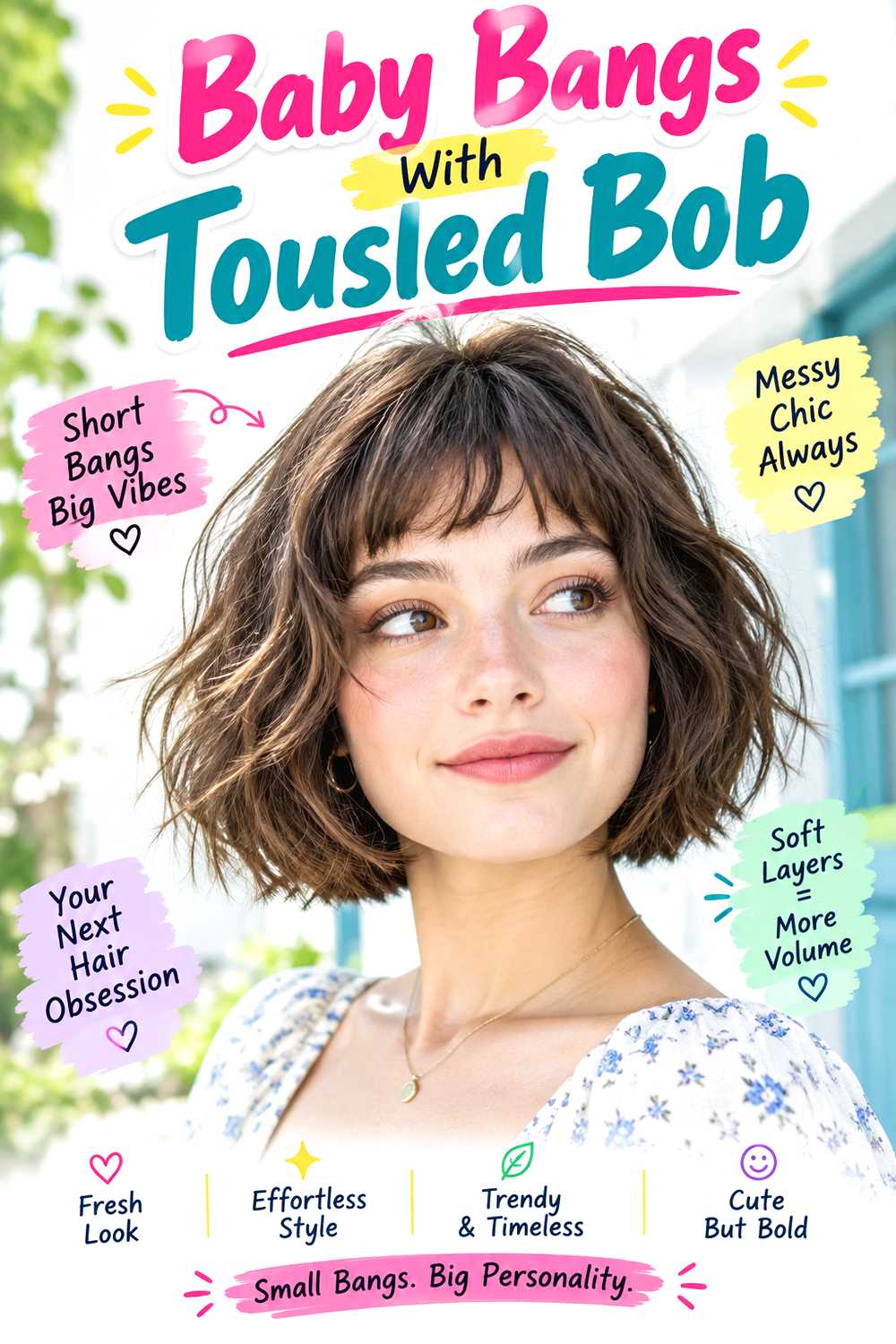
A tousled bob makes baby bangs feel less precise by pairing them with loose bends, slightly irregular texture, and an airy finish through the ends. The bob can sit anywhere from cheekbone to jaw length, while the fringe remains clearly above the brows and lightly separated. Naturally wavy hair can reach the finish with minimal heat, and straight hair can imitate it with a few strategically placed bends. Medium density works especially well; fine hair should avoid excessive texturizing, while thick hair may need hidden weight removal. Use lightweight mousse, a flat iron for relaxed bends, and dry texture spray for separation. The routine is moderate after washing and easy to refresh because the shape does not depend on uniform curls. Ask your stylist for soft internal movement while keeping visible density through the bob’s perimeter and leaving the baby bangs slightly imperfect rather than razor-thin.
Pro tip: Refresh only two or three flattened sections the next morning instead of restyling the entire bob; varied bends make the tousled texture look more natural.
Conclusion
Baby bangs can change dramatically depending on how short, wide, dense, blunt, curved, or textured the fringe is. Pairing them with a pixie creates a compact shape, while bobs emphasize the fringe outline and longer layers provide stronger contrast. Waves, curls, feathered ends, crown volume, and face-framing can further soften or strengthen the effect. Among these baby bangs haircut ideas, the best choice depends on your natural texture, density, face shape, preferred length, and how much styling and fringe maintenance you want to handle. Before choosing a cut, focus on the details you actually want to copy: fringe height, side length, layer placement, perimeter weight, parting, volume, and finish. Those specifics are far more useful than choosing by haircut name alone.
CTA
Choose one or two favorite ideas and save clear photos that show the haircut from the front and side. When you visit your stylist, discuss your face shape, natural texture, hair density, preferred length, maintenance tolerance, and normal styling routine. Point out the exact baby-bang height, fringe density, layers, face-framing position, volume, perimeter, or finish you like so the reference can be adapted to your own hair rather than copied without adjustment.
FAQs
How often do baby bangs usually need trimming?
Because they are already short, even a small amount of growth is noticeable. Many people need fringe maintenance sooner than the rest of the haircut, especially when keeping a precise blunt or micro length.
Can baby bangs work with curly or wavy hair?
Yes. Wavy and curly baby bangs can look soft and textured, but the stylist should account for shrinkage and natural curl direction. Cutting them too short while wet can leave the dried fringe much higher than expected.
Are baby bangs suitable for fine hair?
Fine hair can wear baby bangs, especially with a narrower or wispy fringe section. Avoid excessive thinning, since removing too much density can leave the short pieces looking sparse.
Do baby bangs require daily heat styling?
Not always. Straight hair may need only a quick blow-dry, while natural waves and curls can often be styled with their existing texture. Cowlicks or strong growth patterns may require a short morning refresh even when the rest of the hair is left natural.