18 Cloud Bangs Hairstyles For Fall 2026
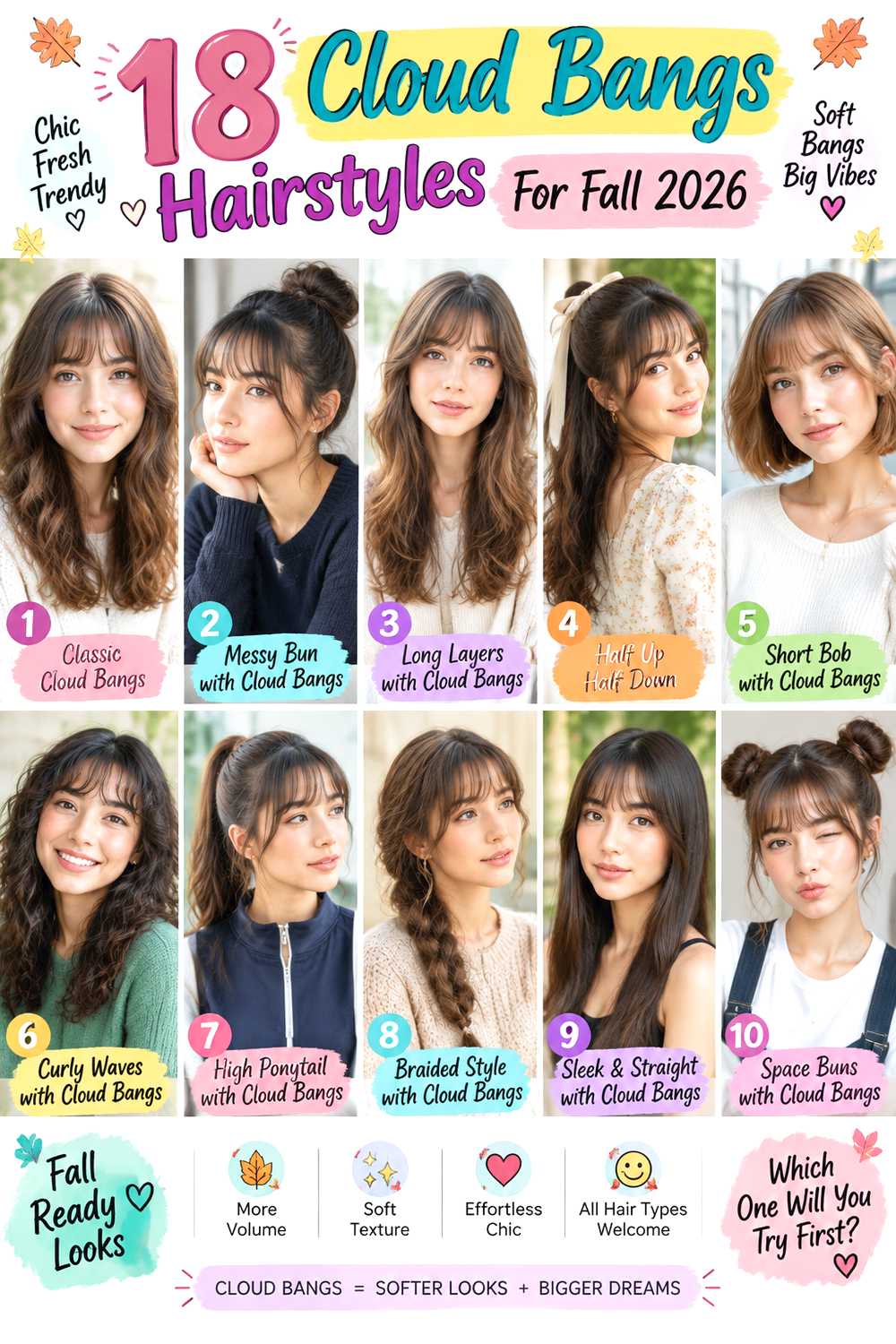
Cloud bangs are a soft, airy type of fringe designed to frame the forehead without forming a heavy, solid line. The shape usually combines light layering, curved edges, and enough movement for individual strands to separate naturally. Some versions sit near the brows, while longer cloud bangs blend into cheekbone-length pieces. That flexibility makes cloud bangs hairstyles for Fall 2026 easy to pair with bobs, lobs, long layers, waves, curls, and shag-inspired cuts.
The result depends heavily on hair texture and density. Fine hair often benefits from a lighter section so the fringe does not steal too much fullness from the rest of the haircut. Medium and thick hair can support a fuller cloud shape, although excess weight may need to be removed. Straight and wavy textures are usually straightforward to shape, while curls need to be cut with shrinkage and natural movement in mind. Length and side pieces can also be adjusted for oval, round, square, heart, and longer face shapes.
Most cloud bangs need light daily reshaping rather than complicated styling. A quick blow-dry at the roots may be enough, though humidity and strong growth patterns can change how the fringe sits. Before committing, consider how often you want trims, whether you use heat, and how much forehead coverage feels comfortable.
Quick List
- Soft Wispy Cloud Bangs
- Curtain Cloud Bangs
- Bottleneck Cloud Bangs
- Feathered Cloud Bangs
- Rounded Cloud Bangs
- Piecey Cloud Bangs
- Long Cloud Bangs
- Short Airy Cloud Bangs
- Side-Swept Cloud Bangs
- Layered Cloud Bangs With Lob
- Cloud Bangs With Long Layers
- Cloud Bangs With Soft Waves
- Cloud Bangs With Shag Layers
- Cloud Bangs With Bob
- Cloud Bangs For Curly Hair
- Cloud Bangs For Fine Hair
- Thick Cloud Bangs With Tapered Ends
- Center-Parted Cloud Bangs
Soft Wispy Cloud Bangs

Soft wispy cloud bangs create a barely-there fringe with fine pieces crossing the forehead and slightly longer sections near the temples. Keeping the center light prevents the bangs from looking blocky, while delicate side pieces make the transition into the haircut smoother. This approach works especially well on straight or softly wavy fine-to-medium hair and can be useful for anyone who wants bangs without a dense curtain across the forehead. Oval and heart-shaped faces can wear the shape easily, while longer side pieces can help adjust it for rounder or squarer faces. Styling is generally quick: dampen the fringe, direct the roots forward with a small round brush, and let the ends separate naturally. A lightweight mousse, heat protectant, and light-hold hairspray are enough for most days. Small fringe trims may be needed as the center reaches the eyes. At the salon, request a shallow bang section with soft, lightly textured edges rather than aggressive thinning.
Pro tip: Keep the shortest wisps around brow level and leave slightly more density at the sides so the fringe grows out without developing a noticeable gap.
Curtain Cloud Bangs
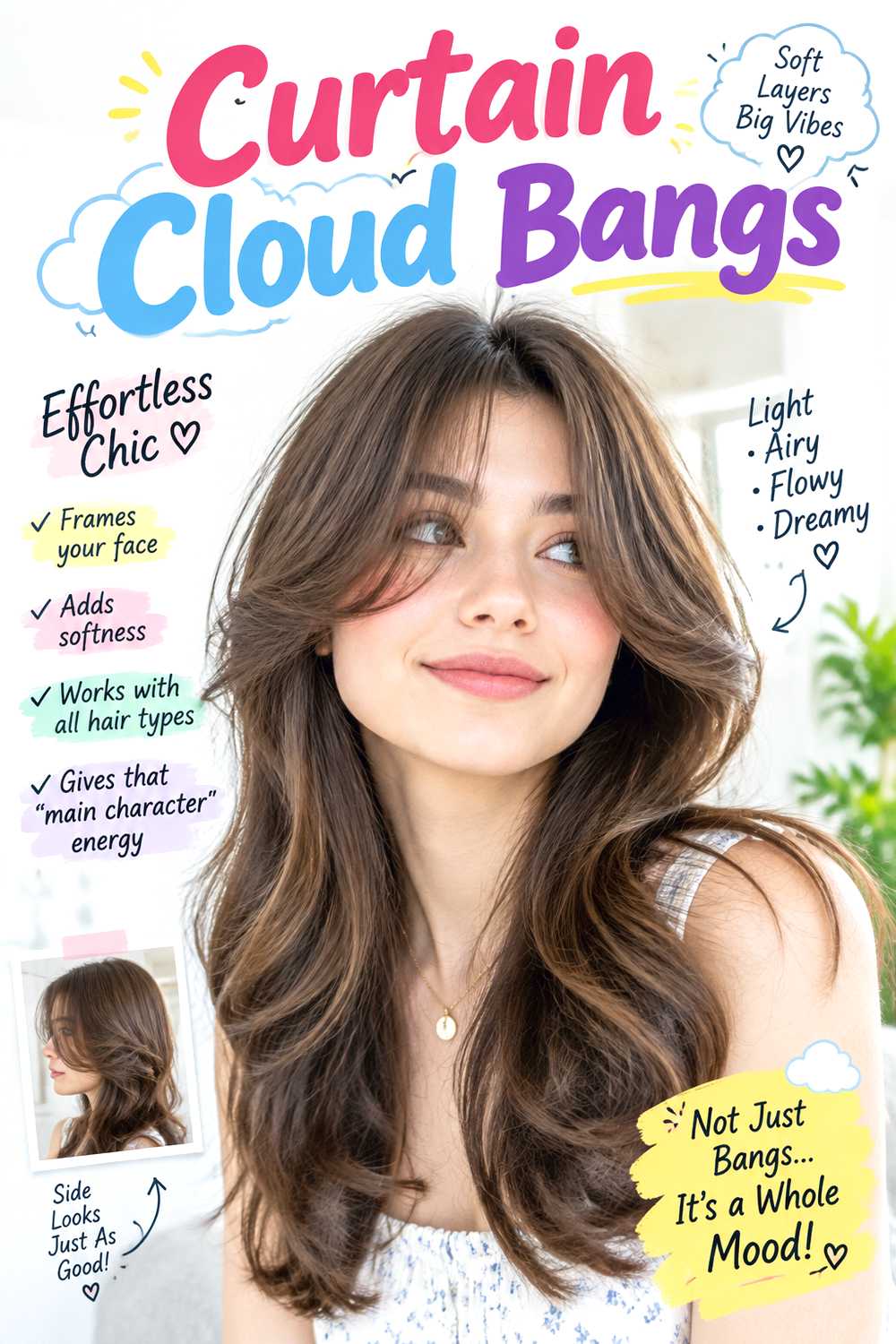
Curtain cloud bangs combine the airy finish of cloud fringe with a soft center opening. Instead of forming a sharply divided curtain, the middle remains loose and feathered, with the longest pieces sweeping toward the cheekbones. Medium-length and long hair suit this shape particularly well because the side sections have space to blend into face-framing layers. It can also soften the transition into a lob. Straight, wavy, and lightly curly textures are workable, while medium density gives enough hair for movement without making the center too heavy. Styling takes a moderate few minutes after washing. Apply heat protectant, lift the roots with a round brush, then direct each side slightly away from the face. A volumizing spray can add enough support without creating stiffness. Regular trims help keep the central pieces out of the eyes, although this fringe grows into face framing more gracefully than very short bangs. Ask your stylist for a soft center opening rather than two sharply separated sections.
Pro tip: Have the outer pieces finish close to the cheekbones rather than the temples if you want the bangs to blend naturally into longer front layers.
Bottleneck Cloud Bangs

Bottleneck cloud bangs are narrower and shorter through the center, then gradually widen and lengthen around the sides of the face. The curved outline resembles a bottleneck, but airy ends keep the fringe from becoming too dense. This combination can work well for medium or thick straight and wavy hair because there is enough density to create the graduation while still allowing texture to be removed where needed. The longer corners are useful for balancing wider cheek areas or adding softness around a square jaw. Daily styling is moderate rather than demanding. Start with a leave-in conditioner on the longer pieces, use a small round brush to curve the center gently, and finish with texturizing spray through the outer sections. The center may need a trim sooner than the sides, often whenever it begins touching the lashes. Show your stylist where you want the shortest point to land and ask for a gradual transition rather than a sudden jump in length.
Pro tip: Keep the center slightly longer than a traditional short fringe if your hair develops strong bends or cowlicks when it dries.
Feathered Cloud Bangs

Feathered cloud bangs use light graduation through the fringe so the ends sweep in different directions rather than sitting in one straight line. The center can skim the brows while longer sections flick softly toward the temples, creating movement that works especially well with layered shoulder-length or long hair. Medium-density straight or wavy textures tend to hold this feathered shape well. Thick hair can also work when internal bulk is reduced carefully, but overly thinning fine hair may make the fringe appear sparse. Styling usually takes only a few extra minutes. Blow-dry the roots first, then turn the ends back slightly with a round brush. Heat protectant, lightweight volumizing mousse, and a flexible hairspray help maintain movement without creating a stiff fan shape. Because the effect relies on graduated lengths, occasional reshaping is more important than keeping every strand at one exact length. Tell your stylist you want visible feathering through the ends but enough weight left near the root area.
Pro tip: Ask for the feathering to begin below the brows rather than high in the fringe; this preserves fullness while giving the ends their light movement.
Rounded Cloud Bangs

Rounded cloud bangs form a gentle arc over the forehead, with a slightly shorter center and progressively longer edges. Unlike a blunt rounded fringe, the perimeter stays soft and separated, which gives the bangs their cloud-like finish. The shape can complement oval, heart, and longer faces, and the curved corners may also soften more angular features. Straight and softly wavy hair are easiest to guide into the rounded outline, while medium or thick density provides enough body for a smooth curve. Expect moderate styling if your hair dries very straight or has a strong growth pattern. A small round brush helps create the bend, heat protectant reduces repeated heat exposure, and smoothing serum can control flyaways without flattening the fringe. Avoid using too much product near the roots. The curved center will usually need more frequent maintenance than long curtain bangs. At your appointment, ask for a soft arc that follows your brow area rather than a pronounced semicircle.
Pro tip: Keep the corners longer and slightly less rounded if your face is wide through the cheeks; the extra vertical line prevents the fringe from becoming overly circular.
Piecey Cloud Bangs

Piecey cloud bangs separate into defined but soft strands, leaving small areas of forehead visible between them. The texture feels relaxed without becoming messy, and it works particularly well with lightly tousled layers, short cuts, and shoulder-length hair. Fine-to-medium hair often creates the separation naturally, while thicker hair may need subtle internal weight removal to stop the pieces from merging into a solid fringe. The style can adapt to many face shapes because the center density and outer length are easy to adjust. Daily styling is quick when the haircut is balanced correctly. Use a small amount of texturizing spray, a wide-tooth comb or fingertips for separation, and light-hold hairspray if the fringe tends to fall together during the day. Avoid heavy waxes, which can make airy bangs look oily. Maintenance mainly involves keeping the central pieces clear of the eyes. Ask your stylist for visible separation through the ends while preserving enough density at the roots for the bangs to look intentional.
Pro tip: Instead of thinning every strand, ask for small areas of carefully placed texture; too much thinning can make piecey bangs look stringy after a few weeks.
Long Cloud Bangs

Long cloud bangs sit around the eyes, cheekbones, or upper cheeks and merge gradually into face-framing layers. They offer the soft movement of fringe without committing to a short section across the forehead, making them easier to pin back and simpler to grow out. This length works particularly well with medium and long hair and suits straight, wavy, or loose curly textures. Fine hair can keep the bang section narrow, while thick hair may support broader face framing with some bulk removed underneath. Styling is usually quick to moderate. A large round brush creates a broad sweep, heat protectant is helpful for frequent blow-drying, and a lightweight smoothing serum can define the ends. Because the bangs are long, trimming is less frequent than with eyebrow-length fringe. Humidity may cause wavy pieces to shorten or curl more noticeably, so allow for natural shrinkage. At the salon, specify the shortest point clearly and show where you want the outer sections to meet your longer layers.
Pro tip: If you want an easy grow-out, keep the shortest pieces near the outer eye or upper cheek rather than cutting a very short center section.
Short Airy Cloud Bangs

Short airy cloud bangs sit above or around the brows while maintaining a soft, open finish. The shorter length exposes more of the forehead, so keeping the ends irregular and lightly separated prevents the fringe from appearing severe. Fine or medium straight hair is particularly manageable at this length, while soft waves can add useful natural texture. On thick hair, careful removal of internal weight is important because a short dense fringe can expand more than expected. Styling is relatively quick but may need to happen every morning because shorter strands react strongly to sleep, humidity, and cowlicks. Mist the bangs lightly with water, use a small flat brush or compact round brush at the roots, and finish with a touch of lightweight mousse. Heat protectant is worthwhile if you blow-dry daily. Short bangs require more regular salon attention than long cloud fringe. Ask for softened edges and enough length to account for how your hair springs upward when dry.
Pro tip: Have the bangs cut dry or checked after drying if your hair has even a slight wave; a small amount of shrinkage makes a noticeable difference at this length.
Side-Swept Cloud Bangs

Side-swept cloud bangs move diagonally across the forehead with a soft, feathered edge and longer strands blending into one side of the haircut. Rather than creating the solid sweep of traditional side bangs, the cloud version keeps visible air between some pieces and uses light layering for movement. It can be a practical choice for people with an off-center natural part or a cowlick that already pushes the fringe sideways. Straight, wavy, and medium-density hair usually respond well, although fine hair can also work with a smaller bang section. Styling takes only a few minutes: direct the roots forward first so they do not lie flat, then guide the fringe sideways. A lightweight mousse, flat brush, and flexible hairspray help maintain the direction. Regular trims are useful once the shortest area starts falling into the eye. Tell your stylist which side you normally part your hair on and where the sweep should finish before cutting begins.
Pro tip: Avoid starting the side sweep too far back on the crown, especially with fine hair; an oversized section can remove too much density from the sides.
Layered Cloud Bangs With Lob

Layered cloud bangs pair naturally with a lob because both shapes can use gradual movement around the face without requiring very long hair. The fringe may begin near the brows and extend toward the cheekbones, while front layers continue into a collarbone-length cut. This creates continuity rather than making the bangs look like a separate addition. Medium-density straight or wavy hair works especially well, though fine hair can use fewer layers to preserve fullness at the ends. For thicker hair, internal layering can reduce excess bulk around the cheeks. Styling takes a moderate amount of time when you want a polished finish. Use volumizing spray at the roots, a medium round brush through the front, and heat protectant before blow-drying. On casual days, the lob can air-dry while the fringe gets a quick directional dry. Ask your stylist to connect the longest bang pieces into the first lob layer rather than leaving a visible length gap.
Pro tip: If your lob has fine ends, keep the face-framing layers relatively long so the combination of bangs and layering does not make the perimeter look thin.
Cloud Bangs With Long Layers

Cloud bangs with long layers create a continuous flow from soft forehead fringe into cheekbone pieces and then into longer sections through the mid-lengths. The overall haircut keeps its length while gaining movement around the face, making it useful for someone who wants a noticeable change without removing many inches. Medium and thick hair can support multiple layers, while fine hair usually looks fuller with fewer, longer layers concentrated near the front. Straight hair shows the graduated shape clearly, and waves add a softer finish with less heat styling. Daily effort can range from quick to moderate depending on how polished you want the layers. A large round brush, heat protectant, and lightweight leave-in conditioner help maintain smooth movement without weighing down the ends. The fringe needs more frequent attention than the long layers, which can usually go longer between reshaping appointments. Tell your stylist where the shortest face-framing section should begin and how much overall perimeter density you want to keep.
Pro tip: On fine hair, begin most of the long layering below the collarbone and concentrate shorter movement around the face to protect fullness through the bottom.
Cloud Bangs With Soft Waves

Cloud bangs with soft waves rely on gentle bends through both the fringe and lengths, giving the haircut a relaxed, blended texture. The bangs can hover around the brows with longer wisps beside the eyes, while broad waves continue through the rest of the hair. Naturally wavy textures are well suited because they can often be refreshed rather than fully restyled each morning. Straight hair can recreate the shape with a curling iron or heatless setting, while very thick hair may benefit from selective weight removal so the waves do not become bulky near the sides of the face. A curl cream or lightweight wave mousse, diffuser, and leave-in conditioner are useful supplies when working with natural texture. Styling time is fairly quick for air-dried waves and more moderate when adding bends with heat. Humidity can make the fringe curl shorter, so cutting length needs to account for that. Ask your stylist to assess the bangs in their naturally dried state before finalizing the perimeter.
Pro tip: Leave the center a little longer if your fringe develops a stronger wave than the rest of your hair; it can rise noticeably once fully dry.
Cloud Bangs With Shag Layers

Cloud bangs with shag layers use a light fringe as the starting point for more noticeable movement around the crown, cheekbones, and lengths. The combination works because both elements depend on texture, but the bangs can stay softer than a traditional heavy shag fringe. Wavy and curly hair can bring out the layered shape naturally, while straight hair may need texturizing spray or quick heat styling for added movement. Medium-to-thick density gives the layers enough material to work with, although fine hair can use a restrained shag with fewer short crown pieces. Daily styling is usually moderate but does not need to look highly polished. Try a texturizing spray, lightweight mousse, and diffuser or blow-dryer with low airflow. The main maintenance is preserving the relationship between the fringe and face-framing layers as they grow. At the salon, discuss how short you are comfortable going around the crown; too many very short layers can completely change the silhouette.
Pro tip: Keep some weight through the lower lengths if the bangs and crown are heavily layered; that balance stops the entire haircut from becoming too wispy.
Cloud Bangs With Bob

A bob gives cloud bangs a clean foundation, while the airy fringe adds softness around the forehead and eyes. The bob can finish at the jaw or slightly below it, with the bang edges tapering toward the temples so they connect neatly to the shorter overall length. Straight and gently wavy textures show the contrast between the structured perimeter and soft fringe particularly well. Fine hair may benefit from a blunter bob edge for visual fullness, while thick hair can use controlled internal weight removal without over-layering the perimeter. Styling is moderate if you want a smooth bob, but the bangs themselves are quick to refresh. Use heat protectant, a small round brush for the fringe, and smoothing serum through the bob ends. The fringe may need trims before the bob does. Ask your stylist to decide whether the side pieces should tuck into the bob or remain visibly separate, since that detail changes the face-framing effect.
Pro tip: If your bob sits at jaw level, keep the longest bang pieces above or near the cheekbones so they do not create an awkward disconnected layer beside the jaw.
Cloud Bangs For Curly Hair

Cloud bangs for curly hair keep the fringe light enough for individual curls to move while respecting the amount each curl shrinks after drying. The center can sit near the brows in its natural state, with longer curls around the temples gradually joining the rest of the haircut. Curly fringe is rarely best treated like straight bangs because tension during cutting can make the finished result much shorter than expected. Medium and thick curly hair can support a fuller section, while finer curls generally benefit from fewer pieces so density remains around the hairline. Daily styling can be quick when the natural curl pattern is encouraged. Leave-in conditioner, curl cream, and a diffuser are useful for definition without crunchiness. Refreshing with water may be enough between wash days. Salon maintenance depends on how quickly the curls begin covering the eyes. Ask for the fringe to be evaluated dry and in its natural curl pattern before significant length is removed.
Pro tip: Point out the individual curls that spring up the most in your reference photo or consultation; those pieces may need to stay longer than neighboring curls.
Cloud Bangs For Fine Hair

Cloud bangs for fine hair should create softness without borrowing so much hair from the front that the sides or crown begin to look thin. A shallow triangular or gently curved section usually provides enough fringe, with wispy brow-level pieces in the center and slightly longer edges. Straight and softly wavy fine hair can both work well, especially when the cut preserves density rather than relying on heavy thinning. Light root lift gives the bangs their airy character without requiring a large amount of hair. Styling is normally quick. A small amount of volumizing spray, lightweight mousse, and a compact round brush can create lift and direction; heavy creams and oils are more likely to collapse the fringe. Washing or refreshing the bangs separately can also help when roots become oily before the lengths. Tell your stylist that maintaining density is a priority and ask them to avoid excessive razor work. The fringe can be trimmed independently as it grows.
Pro tip: Keep the section shallow and avoid taking hair too far back from the hairline—the illusion of fullness usually comes from root lift, not from cutting a larger amount into bangs.
Thick Cloud Bangs With Tapered Ends

Thick cloud bangs with tapered ends preserve noticeable fullness near the roots while reducing heaviness toward the perimeter. The result gives dense hair a softer fall across the forehead without turning the entire fringe into thin wisps. A brow-skimming center with longer temple pieces can distribute the volume well, especially when paired with medium or long layered hair. Straight, wavy, and coarse textures may all suit the shape, but the cutting technique needs to respect how much the hair expands after drying. Styling generally takes a moderate amount of time because dense bangs need their roots directed before they set. Use heat protectant, a strong but lightweight round brush, and smoothing serum only through the ends. Regular trims prevent the fringe from becoming heavy around the eyes, while careful internal debulking can preserve movement. At the salon, request weight reduction underneath or through selected areas rather than aggressive thinning across the visible surface.
Pro tip: Leave enough density along the outer surface of the bangs to control frizz; removing too much hair from thick fringe can make humidity-related expansion harder to manage.
Center-Parted Cloud Bangs

Center-parted cloud bangs create a soft opening through the middle while keeping enough shorter strands nearby to maintain the feeling of a true fringe. The two sides curve away gently and lengthen toward the cheekbones, making the style easy to blend with long layers, lobs, or shoulder-length hair. Straight and wavy textures are particularly easy to shape, while finer hair can use a narrow section to protect density. This design can also be adjusted by shifting the opening slightly off-center if a natural growth pattern makes a perfectly central split difficult. Styling takes only a few minutes once the bangs are trained. Use heat protectant, a round brush for root lift, and flexible hairspray to keep the pieces moving instead of locking them in place. Because the center remains relatively long, grow-out is manageable. Ask your stylist to soften the transition between each side and your face-framing layers rather than cutting two separate curtain-like panels.
Pro tip: Dry the fringe forward before dividing it in the middle; parting wet bangs immediately can leave the roots too flat and create a wider gap than intended.
Conclusion
These 18 cloud bangs hairstyles for Fall 2026 show how much the same airy fringe idea can change through proportion and texture. The fringe can be short and wispy, long and parted, softly rounded, curly, feathered, or connected to a bob, lob, shag, or long layered cut. Density can also be adjusted so fine hair keeps enough fullness while thicker hair avoids unnecessary bulk.
The most useful version is the one adapted to your face shape, natural texture, hair density, preferred length, and daily routine. Bang thickness, layers, fringe length, parting, volume, texture, and finish can all be modified. Before cutting, decide how much regular styling and salon maintenance you realistically want, especially if you are choosing a shorter fringe.
CTA
Choose one or two cloud bangs ideas that match the amount of styling you are comfortable doing, then save clear photo references for your appointment. Discuss your face shape, natural hair texture, density, preferred length, maintenance schedule, and usual styling routine with your stylist. Instead of simply asking for the whole haircut in a photo, point out the exact bang length, face-framing pieces, layers, volume, parting, or airy finish you want to recreate.
FAQs
Are cloud bangs better for fine or thick hair?
They can work with both. Fine hair usually benefits from a shallow, lightweight bang section that preserves density, while thick hair may need carefully placed weight removal to keep the fringe airy.
How often do cloud bangs need trimming?
Short or brow-length versions generally need attention sooner than long curtain-style cloud bangs. Your growth rate, preferred length, curl pattern, and tolerance for fringe near your eyes determine the most practical schedule.
Do cloud bangs require heat styling every day?
Not necessarily. Straight or cooperative wavy hair may only need a quick root reset with water and a blow-dryer. Curly versions can often be refreshed with moisture and curl product instead of direct heat.
Which face shapes can wear cloud bangs?
The shape can be adapted for many face shapes. Changing the center length, side pieces, parting, density, and amount of curve lets a stylist adjust where the fringe adds width, softness, or vertical framing.