18 Wispy Cloud Bangs Hairstyle Ideas for Fall

Wispy cloud bangs are an airy fringe built around soft separation rather than a thick, solid line across the forehead. The center may skim the brows, sit above them, or fall slightly lower, while longer outer corners blend toward the temples or cheekbones. Their defining shape comes from light density, controlled movement, and a soft connection to the rest of the haircut. Long layers, bobs, lobs, shags, waves, curls, and straighter finishes can all support the same fringe family.
Texture and density change how cloud bangs behave. Straight hair makes individual wisps easy to see, while waves add movement and curls create natural spaces between grouped pieces. Coily hair needs dry shrinkage considered before shortening the front. Fine strands are not automatically low density, so the amount of hair included in the fringe should be judged separately from strand thickness. Outer corners can also be lengthened if you prefer more cheekbone framing.
Daily effort can range from a quick damp-root reset to a fuller styling routine. Fall hats, hoods, scarves, and changing humidity can disturb the fringe before the rest of the haircut. Bang upkeep should therefore follow finished length, splitting, growth direction, and how easily the center resets rather than one universal trimming schedule.
Quick List
- Airy Brow-Skimming Cloud Bangs Hairstyle
- Long Feathered Cloud Bangs Hairstyle
- Center-Split Cloud Bangs Hairstyle
- Curly Cloud Bangs Hairstyle
- Soft Wave Cloud Bangs Hairstyle
- Cheekbone-Draped Cloud Bangs Hairstyle
- Piecey Micro Cloud Bangs Hairstyle
- Cloud Bangs Long Layers Hairstyle
- Side-Swept Cloud Bangs Hairstyle
- Rounded Bob Cloud Bangs Hairstyle
- Cloud Bangs Soft Shag Hairstyle
- Collarbone Lob Cloud Bangs Hairstyle
- Fine Strand Cloud Bangs Hairstyle
- Dense Hair Cloud Bangs Hairstyle
- Coily Cloud Bangs Hairstyle
- Soft Curtain Cloud Bangs Hairstyle
- Hat-Friendly Fall Cloud Bangs Hairstyle
- Glossy Straight Cloud Bangs Hairstyle
Airy Brow-Skimming Cloud Bangs Hairstyle

A brow-skimming fringe gives cloud bangs a light, recognizable shape without covering the forehead completely. Keep the center close to the brows with narrow spaces between wisps, then let the outer corners lengthen gradually toward the temples. A center or soft off-center part can work, while shoulder-length or longer hair creates a useful contrast between the airy fringe and fuller lengths. Soft face-framing pieces around the cheekbones help the bangs connect without turning into a heavy curtain.
Straight and softly wavy hair generally need the least reshaping, although growth direction can make one side separate more readily. Use heat protectant when heat styling, a small round brush to guide the roots, and flexible hairspray for light hold. A dry or lightly damp fringe refresh can take only a few minutes, while a complete wash, dry, and style takes considerably longer depending on length and density.
At the salon, show exactly where you want the center to finish once dry and how much forehead should remain visible between pieces. Ask to keep the outer corners long enough to blend into the temples. Upkeep becomes useful when the center starts entering the eyes or repeatedly splits in a way you do not want.
Pro tip:
Dry the fringe gently from side to side before settling it forward. Redirecting the roots first can reduce unwanted splits without creating an exaggerated rounded bend.
Make It Work for You:
If your natural growth pushes the fringe sideways, keep the center slightly longer and allow a soft off-center fall rather than forcing perfect symmetry each morning.
Watch Out For:
Avoid taking an overly wide fringe section for extra coverage. That can remove useful density from the temples and make the supposedly airy front feel unexpectedly heavy.
Long Feathered Cloud Bangs Hairstyle

Long feathered cloud bangs sit below or around the brows at the center and extend toward the cheekbones at the outer edges. The tips remain separated rather than forming a solid curtain, and the longer corners can blend into jaw-level face framing. A middle part encourages balanced movement, while straight or softly waved lengths emphasize the gradual change from short center pieces to longer sides. This version offers more drape than a short, brow-skimming fringe.
The extra length can suit anyone who wants a softer grow-out or prefers the option to sweep the bangs away from the face. Straight, wavy, and loosely curly textures can adapt well, though styling effort depends strongly on growth direction. Use heat protectant before heat styling, a medium round brush to turn the outer pieces gently away, and lightweight mousse for soft root lift. Resetting only the fringe can be quick; a full blowout after washing takes longer.
At the salon, point to the finished dry center length and the cheekbone position where the outer corners should land. Ask for a gradual transition rather than a sudden jump into the side layers. Reshape when the center becomes too long to sit cleanly or the outer corners lose their feathered connection.
Pro tip:
Turn the outer corners away from the face only slightly. A dramatic flip can transform the feathered cloud shape into a much heavier curtain-bang effect.
Make It Work for You:
For lower-density hair, keep the fringe section narrow and preserve more hair around the temples while retaining the longer corners that give the shape its feathered movement.
Watch Out For:
Do not over-layer the front to force softness. Too many short pieces can weaken the transition into the lengths and make the ends appear unnecessarily sparse.
Center-Split Cloud Bangs Hairstyle
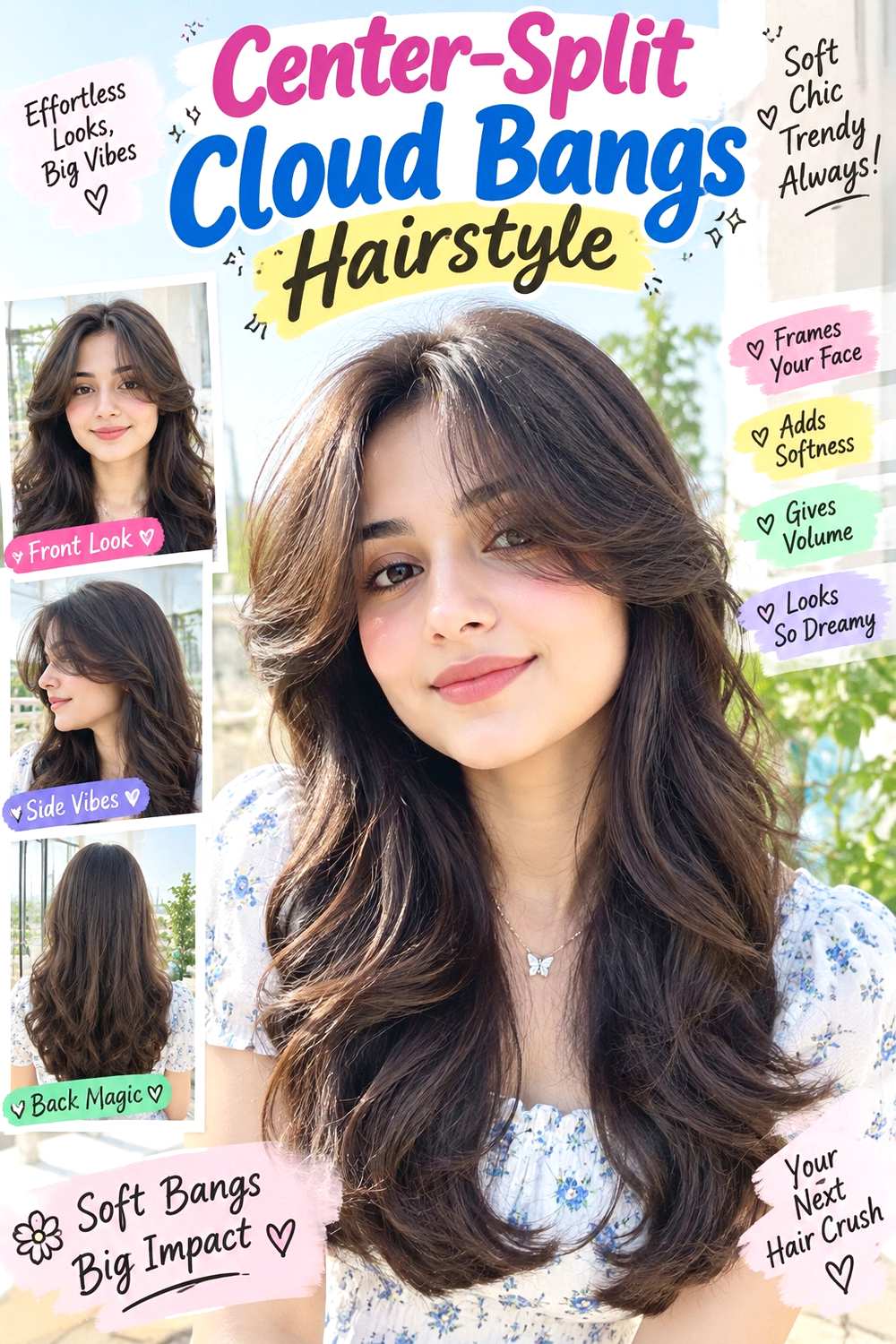
A soft center split works with cloud bangs by leaving a narrow opening while retaining short wisps across the middle. Keep the center pieces around the brows and let the outer edges lengthen toward the temples, so the split never becomes a completely empty gap. Medium or long hair gives the fringe room to merge into cheekbone or jaw-level face framing. The crown can stay relatively smooth so the light opening remains the most visible detail at the front.
This approach is especially practical when your fringe naturally separates near the middle. Straight and wavy textures can often be reset with very little work, while curls can adapt the same idea through two softly divided curl groups. Use lightweight mousse for root support, a small round brush to direct each side, and heat protectant whenever heat is involved. Reopening the middle after sleep may take only a few minutes; full wash-day styling is a separate, longer task.
At the salon, specify how wide the center opening should be when the hair is dry and where the shortest pieces should finish. Ask the stylist to leave enough short hair in the middle that the result still reads as cloud bangs. Reshape when the opening becomes too broad or the outer pieces grow too heavy.
Pro tip:
Dry each half briefly toward the opposite side before returning it to place. That root reset can create a softer split without over-rounding the bangs.
Make It Work for You:
If your natural part sits off-center, allow the opening to follow it slightly rather than forcing a precise middle line that requires repeated correction.
Watch Out For:
Avoid creating the split by removing too much hair from the center. A few brow-length wisps should remain so the fringe does not become ordinary curtain bangs.
Curly Cloud Bangs Hairstyle

Curly cloud bangs use separated curl groups to create airiness instead of relying on straight feathered strands. The shortest center curls can sit near the brows when dry, while longer outer pieces move toward the temples or cheekbones. A rounded shoulder-length cut, longer curly layers, or even a compact curly bob can support the fringe as long as the front connects naturally to the surrounding shape. Small spaces between curls keep the fringe light.
Shrinkage is the main planning issue, because the same front section can look much longer when wet or stretched. Use a lightweight leave-in conditioner for slip, curl gel to encourage grouped definition, and a diffuser for controlled drying. Refreshing two or three front curls between washes can be quick; a complete detangle, product application, and dry usually takes much longer.
At the salon, discuss where the center curls should land when fully dry and how much forehead you want visible between them. Ask for the outer pieces to blend into the face frame without unnecessary thinning. Upkeep is needed when the curls begin falling into the eyes, stop grouping well, or become disconnected from the surrounding layers as they grow.
Pro tip:
Define the fringe in slightly smaller curl groups than the back, then leave it mostly untouched while drying so the airy spaces stay intentional.
Make It Work for You:
If your curls shrink strongly, keep the first cut conservatively long and reassess the fringe after it dries before deciding whether additional shortening is needed.
Watch Out For:
Do not choose curly bang length from wet hair alone. Shrinkage can move the finished center much higher than expected once the curls settle.
Soft Wave Cloud Bangs Hairstyle

Soft waves make cloud bangs feel relaxed by pairing an airy fringe with larger bends through the mid-lengths. Let the center skim the brows, keep the tips lightly separated, and extend the outer corners toward the temples. The longer waves can begin below the cheekbones so the roots stay relatively calm while the lower hair gains movement. A center or slightly off-center part works, provided the fringe remains soft rather than heavily flipped.
Naturally wavy hair often reaches this shape with the least effort, while straight hair can recreate the movement with heat. Stronger curls can adapt it by keeping natural texture and focusing on a lighter front. Use heat protectant before heated styling, a large-barrel curling iron for broad bends, and flexible hairspray for gentle hold. Resetting only the fringe and two front waves can be a quick refresh; styling the entire head after washing takes longer.
At the salon, specify the dry center length and where the outer fringe corners should blend into the face frame. Ask to preserve enough lower weight if your ends are fine. Maintain the fringe when it begins entering the eyes, while the longer layers can be reshaped according to how their movement and perimeter change.
Pro tip:
Style the fringe before the longer waves. Finishing the front first prevents repeated handling while you arrange larger sections around the cheeks and shoulders.
Make It Work for You:
For fine strands, use broad waves and a narrower fringe section so the haircut gains movement without sacrificing too much density around the temples.
Watch Out For:
Avoid using the same large curling motion on the fringe and lengths. Too much lift at the front can make cloud bangs appear bulky instead of airy.
Cheekbone-Draped Cloud Bangs Hairstyle

Cheekbone-draped cloud bangs are longer than a traditional fringe, with the shortest center pieces sitting below the brows and the outer corners reaching toward the upper cheekbones. The front stays light and partially open, while the long edges frame the face without forming a heavy curtain. Medium and long hair support the shape particularly well because the outer fringe can merge into jaw-length or longer layers. A center part creates an even drape on both sides.
This version can suit someone who wants a softer grow-out and the option to tuck the fringe away. Straight and wavy textures usually need little more than directional styling, while loose curls can keep their own shape with longer dry lengths. Use lightweight root-lift spray for controlled movement, a medium round brush to guide the corners, and heat protectant if heat is involved. Refreshing the front alone can be brief; a complete blowout takes longer.
At the salon, show the exact cheekbone point where the outer sections should finish and how much forehead should remain visible through the center. Ask for gradual blending into the side layers. Reshape when the center feels heavy or when the longer edges stop sitting beside the cheekbones in the way you prefer.
Pro tip:
Direct the outer sections diagonally away from the face instead of straight backward. This keeps the cheekbone framing visible rather than hiding it inside the side layers.
Make It Work for You:
If you prefer more openness across the forehead, keep the center section narrower while preserving the same long cheekbone corners that define the draped shape.
Watch Out For:
Do not thin the outer pieces until they become stringy. Cloud bangs need separation, but the longer edges still require enough substance to blend cleanly.
Piecey Micro Cloud Bangs Hairstyle

Micro cloud bangs shorten the airy fringe above the brows while keeping the tips irregular and softly separated. The center can sit clearly above the brow line, with slightly longer edges moving toward the temples to prevent a harsh horizontal strip. A short bob, shag, or shoulder-length cut can all balance the small fringe. Keeping the crown reasonably calm allows the fine spaces between the micro pieces to remain visible instead of competing with excessive volume.
This is a higher-maintenance option because a small amount of growth noticeably changes its proportion. Straight and softly wavy textures show the piecey finish clearly, while curls need generous allowance for shrinkage. Use heat protectant before any hot-tool styling, a mini flat iron for targeted corrections, and light texturizing spray for separation. A dry fringe refresh can be very quick; styling the complete haircut takes longer according to texture.
At the salon, point to the exact dry point where the shortest center pieces should stop and show how long the corners should remain. Ask for controlled separation rather than aggressive thinning. Maintenance becomes useful once the fringe loses its above-brow position or begins grouping into thicker sections that no longer look airy.
Pro tip:
Separate the finished fringe with fingertips rather than repeatedly combing it. Small irregular groups keep the micro shape soft instead of making it overly precise.
Make It Work for You:
For higher-density hair, use a shallow fringe section and controlled width so the short length remains light rather than turning into a dense micro block.
Watch Out For:
Avoid cutting every piece to the same short line. Slightly longer outer edges are important for connecting the micro center to the temples.
Cloud Bangs Long Layers Hairstyle

Long layers provide a gradual route from airy bangs into the rest of the haircut. Keep the fringe center close to the brows, extend the outer corners toward the cheekbones, and let the first true face-framing layer begin around the jaw. Chest-length or longer hair can then carry broad movement through the mid-lengths while preserving a substantial lower edge. A center part gives the transition symmetry, though a soft off-center part can follow natural root direction.
Medium and dense hair can support multiple long layers, while lower-density hair usually benefits from fewer levels and more perimeter weight. Use heat protectant before heat styling, a medium round brush to direct the fringe and face frame, and lightweight mousse for controlled root lift. Resetting only the front can be a short routine; a complete wash-day blowout on long hair takes significantly more time.
At the salon, point to the exact location where the fringe should become a face-framing layer. That connection matters more than simply asking for “lots of layers.” If preserving length is important, explain how full you want the lower edge to remain. Maintain the bangs when they reach the eyes, but reshape the long layers only when their movement or perimeter balance starts changing.
Pro tip:
Shape the outer fringe and first face-framing layer in the same direction so the front reads as one connected progression instead of separate flipped sections.
Make It Work for You:
For sparse ends, keep the back layers minimal and concentrate most of the movement around the face, preserving a fuller lower edge through the length.
Watch Out For:
Avoid stacking many short layers immediately behind the bangs. Excess removal can make the front look disconnected from the stronger length through the back.
Side-Swept Cloud Bangs Hairstyle
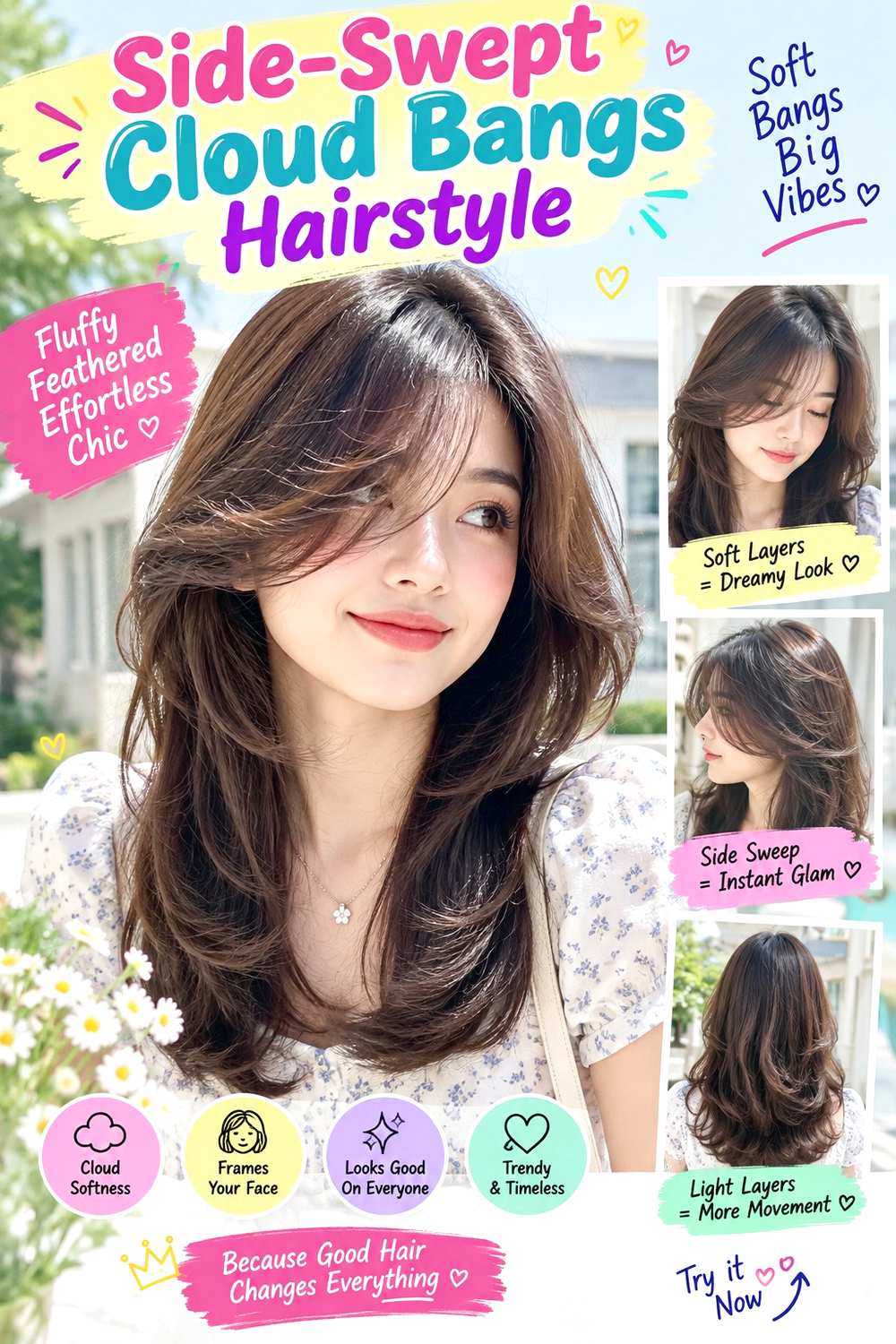
Side-swept cloud bangs keep the same airy density but allow the fringe to fall diagonally rather than opening at the center. The shortest pieces can sit near one brow, then gradually lengthen as they move across the forehead toward the opposite temple. A soft side part supports the direction, while cheekbone or jaw-level face framing connects the sweep into the rest of the haircut. Straight, wavy, or naturally textured lengths can all support the asymmetry.
This is useful when your growth pattern already pushes the front toward one side. Straight and wavy hair may need only a quick root reset, while curly hair can use separated curl groups to create the diagonal. Use lightweight mousse for root control, a small round brush to guide the sweep, and heat protectant whenever heat is used. A fringe-only refresh can be brief; full wash-day styling takes longer.
At the salon, wear your usual part and point to the dry location of the shortest section. Ask for enough length at the far edge to blend comfortably into the temple. Reshape when the fringe repeatedly falls into the eye or becomes too heavy to sweep without extra product.
Pro tip:
Dry the fringe briefly against its final direction before sweeping it back across. This root reset adds movement without forcing a stiff curved shape.
Make It Work for You:
If your bangs naturally split in two places, keep the section slightly longer and accept a softer irregular sweep rather than forcing one solid diagonal.
Watch Out For:
Do not keep shortening a stubborn fringe to make it stay sideways. Better root direction usually solves more than removing extra length from the front.
Rounded Bob Cloud Bangs Hairstyle

A rounded bob gives cloud bangs a compact frame with a fuller bottom edge and soft curve around the jaw. Keep the bob between chin and jaw length, with minimal visible layering so the perimeter stays substantial. The fringe can skim the brows at the center and taper toward the temples with separated tips. A center part is optional because the bangs can fall lightly forward while the longer bob curves around the sides.
Straight and softly wavy hair can achieve the rounded outline with relatively little work, while dense hair may need controlled internal weight adjustment so the sides do not spread too widely. Use heat protectant before heat styling, a small round brush for the fringe, and a larger round brush to guide the bob ends. Refreshing only the bangs can take a few minutes; rebuilding the full rounded finish after washing takes longer.
At the salon, specify both the dry bob perimeter and the exact center fringe length. Ask to preserve enough weight at the bottom so the short cut still feels full. Bang trims may become necessary before the bob itself needs reshaping, so keep the two maintenance needs separate rather than automatically trimming everything together.
Pro tip:
Dry the fringe before shaping the bob ends. The front roots set quickly, while the lower curve can be refined afterward without disturbing the bangs.
Make It Work for You:
For dense hair, ask about discreet internal weight adjustment through the bob while keeping the visible perimeter full and the fringe itself light.
Watch Out For:
Avoid using the same strong round bend on both fringe and bob. Too much curve at the front can make the entire shape look overly bulbous.
Cloud Bangs Soft Shag Hairstyle

A soft shag gives cloud bangs more movement by surrounding them with cheekbone layers and gentle crown lift. Keep the fringe center near the brows with fine gaps between pieces, then let the outer corners merge into face framing around the cheekbones. Crown layers should remain connected to the sides rather than forming a very short top layer, while the lower perimeter can stay shoulder-length or longer. Loose waves or natural texture emphasize the stepped shape.
Wavy and curly textures often carry the shag movement naturally, while straight hair may need a little styling to separate the layers. Use lightweight mousse for crown support, heat protectant if heat is involved, and a diffuser for wavy or curly drying. Refreshing the fringe and crown can be quick; a full wash-day restyle takes longer depending on texture and density.
At the salon, point to both the shortest crown layer and the outer fringe length so the connection between them remains soft. Lower-density hair usually benefits from fewer short layers, while dense hair may need targeted internal weight adjustment. Reshape when the crown becomes heavy, the fringe enters the eyes, or the face frame stops separating from the longer perimeter.
Pro tip:
Refresh the fringe and crown separately from the long ends. Restoring movement at the top can revive the shag shape without restyling every section.
Make It Work for You:
If your ends are naturally sparse, keep lower layers longer and concentrate most of the shag movement around the crown and face for better perimeter fullness.
Watch Out For:
Avoid aggressive thinning throughout the entire cut. Too much removal can make both the fringe and the lower shag layers appear stringy rather than soft.
Collarbone Lob Cloud Bangs Hairstyle

A collarbone lob balances an airy cloud fringe with a relatively strong, easy-to-manage perimeter. Keep the lob close to one length through the back, using only long front pieces to connect the bangs into the sides. The fringe center can sit at the brows with longer corners at the temples, while a soft bend through the mid-lengths adds movement without hiding the bottom line. A center or gentle side part can both work.
Fine strands often benefit from the fuller perimeter, while dense hair may need controlled internal weight adjustment so the lob does not become too wide. Use heat protectant before heat styling, a small round brush for the fringe, and flexible hairspray for light front hold. Resetting just the bangs and ends can be a short refresh; a complete wash and polished finish requires more time.
At the salon, specify where the lob should sit when dry and how transparent you want the fringe to appear. Ask for the outer corners to connect through a few deliberate front pieces rather than adding unnecessary layers throughout the back. Maintain the bangs when the center reaches the eyes, and reshape the lob when its perimeter no longer sits cleanly around the collarbone.
Pro tip:
Keep the lob roots comparatively smooth and give the fringe only slight lift. This prevents competing volume from making the whole silhouette look too rounded.
Make It Work for You:
For naturally wavy hair, leave the lob texture intact and reshape only the fringe when needed, reducing how much full-head heat styling your routine requires.
Watch Out For:
Do not over-layer the front simply to connect the bangs. A few longer pieces can create the transition while preserving the lob’s substantial bottom edge.
Fine Strand Cloud Bangs Hairstyle

Fine strands can wear cloud bangs well when the fringe section is planned around density instead of assuming every fine-haired person needs an extremely small fringe. Keep the center light and brow-skimming, with longer temple pieces that blend into the sides. A collarbone or shoulder-length cut with a fuller lower edge can balance the airy front, while gentle bends add movement without fragmenting the ends. The part can remain centered or slightly offset according to natural growth.
Use lightweight mousse near the fringe roots for support, a small round brush for directional control, and heat protectant whenever heat is used. Product quantities should stay modest because fine strands can become coated quickly. A small morning refresh may take only a few minutes; a complete wash-day style takes longer but can remain simple if the base cut follows the natural texture.
At the salon, ask to preserve density around the temples and explain how much forehead you want visible between the wisps. The finished dry length is more useful than simply requesting “thin bangs.” Reshape when the fringe becomes stringy, overgrown, or difficult to separate without adding excess product.
Pro tip:
Apply root product beneath the fringe rather than through the tips. Keeping the ends cleaner helps fine strands stay airy instead of sticking into oily-looking pieces.
Make It Work for You:
If your fine strands are also dense, you can use a slightly fuller fringe section while still keeping the tips separated and the outer corners long.
Watch Out For:
Do not treat fine hair and low density as the same thing. Layer placement should reflect how much hair is present, not just strand thickness.
Dense Hair Cloud Bangs Hairstyle

Dense hair can support cloud bangs, but the fringe section needs careful control so it does not become a thick block across the forehead. Keep the center around the brows with visible separation, then lengthen the corners toward the temples. The hair behind the fringe can remain medium or long with restrained layers, allowing the front to feel light even when the overall density is high. A soft center split or forward fall can both work.
The styling challenge is usually bulk rather than lack of hold. Use a lightweight smoothing cream to manage surface frizz, a small round brush to direct the fringe, and heat protectant whenever heat is used. Dividing the bangs into smaller styling layers often gives better control than drying one thick section at once. A quick front reset can be brief, while drying and styling a full head of dense hair can take considerably longer.
At the salon, show how much forehead you want visible and ask for bulk adjustment only where the fringe or surrounding shape truly needs it. Preserve enough weight at the outer corners to connect into the sides. Maintain the bangs when they become heavy or enter the eyes instead of repeatedly thinning the entire front every time they grow.
Pro tip:
Dry the fringe in two shallow layers rather than one thick section. Better root control can create airiness without relying on aggressive thinning.
Make It Work for You:
If you prefer less daily styling, keep the fringe slightly longer so its natural density can settle softly rather than needing constant separation into tiny pieces.
Watch Out For:
Avoid aggressive thinning throughout dense bangs. Short internal hairs can spring outward and create more puffiness instead of producing the airy finish you wanted.
Coily Cloud Bangs Hairstyle
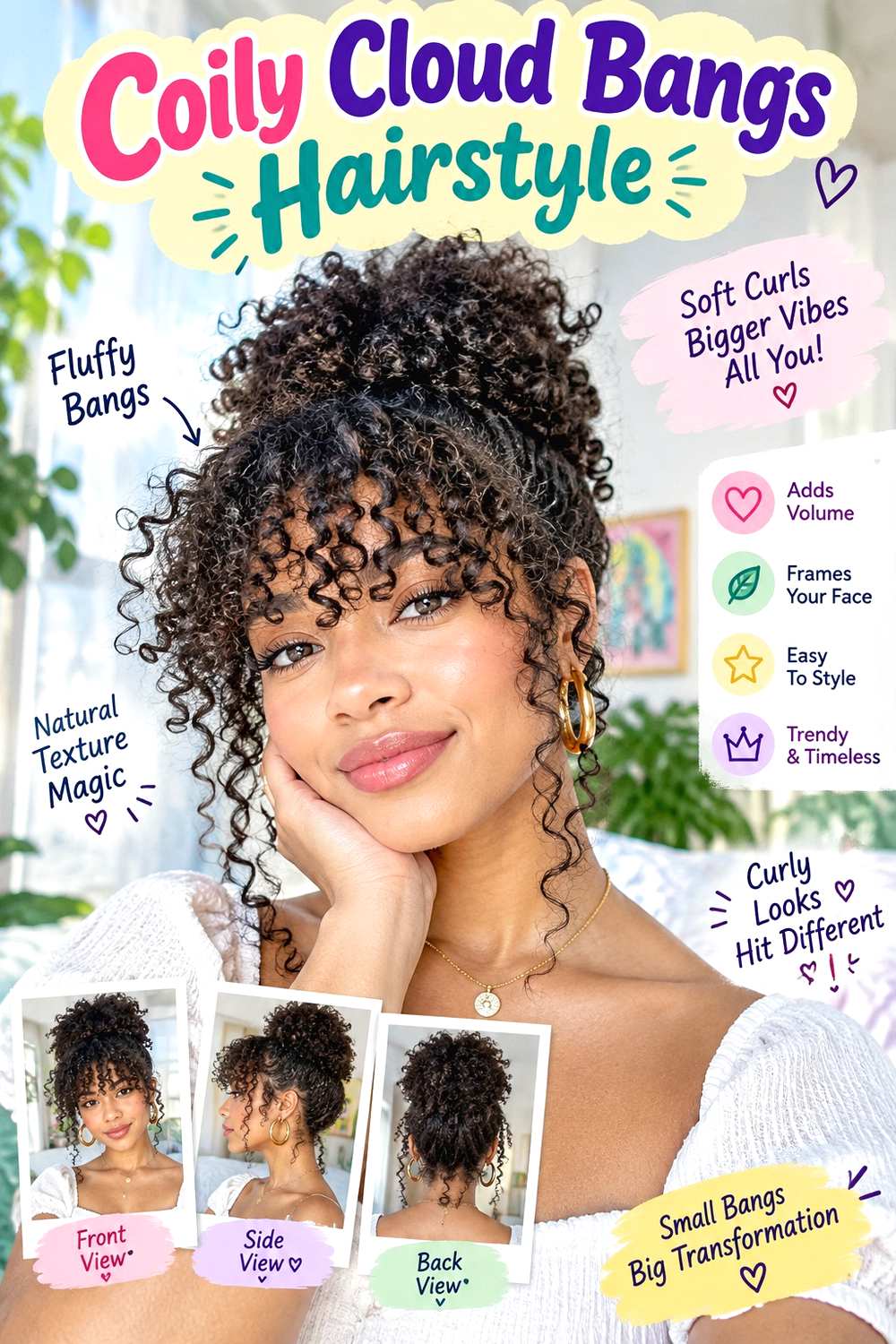
Coily cloud bangs create lightness through separated coil groups and visible spaces rather than straight wisps. The shortest center coils can finish around the brows or slightly lower when dry, while longer outer sections blend toward the temples. A rounded cut, tapered silhouette, or shoulder-length coil pattern can all support the idea as long as the fringe feels connected. The center should remain breathable rather than compressed into a dense block.
Shrinkage and individual coil behavior need to guide the cut. Use a lightweight leave-in conditioner for slip and moisture, curl-defining gel to encourage grouped coils, and a diffuser for controlled drying when desired. Refreshing a few front groups can be quick; a full detangle, style, and dry is a longer wash-day routine.
At the salon, describe where you want the shortest center coils to sit once fully dry and how much forehead should remain visible. Ask for the outer fringe to merge into the surrounding silhouette without unnecessary bulk removal. If shrinkage differs across the front, identical stretched lengths may not create an even dry result. Maintain the fringe when the front begins covering the eyes or loses its intended separation and balance.
Pro tip:
Let the fringe dry in complete coil groups before separating further. Final shrinkage may create enough airy space without extra manipulation or unwanted frizz.
Make It Work for You:
If different front coils shrink by different amounts, allow varied cut lengths so the finished dry fringe can look balanced rather than mechanically even.
Watch Out For:
Do not trim coily bangs according to stretched length alone. Assess the dry resting position first, especially through the center where small changes are highly visible.
Soft Curtain Cloud Bangs Hairstyle

Soft curtain cloud bangs sit between an airy forward fringe and full curtain bangs. Keep several brow-length pieces through the center, but let the outer sections open gradually toward the cheekbones. The middle should never become completely empty, because those short wisps preserve the cloud effect. Long waves, a collarbone cut, or straight lengths can all support the shape, and a center part gives the outer corners a balanced direction.
This version offers useful styling flexibility because the bangs can fall more forward one day and open wider the next. Straight and wavy textures generally need modest reshaping, while curly hair can use grouped curls with longer outer edges. Use heat protectant when heat is involved, a medium round brush to guide the sides, and lightweight mousse for gentle root movement. A fringe refresh can be quick; a full-head styling routine depends on the rest of the haircut.
At the salon, show how much center coverage you want and where the outer corners should finish dry. Ask to preserve the shorter central wisps rather than creating a wide gap. Reshape when the opening becomes too broad or the middle begins falling directly into the eyes.
Pro tip:
Shape the center pieces forward first, then turn only the longer corners outward. This preserves cloud-bang softness instead of turning the entire fringe into wings.
Make It Work for You:
For a naturally wide center part, keep slightly more short hair through the middle so visible wisps remain even when the fringe opens on its own.
Watch Out For:
Avoid dramatically flipping the outer corners. A large bend can overpower the light center and make the shape read as conventional curtain bangs instead.
Hat-Friendly Fall Cloud Bangs Hairstyle

A hat-friendly cloud fringe works best when the center is slightly longer and easy to reset after being flattened. Let the bangs skim or sit just below the brows, with longer temple pieces that can tuck away if needed. Pair them with shoulder-length or longer hair and keep the crown volume moderate so hats, hoods, and scarves do not dramatically alter the haircut’s balance. Soft bends through the lengths add movement without demanding a perfectly polished finish.
Straight, wavy, and loosely curly textures can all use this approach, especially if the fringe follows natural growth direction. Use heat protectant before heated styling, a small round brush for the front, and flexible hairspray for light hold that can still be reshaped. After removing a hat, refreshing only the dampened roots may take a few minutes; complete wash-day styling is much longer.
At the salon, request a dry fringe length that remains manageable if the center becomes slightly flattened or separated. Keep the outer corners long enough to tuck comfortably. Growth direction matters, so explain how you normally part the front. Reshape when the fringe becomes too long to reset easily or when the corners stop blending with the surrounding hair.
Pro tip:
After removing a hat, lightly dampen only the bang roots and reset their direction first. Root position usually matters more than restyling every tip.
Make It Work for You:
If your hair flattens easily under hats, keep the crown layers modest and put most of the movement around the face and lower lengths instead.
Watch Out For:
Do not compensate for flattened bangs by applying heavy texture product at the roots. Buildup can make the fringe harder to reset the next day.
Glossy Straight Cloud Bangs Hairstyle

A glossy straight finish makes every detail of cloud bangs visible, from the narrow spaces between strands to the longer outer corners. Keep the center near the brows, taper the sides toward the temples, and pair the fringe with shoulder-length or longer hair that has minimal visible layering. A center or soft off-center part works, while the lengths can stay smooth with only a slight inward movement at the ends. The clean surface contrasts with the airy front.
Naturally straight hair usually needs the least work, while wavy or curly textures require more styling if you want the same polished finish. Use heat protectant before heated smoothing, a paddle brush for the lengths, and a tiny amount of lightweight shine serum through the mid-lengths and ends. Resetting only the fringe can be quick; producing a complete polished finish after washing takes longer when the natural texture is very different.
At the salon, specify how transparent the fringe should look and exactly where the dry center should finish. If you want to preserve fullness, ask for minimal layering through the lower perimeter. Maintain the bangs when growth changes their position, and treat temporary puffiness or frizz as a styling issue before removing additional hair.
Pro tip:
Keep shine serum away from the fringe roots. Apply it to the longer hair first, then use only fingertip residue if the bang tips need smoothing.
Make It Work for You:
If your hair is naturally wavy, smooth the fringe and upper surface while keeping a subtle bend through the lengths to reduce full-head heat styling.
Watch Out For:
Do not keep thinning the fringe to solve temporary puffiness. Reassess product weight and drying direction first, because extra cutting may create unwanted short pieces.
Conclusion
Wispy cloud bangs can be short and piecey, long and feathered, softly split, curly, coily, or blended into curtain-like corners. Brow-skimming versions need more frequent length checks, while cheekbone styles generally offer an easier grow-out. Bobs and lobs keep the surrounding outline strong; shags and long layers add more movement. Fine strands may need a restrained fringe section, while dense hair benefits from thoughtful bulk placement rather than aggressive thinning. Curly and coily hair require dry shrinkage planning. For fall, consider hats, hoods, scarves, humidity, and how much morning reshaping fits your routine. The best version is the one whose fringe length, parting, texture, volume, and maintenance match how your hair naturally behaves.
Before Your Salon Visit
Choose one or two favorites and save references that clearly show the fringe from the front and side. Discuss your natural texture, density, growth direction, face shape, preferred length, and realistic upkeep routine. Point to the exact dry center length, outer-corner length, amount of forehead coverage, face-frame connection, volume, and finish you like. If one reference has the bangs you want and another has your preferred overall length, explain that combination clearly before cutting begins.
FAQs
How often do wispy cloud bangs need trimming?
There is no single schedule because growth rate and preferred fringe length vary. Brow-skimming versions usually need attention when the center enters the eyes or stops separating cleanly. Longer feathered and cheekbone versions can often grow more gradually, so use the finished shape and daily manageability as your main signals.
Can wispy cloud bangs work on curly or coily hair?
Yes. Curly and coily cloud bangs create airiness through separated curl or coil groups rather than straight strands. The important part is judging shrinkage and finished dry length before shortening too much. Longer outer pieces can help the fringe connect naturally into the surrounding shape.
Do cloud bangs need heat styling every morning?
Not necessarily. Some hair only needs a damp root reset, while curls and coils may respond better to their normal defining routine. If you use heat, apply heat protectant. Choosing a fringe that follows your natural growth direction can also reduce how much daily correction is necessary.
What should I do when cloud bangs keep splitting?
Check root direction, product buildup, and the natural growth pattern first. Lightly dampening the roots and drying them side to side can help reset the fringe. If the split remains strong, a slightly longer, center-split, or off-center version may be easier to maintain than forcing an unnatural fall.